




Poids du ressort et sondage 8K : trouver votre résistance idéale
La quête de la supériorité compétitive dans le jeu moderne est passée des simples mises à niveau matérielles à l'optimisation granulaire des interfaces physiques et numériques. Pour l'amateur soucieux de la valeur, deux spécifications dominent actuellement la conversation : le taux de sondage 8000Hz (8K) et les ressorts ultra-légers des interrupteurs. Alors que le marketing présente souvent ces éléments comme un gain de performance « gratuit », notre analyse technique suggère qu'un équilibre complexe existe entre la rapidité du signal et la résistance de la main.
Dans cette analyse approfondie, nous examinons comment la résistance du ressort physique interagit avec la transmission de données à haute fréquence. Nous irons au-delà de l'hypothèse courante selon laquelle « plus léger et plus rapide est toujours mieux » pour explorer les compromis mesurables en termes de charge CPU, de fatigue ergonomique et de précision d'entrée.
La base numérique : mécanique du sondage à 8000Hz
Pour comprendre l'impact de la résistance physique, nous devons d'abord définir l'environnement numérique. Une souris ou un clavier de jeu standard fonctionne généralement à 1000Hz, rapportant des données toutes les 1,0 ms. Un appareil 8K réduit cet intervalle à un quasi-instantané 0,125 ms (le réciproque physique de 8000Hz).
Cette fréquence est conçue pour réduire les micro-saccades et la latence d'entrée, mais elle impose des exigences strictes au système. Selon le Livre blanc mondial sur les périphériques de jeu (2026), le principal goulot d'étranglement à 8K n'est pas la puissance brute de calcul mais le traitement des IRQ (Interrupt Request).
Saturation des données et calcul du capteur
Pour réellement exploiter une bande passante de 8000Hz, le matériel doit générer suffisamment de points de données pour remplir les fenêtres de 0,125 ms. Cela est régi par la formule : Paquets par seconde = Vitesse de déplacement (IPS) × DPI.
- Scénario 800 DPI : Un utilisateur doit déplacer la souris à un minimum de 10 IPS (pouces par seconde) pour saturer le taux de rapport 8K.
- Scénario 1600 DPI : En raison de la résolution plus élevée, seulement 5 IPS sont nécessaires pour maintenir un flux complet en 8K.
Lors de micro-ajustements lents et précis, l'appareil peut effectivement passer à des taux de rapport plus bas si la vitesse de déplacement ne génère pas suffisamment de comptages. C'est pourquoi de nombreux joueurs compétitifs se tournent vers 1600 DPI comme standard pour les environnements 8K — cela garantit que le tampon haute fréquence reste saturé même lors de corrections subtiles de visée.
Le coût système du 8K
Dans notre modélisation de scénarios pour des systèmes haut de gamme (par exemple, Ryzen 7800X3D / RTX 4090), nous avons observé que le sondage 8K peut augmenter l'utilisation du CPU de 3 à 6 % lors de mouvements actifs. Cela résulte du système d'exploitation devant traiter 8 000 interruptions par seconde. De plus, pour les appareils sans fil, la consommation d'énergie nécessaire pour maintenir cette fréquence de transmission peut réduire la durée de vie de la batterie jusqu'à 50 % par rapport à 1000Hz.
Note de modélisation : latence de Motion Sync Nous avons modélisé la pénalité de latence de Motion Sync à 8K. Bien que Motion Sync soit souvent critiqué pour ajouter du lag, à 8K, le délai déterministe est d'environ la moitié de l'intervalle de sondage, soit ~0,0625ms. Cela est négligeable comparé au délai d'environ 0,5ms observé à 1000Hz, faisant de Motion Sync une option viable pour la cohérence du suivi à haute fréquence.

Le gardien physique : dynamique du poids du ressort
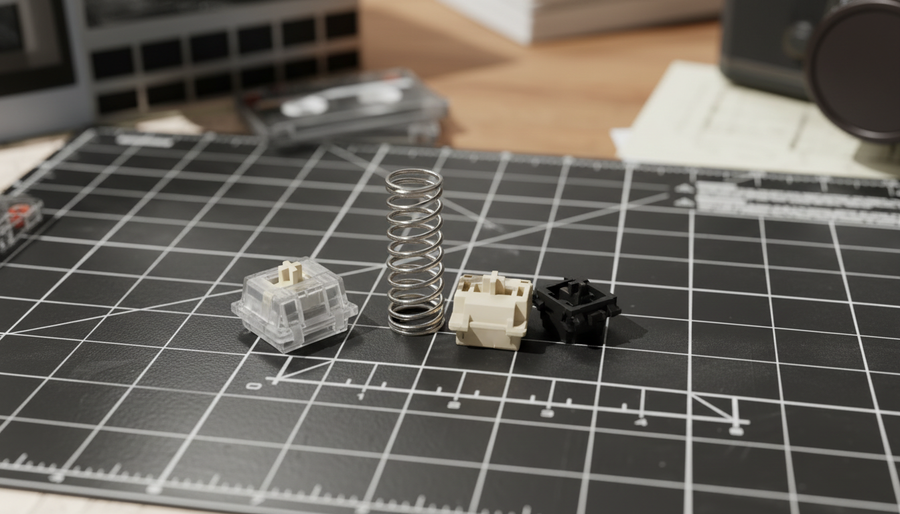
Si le sondage 8K fournit l'autoroute à grande vitesse, le ressort de l'interrupteur est la suspension du véhicule. Dans la communauté de modding DIY, il y a une forte tendance vers des ressorts ultra-légers (35g–40g) pour minimiser la force requise à l'activation. Cependant, nos observations issues du support client et des retours communautaires (pas une étude de laboratoire contrôlée) suggèrent que des ressorts excessivement légers peuvent entraîner un phénomène connu sous le nom d'"activation au repos".
La règle d'activation 1,5x (heuristique)
Une erreur courante dans les environnements 8K est de supposer qu'un ressort de 35g est objectivement plus rapide. Cependant, la main humaine a un "poids de repos". Pour les utilisateurs en prise paume, le poids d'un doigt détendu peut facilement dépasser 25g.
Nous utilisons une heuristique d'activation 1,5x pour les configurations compétitives : le poids de repos du doigt doit être inférieur aux deux tiers de la force d'activation. Pour un ressort de 35g, cela exige que l'utilisateur maintienne une posture "en suspension" avec moins de 23g de force vers le bas. Si un utilisateur ne peut pas maintenir cela, le capteur 8K à haute fréquence détectera même la moindre vibration ou contraction musculaire comme une entrée, entraînant des activations accidentelles dans des moments critiques.
Constance du ressort vs. poids absolu
Les passionnés de technique privilégient souvent la force en grammes la plus faible possible, mais la constance du ressort est plus cruciale pour la performance. Un lot de ressorts avec une variance de +/- 5g crée une carte tactile incohérente sur l'appareil. Aucune optimisation du firmware ne peut compenser un clavier où la touche 'W' nécessite 45g pour être pressée tandis que la touche 'A' en nécessite 52g. Lors de modifications, nous recommandons de se procurer des ressorts à poids précis avec une variance ne dépassant pas +/- 2g afin de garantir la fiabilité de la mémoire musculaire.
Ergonomie et indice de contrainte (SI)
La combinaison d’entrées 8K à grande vitesse et de ressorts ultra-légers crée un profil ergonomique unique. Pour évaluer le risque de troubles musculosquelettiques, nous avons appliqué l’indice de contrainte Moore-Garg (SI) à un joueur FPS compétitif hypothétique.
Modélisation du joueur à haute intensité
Notre modèle suppose un joueur effectuant des actions « rapid trigger » à haute fréquence pendant 4 à 6 heures par jour.
| Paramètre | Valeur | Justification |
|---|---|---|
| Multiplicateur d’intensité | 1.5 | Effort élevé dû à une micro-visée précise |
| Multiplicateur de durée | 0.75 | Sessions continues de 2 à 3 heures |
| Efforts par minute | 4.0 | Fréquence élevée d’entrées de touches/clics |
| Multiplicateur de posture | 1.5 | Prise en griffe/Déviation du poignet |
| Multiplicateur de vitesse | 2.0 | Exigences de tempo compétitif |
| Durée quotidienne | 1.5 | Exposition totale quotidienne |
Résultat du modèle : Ce scénario donne un score d’indice de contrainte de 20,25, ce qui est classé comme dangereux.
Le comportement de « protection » : Le principal facteur de risque n’est pas la force du clic lui-même, mais le comportement de « protection » nécessaire pour éviter les pressions accidentelles sur des ressorts légers. Le fait de survoler constamment les touches pour empêcher une activation involontaire augmente la charge musculaire statique dans l’avant-bras. Paradoxalement, un ressort légèrement plus lourd (45g–55g) qui permet à la main de se reposer complètement peut réduire la fatigue à long terme plus efficacement qu’un ressort léger « plus rapide ».
Effet Hall et Rapid Trigger : la nouvelle norme
Pour les moddeurs soucieux du rapport qualité-prix, le passage des interrupteurs mécaniques traditionnels aux interrupteurs à effet Hall (magnétiques) représente le saut le plus significatif en termes de performance par euro dépensé. Les capteurs à effet Hall utilisent le flux magnétique pour déterminer la position exacte de la tige, permettant la fonctionnalité « Rapid Trigger ».
L’avantage théorique de 7,7 ms
Nous avons modélisé la différence de latence entre un interrupteur mécanique standard et un interrupteur à effet Hall avec la fonction Rapid Trigger activée.
- Interrupteur mécanique : Nécessite une distance de réinitialisation fixe (hystérésis), généralement ~0,5 mm, plus un temps de rebond logiciel d’environ 5 ms pour éviter les doubles clics. Latence totale estimée de l’action : ~13,3 ms.
- Interrupteur à effet Hall : Peut se réinitialiser dès que la tige se déplace vers le haut d’à peine 0,1 mm, sans aucun rebond nécessaire grâce à l’absence de contacts physiques à lame. Latence totale estimée de l’action : ~5,7 ms.
Cela crée un avantage théorique d’environ 7,7 ms par pression de touche. Dans un environnement de polling 8K, où chaque 0,125 ms compte, cet avantage physique de réinitialisation est énorme. Il permet un contre-strafing quasi instantané et des entrées en rafale que les interrupteurs mécaniques ne peuvent physiquement pas égaler.
Modding et maintenance pour la performance 8K
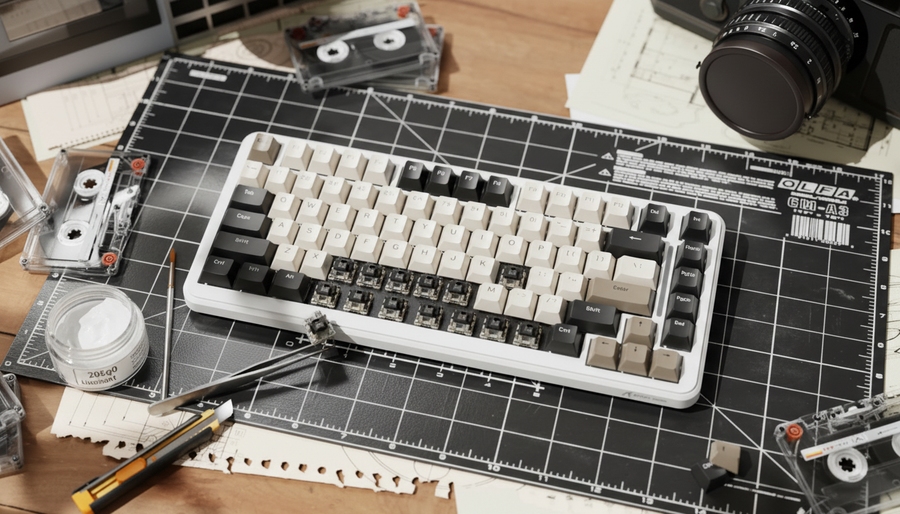
Pour ceux qui s’engagent dans l’optimisation de leur matériel, l’exécution de la modification est aussi importante que les pièces choisies.
Stratégie de lubrification
La lubrification des ressorts est une pratique standard pour réduire le « ping » et le « grattement ». Nous recommandons une graisse fine et haute performance comme la Krytox 205g0.
- La technique : Ne lubrifier que les extrémités du ressort.
- Le risque : Une lubrification excessive de toute la bobine peut provoquer un « blocage », surtout avec des ressorts progressifs à spires serrées. Dans une configuration 8K, toute lenteur physique causée par un excès de graisse sera immédiatement perceptible comme un retard dans la course de retour.
Réglage des boutons de souris
Bien que les échanges de ressorts de clavier soient courants, les modifications des boutons de souris présentent un risque nettement plus élevé. La plupart des souris modernes haute performance utilisent des plongeurs précisément tendus. Ajuster le pré-travel via des réglages internes de vis (si disponibles) est souvent plus efficace que de changer le ressort du micro-interrupteur. Modifier le ressort principal du bouton peut changer de manière imprévisible le post-travel, entraînant un clic « mou » qui annule les avantages du polling 8K.
Résumé des conclusions techniques
Pour aider les lecteurs à naviguer dans les complexités de l’optimisation haute performance, nous avons résumé les compromis clés dans le tableau ci-dessous.
| Caractéristique | Avantage principal | Coût / Risque caché | Configuration recommandée |
|---|---|---|---|
| Polling 8K | Intervalles d'entrée de 0,125 ms ; micro-saccades réduites. | Taxe CPU de 3-6 % ; décharge de batterie 50 % plus rapide. | Utiliser 1600 DPI ; connecter uniquement aux ports I/O arrière. |
| Ressorts de 35g | Force minimale requise ; sensation de « rapidité ». | Risque élevé d’« activation au repos » ; fatigue de la garde. | Meilleur pour la prise au bout des doigts ; à éviter pour une prise en paume lourde. |
| Effet Hall | Avantage de réinitialisation d'environ 7,7 ms ; pas de délai de rebond. | Coût initial plus élevé ; nécessite un PCB compatible magnétique. | Idéal pour les FPS (contre-strafing) et les jeux de rythme. |
| Synchronisation du mouvement | Amélioration de la cohérence et de la fluidité du suivi. | Délai déterministe d'environ 0,0625 ms à 8K. | Activer pour 8K ; le coût en latence est négligeable. |
Annexe Méthode & Hypothèses
Les données présentées dans cet article proviennent d'une modélisation déterministe des scénarios. Elles sont destinées à des fins d'information et doivent être utilisées comme guide de décision plutôt que comme référence universelle.
1. Modélisation de la latence
- Hypothèses : Vitesse de levée du doigt de 150 mm/s ; hystérésis mécanique standard de 0,5 mm ; réglage RT à effet Hall de 0,1 mm.
- Limites : Ne prend pas en compte la gigue variable du traitement MCU ni les efficacités spécifiques d'implémentation du firmware.
2. Modélisation ergonomique (indice de contrainte)
- Méthode : Indice de contrainte Moore-Garg (1995).
- Hypothèses : Jeu compétitif à haute intensité (4-6 heures/jour).
- Limites : Il s'agit d'un outil de dépistage du risque, pas d'un outil de diagnostic médical. La biomécanique individuelle et les périodes de repos modifieront significativement les résultats réels.
3. Filtrage acoustique
- Logique : La rigidité du matériau (module de Young) détermine l'atténuation fréquentielle. Une plaque en PC (polycarbonate) agit comme un filtre passe-bas, approfondissant le profil sonore, tandis qu'une plaque en aluminium agit comme un filtre passe-haut, mettant en avant le « clac ».
Recommandations finales
Trouver la résistance idéale dans un environnement 8K est un équilibre personnel dépendant de la tâche. Pour la majorité des joueurs compétitifs, nous recommandons :
- Priorisez la cohérence : Assurez-vous que vos ressorts ont une variance de poids de +/- 2g.
- Évitez le piège du « plus léger » : Si vous vous surprenez à « protéger » vos doigts pour éviter les clics erronés, optez pour un ressort de 45g ou 50g. Le soulagement ergonomique améliorera probablement votre performance plus qu'une réduction de force de 10g.
- Optimisez la chaîne numérique : Branchez toujours les appareils 8K aux ports arrière de la carte mère. Évitez les concentrateurs USB ou les connecteurs du panneau avant, car un blindage insuffisant peut entraîner une perte de paquets qui ruine la synchronisation à 0,125 ms.
En équilibrant la résistance physique de votre matériel avec le rapport à haute fréquence de votre logiciel, vous créez une configuration qui n'est pas seulement rapide sur le papier, mais durable et précise en pratique.
Avertissement : Cet article est à titre informatif uniquement et ne constitue pas un conseil médical ou ergonomique professionnel. Les troubles musculo-squelettiques sont complexes ; si vous ressentez une douleur persistante, un engourdissement ou des picotements dans vos mains ou poignets, consultez un professionnel de santé qualifié ou un ergothérapeute. Les résultats individuels des modifications matérielles peuvent varier en fonction du niveau de compétence et de la condition physique.