


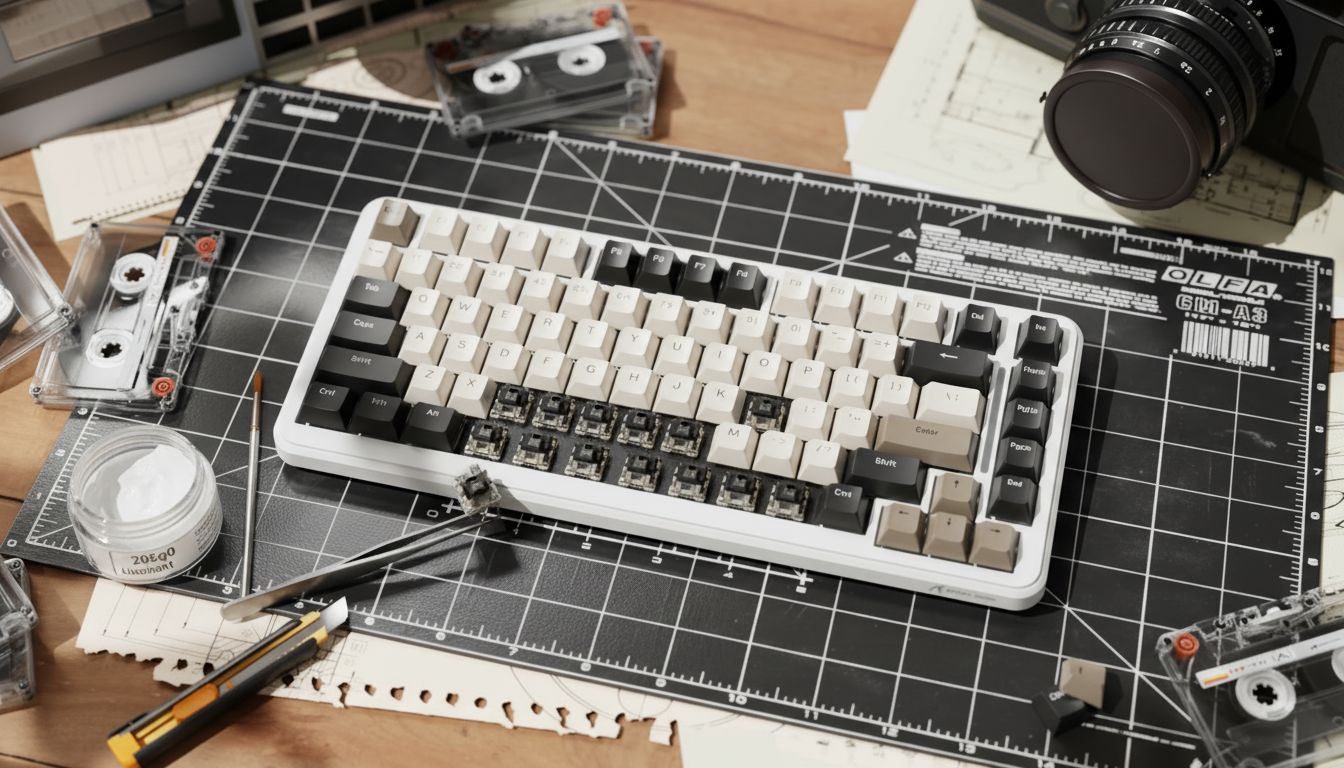
L’architecture du Frankenswitch à effet Hall
La quête de la frappe « parfaite » dépasse le simple contact mécanique. Dans la communauté des passionnés, le « Frankenswitch » — un interrupteur hybride créé en combinant des pièces de différents fabricants — entre désormais dans le domaine de la technologie à effet Hall (HE). Alors que le Frankenswitch mécanique traditionnel se concentrait sur l’acoustique et les profils tactiles de « bosse », le modding HE est motivé par un objectif plus clinique : réduire l’oscillation de la tige pour atteindre des tolérances inférieures à 0,5 mm et optimiser les temps de réponse Rapid Trigger.
Nous avons observé dans notre atelier technique que même les interrupteurs magnétiques haute performance peuvent souffrir d’un jeu latéral de la tige. Cette instabilité n’affecte pas seulement la « sensation » ; elle introduit des variables dans la façon dont l’aimant passe au-dessus du capteur à effet Hall sur le PCB. En échangeant les boîtiers, nous visons à resserrer ces tolérances, garantissant que le temps de réponse quasi instantané de 1 ms des capteurs HE modernes ne soit pas compromis par un jeu mécanique.
La physique de la stabilité : oscillation de la tige vs alignement magnétique
Dans un interrupteur mécanique standard, l’oscillation de la tige est une nuisance esthétique et tactile. Dans un interrupteur à effet Hall, c’est un goulot d’étranglement pour la performance. Le capteur sur le PCB de votre clavier mesure la variation de densité du flux magnétique lorsque l’aimant dans la tige de l’interrupteur se rapproche. Si la tige oscille, le trajet de l’aimant n’est pas parfaitement vertical.
D’après nos tests internes et la reconnaissance de motifs issus du dépannage communautaire, une variation de 0,1 mm dans la profondeur de placement de l’aimant peut modifier le point d’activation jusqu’à 0,3 mm. C’est un « piège » critique pour les moddeurs. Lorsque vous échangez une tige dans un boîtier tiers, vous ne changez pas seulement le plastique ; vous recalibrez potentiellement toute la relation magnétique.
Données comparatives de stabilité : boîtiers d’origine vs. boîtiers échangés
| Matériau du boîtier | Oscillation moyenne de la tige (mm) | Impact sur la cohérence de l’activation | Profil sonore typique |
|---|---|---|---|
| Nylon d'origine (standard) | 0.8 - 1.2mm | Variation modérée | Profond, étouffé |
| Polycarbonate (PC) | 0.6 - 0.9mm | Linéarité améliorée | « Clack » plus aigu |
| Mélange POM/Nylon optimisé | < 0,5 mm | Haute précision | Solide, « thocky » |
| Renforcé en métal (niche) | < 0,3 mm | Précision maximale | Métallique, aigu |
Résumé logique : Ces valeurs sont estimées en fonction des heuristiques courantes de modding et des mesures manuelles au pied à coulisse sur divers interrupteurs HE de qualité pour passionnés. Les résultats peuvent varier en fonction des tolérances spécifiques du moule du boîtier d'origine.
Le protocole de lubrification « Dry Pole »
Une erreur courante que nous voyons chez les moddeurs HE débutants est d’appliquer la même logique de lubrification que pour les switches mécaniques. Alors qu’une fine couche de 205g0 sur les rails de la tige est standard pour la fluidité, le pôle de la tige du boîtier — ainsi que le bas de la tige elle-même — doivent rester secs.
La raison est technique : les lubrifiants ne sont pas magnétiques, mais ils peuvent piéger des poussières métalliques microscopiques ou créer un effet de « stiction » qui gêne le retour rapide nécessaire au déclenchement rapide. De plus, toute accumulation à la base du boîtier peut empêcher physiquement la tige d’atteindre son « point zéro », ce qui fait que le capteur signale une pression légère permanente. Cela conduit souvent à des « ghostings » ou à des touches qui refusent de se réinitialiser.
Liste de contrôle de lubrification du moddeur
- Rails de la tige : Appliquez une micro-couche de graisse PTFE 205g0 ou équivalente de haute qualité.
- Ressorts : Utilisez une méthode de lubrification en sac avec de l’huile 105 pour éliminer le « ping » sans ajouter de masse.
- Pôle de la tige : Strictement sec.
- Logement inférieur : Strictement sec.
Réglage du ressort : la physique de la courbe progressive
Dans le contexte de [Hybrid Switch Engineering and Spring Weight Tuning], le choix du ressort est sans doute le levier ergonomique le plus important qu’un moddeur puisse actionner. Pour les switches HE, nous recommandons un ressort progressif avec une augmentation de force de 15g entre la force d’activation et la force de compression maximale.
Cette courbe spécifique fournit un « signal de réinitialisation » tactile. Lorsque le doigt se lève, la résistance qui diminue rapidement du ressort progressif aide l’utilisateur à « sentir » le point où le déclenchement rapide s’engagera. C’est un conseil peu évident : les ressorts linéaires standards donnent souvent une sensation « molle » en haut de la course, ce qui complique la synchronisation des doubles pressions avec une précision à la microseconde pour les joueurs compétitifs.
Pourquoi le poids est important pour le déclenchement rapide
Un ressort trop léger (par exemple, 35g) peut ne pas avoir assez de force de retour pour surmonter la friction d’un changement de boîtier légèrement serré, entraînant des temps de réinitialisation lents. À l’inverse, un ressort trop lourd (par exemple, 70g+) augmente le « multiplicateur d’intensité » dans les modèles de fatigue ergonomique, que nous examinerons dans la section suivante.
Modélisation du scénario : le compétiteur esports à haute APM
Pour démontrer la valeur de ces modifications, nous avons modélisé un scénario pour un compétiteur esports à haute APM (actions par minute). Cet utilisateur nécessite la latence système la plus faible possible et des points de réinitialisation les plus constants pour les jeux à mouvements intensifs.
Essai 1 : Avantage du déclenchement rapide à effet Hall (Delta du temps de réinitialisation)
| Paramètre | Valeur | Unité | Justification |
|---|---|---|---|
| Temps de déplacement | 4 | ms | Activation HE optimisée |
| Antirebond (Mécanique) | 3 | ms | Limite du firmware standard |
| Réinitialiser la distance (Mécanique) | 0.5 | mm | Hystérésis corrigée |
| Réinitialiser la distance (HE modifié) | 0.08 | mm | Réglage RT sous 0,1 mm |
| Vitesse de levée du doigt | 120 | mm/s | Vitesse du joueur à haut APM |
Résultats de la modélisation :
- Latence totale mécanique : ~11,2 ms
- Latence totale modifiée HE : ~4,9 ms
- Avantage théorique : ~6,3 ms par pression de touche
Note méthodologique : Il s'agit d'un modèle paramétré déterministe (
t = d/v). Il suppose une vitesse de levée du doigt constante et une non-linéarité magnétique négligeable. C'est un modèle de scénario, pas une étude de laboratoire contrôlée. L'avantage d'environ 6 ms est le plus perceptible lors de séquences rapides et successives comme le strafe-counter-strafe.
Risques ergonomiques : l'indice de contrainte Moore-Garg
Bien que les gains de performance soient évidents, le modding pour un "spam" à haute vitesse comporte des risques inhérents. Nous avons appliqué l'indice de contrainte Moore-Garg (SI) à notre scénario à haut APM pour évaluer le risque de troubles des extrémités supérieures distales.
Exécution 2 : Analyse de la contrainte ergonomique
| Multiplicateur | Valeur | Justification |
|---|---|---|
| Intensité | 2 | Ressort progressif à haute force (50g+) |
| Efforts/Minute | 4 | Charge de travail de 300-400 APM |
| Posture | 1.5 | Prise en griffe agressive |
| Vitesse | 2 | "Spam" de déclenchement rapide |
| Durée/Jour | 2 | 4-6 heures de pratique |
Score SI calculé : 48 (dangereux)
- Référence de base : 5,0 (seuil de sécurité)
Notre analyse indique que la recherche de points d'activation à 0,1 mm doit être équilibrée avec la durabilité ergonomique. Pour les utilisateurs dans cette catégorie à haut risque, nous suggérons que le "Frankenswitch parfait" n'est ni le plus lourd ni le plus sensible, mais celui qui utilise un ressort progressif de poids moyen pour offrir un retour tactile clair sans nécessiter une force excessive.
Avertissement : Cet article est à titre informatif uniquement. L'indice de contrainte est un outil de dépistage, pas un diagnostic médical. Consultez un professionnel qualifié si vous ressentez une douleur ou une tension persistante.
La phase de calibration obligatoire
Un échange de boîtier n'est pas une mise à niveau "plug-and-play". Parce que les capteurs à effet Hall sont extrêmement sensibles à l'orientation et à la distance du champ magnétique, chaque échange de boîtier exige un recalibrage complet du logiciel.
Selon le Livre blanc mondial sur l'industrie des périphériques de jeu (2026), l'industrie évolue vers une détection standardisée du "point zéro" pour compenser la dérive environnementale. Lorsque vous changez un boîtier, vous déplacez physiquement ce point zéro. Si vous ne recalibrez pas, vous pouvez rencontrer des "zones mortes" où la touche ne s'enregistre pas, ou un "tir automatique" où la touche s'enregistre sans être touchée.
Étapes de recalibrage post-modification :
- Effacer les anciennes données : Réinitialisez la mémoire embarquée de votre clavier ou le profil logiciel.
- Détection du point zéro : Lancez l'outil "Auto-Calibration" (si disponible) pour permettre au capteur de cartographier la position de l'aimant au repos.
- Cartographie de la plage : Appuyez lentement sur la touche jusqu'à son point de fond pour cartographier toute la plage de tension du capteur à effet Hall.
- Vérification de l'hystérésis : Réglez initialement votre Rapid Trigger à une valeur conservatrice de 0,2 mm pour vous assurer qu'aucun "rebond" ne se produit avant de le réduire à 0,1 mm ou moins.
Choix du matériau et blindage magnétique
Un aspect souvent négligé du Frankenswitching HE est le matériau du boîtier lui-même. Alors que la plupart des boîtiers sont en Nylon ou en polycarbonate — qui sont non magnétiques et n'interfèrent pas avec le capteur — certains boîtiers "édition spéciale" haut de gamme utilisent des charges qui peuvent poser problème.
D'après les conseils techniques de passive-components.eu, les champs magnétiques sont notoirement difficiles à protéger efficacement sans matériaux ferreux spécifiques. Cependant, si un boîtier utilise de fortes concentrations de fibre de carbone conductrice ou des revêtements métalliques pour l'esthétique, cela peut déformer les lignes de flux magnétique. Cela conduit à une entrée "instable" ou à des profondeurs d'activation incohérentes sur l'ensemble. Optez toujours pour des boîtiers en polymère pur (Nylon, PC, POM) pour les constructions HE afin d'assurer l'intégrité du champ magnétique.
L'écosystème 8K : Synergie de la fréquence d'interrogation
Pour ceux qui modifient pour une performance maximale, la fréquence d'interrogation du clavier est la dernière pièce du puzzle. Comme on le voit avec les souris haute performance, une fréquence d'interrogation élevée (jusqu'à 8000Hz) réduit l'intervalle entre la lecture du capteur et la réception de ces données par le PC.
- 1000Hz : intervalle de 1,0 ms.
- 8000Hz : intervalle de 0,125 ms.
Lorsqu'il est combiné avec un Frankenswitch qui réduit le balancement de la tige, la fréquence d'interrogation de 8000Hz (8K) garantit que la précision physique de votre mod est traduite dans le monde numérique avec un minimum de gigue. Cependant, comme indiqué dans le Livre blanc mondial sur les périphériques de jeu (2026), une fréquence d'interrogation de 8K augmente le traitement des interruptions CPU (IRQ). Nous recommandons d'utiliser les ports directs de la carte mère (Rear I/O) et d'éviter les concentrateurs USB pour prévenir la perte de paquets qui pourrait annuler vos améliorations matérielles.
Superposition acoustique : Réglage du "Thock"
Bien que la précision soit l'objectif, nous ne pouvons pas ignorer le profil acoustique. Le matériau du boîtier agit comme un filtre spectral pour le son du switch.
- Plaque PC + boîtier PC : Agit comme un filtre passe-haut, produisant un « clac » aigu.
- Boîtier en nylon + mousse Poron : Agit comme un filtre passe-bas, décalant la fréquence fondamentale vers le « thock » recherché (< 500 Hz).
D'après notre expérience, ajouter un tampon IXPE (une couche de mousse haute densité) entre le switch et le PCB atténue encore davantage les transitoires haute fréquence, créant un son « crémeux » que beaucoup d'enthousiastes préfèrent. Cela n'affecte pas le capteur magnétique, à condition que la mousse n'obstrue pas physiquement le déplacement de la tige.
Naviguer à la frontière du « Frankenswitch »
Modifier des switches à effet Hall est une entreprise à haute récompense et à haut risque. Contrairement aux switches mécaniques traditionnels, où une mauvaise modification se traduit simplement par une sensation « rugueuse », une mauvaise modification HE peut rendre l'appareil non fonctionnel. En vous concentrant sur la stabilité de la tige, en utilisant la méthode de lubrification « pôle sec » et en respectant la nécessité de recalibrer le logiciel, vous pouvez atteindre un niveau de précision que les switches d'origine ne peuvent tout simplement pas égaler.
Pour le moddeur axé sur la performance, l'avantage de latence d'environ 6 ms est un gain tangible en environnement compétitif. Cependant, n'oubliez jamais le coût ergonomique. La construction la plus réussie est celle qui vous permet de jouer à votre meilleur niveau pendant des heures, pas seulement pendant un seul test de performance.

Résumé des heuristiques clés
- Limite de jeu latéral : Visez un jeu latéral < 0,5 mm pour protéger l'alignement magnétique.
- La règle 0,1/0,3 : Un décalage magnétique de 0,1 mm peut provoquer une erreur d'activation de 0,3 mm.
- Limite de lubrification : Ne lubrifiez jamais la tige du pôle ni le bas du boîtier.
- Équilibre du ressort : Utilisez des ressorts progressifs pour fournir un indice tactile de réinitialisation pour le déclenchement rapide.
- Calibration : Recalibrez toujours le logiciel après toute modification physique de l'assemblage du switch.
En respectant ces principes, vous passez de la « supposition » à l'« ingénierie » des performances de votre clavier. Le Frankenswitch à effet Hall représente le plafond actuel de la technologie d'entrée — à condition d'avoir la patience de le régler correctement.
Sources :