

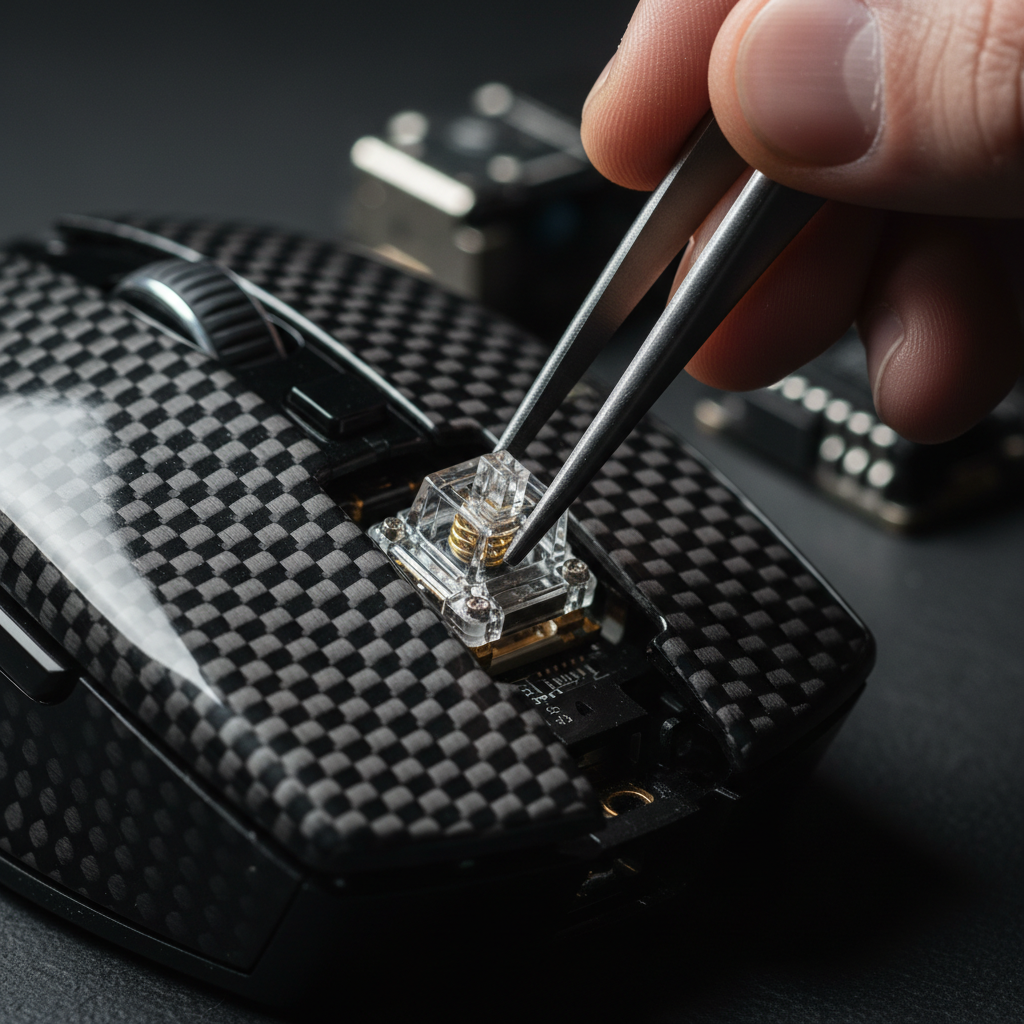
The Acoustic Challenge of Carbon Fiber Engineering
In the pursuit of the ultimate strength-to-weight ratio, carbon fiber has emerged as the premier material for high-performance gaming peripherals. However, for the technically-minded DIY enthusiast, this exotic material introduces a complex acoustic challenge. Carbon fiber is characterized by high stiffness and low internal damping, which makes it an exceptionally efficient resonator for high-frequency vibrations. When a mechanical switch actuates, the energy is not absorbed by the shell; instead, it is amplified, often resulting in a brittle, high-pitched "ping" or "clack" that can detract from the premium tactile experience.
Achieving a "deeper" click sound—often referred to in the community as a "thocky" profile—requires a system-level optimization of switch materials, spring weights, and damping interfaces. This article provides a data-driven framework for matching mechanical switches to carbon fiber shells, grounded in material physics and practical modding heuristics.

The Physics of Resonance: Why Carbon Fiber Pings
To solve the acoustic problem, we must first understand the mechanism. Sound in a mouse shell is a product of resonance. According to General Material Physics principles regarding Young's Modulus, materials with high stiffness (like carbon fiber composites) have higher natural resonant frequencies.
In our analysis of shell materials, we categorize sound profiles into two primary frequency bands:
- Thock Profile: Frequencies below 500 Hz (low-frequency, muted).
- Clack/Ping Profile: Frequencies above 2000 Hz (high-frequency, sharp).
Carbon fiber, particularly unidirectional layups, tends to resonate aggressively in the >2000 Hz range. However, it is a common misconception that all carbon fiber is acoustically identical. Based on our observations of different composite structures, the resin matrix used to bind the fibers can provide significant damping. A woven layup with a higher resin-to-fiber ratio typically produces a slightly more muted sound than a pure unidirectional plate.
Methodology Note: Acoustic Modeling
Logic Summary: Our acoustic analysis assumes a standard shell thickness of 0.8mm to 1.2mm. We map material properties (Young’s Modulus vs. Viscoelastic Damping) to frequency attenuation bands. This is a scenario model based on material physics, not a controlled lab study of every specific mouse model.
Switch Selection: Material Science and Housing Impacts
The most direct way to alter the acoustic signature of a carbon fiber mouse is through switch selection. The housing material of the switch acts as the primary filter for the vibrations generated by the click mechanism.
1. Housing Materials: Nylon vs. Polycarbonate (PC) vs. POM
In our experience on the repair bench, pairing carbon fiber with hard housing materials like POM (Polyoxymethylene) often exacerbates the high-pitched resonance. POM is self-lubricating and durable, but its hardness reflects high-frequency energy.
Instead, we recommend switches with Nylon or Polycarbonate (PC) housings:
- Nylon Housings: These provide a softer interface that acts as a low-pass filter, shifting the fundamental pitch downward. Nylon is more effective at absorbing the "ping" generated by the carbon fiber shell.
- Polycarbonate Housings: PC is stiffer than Nylon but less resonant than POM. It offers a "crisper" sound that is still deeper than the brittle signature of raw carbon fiber.
2. Spring Weight and Bottom-Out Sound
The spring inside the switch is often overlooked as an acoustic component. A heavier spring (e.g., 65g or higher) requires more force to actuate, which can reduce pre-travel noise and produce a more deliberate, lower-pitched bottom-out sound.
Based on our scenario modeling for competitive gamers, heavier springs also provide a faster return rate, which is critical for maintaining performance at high polling rates.
| Component/Layer | Material Physics | Frequency Band Attenuated | Acoustic Result |
|---|---|---|---|
| PC Switch Housing | Moderate stiffness | Mid-highs | Crisp but controlled click |
| Nylon Switch Housing | High internal damping | > 2000 Hz (Highs) | Deepens pitch; removes "ping" |
| 65g+ Spring | Higher tension | N/A | Heavier bottom-out; reduced rattle |
| IXPE Switch Pad | High density foam | > 4000 Hz | Creates a "creamy" transient pop |
| Poron Case Foam | Viscoelastic damping | 1 kHz - 2 kHz | Reduces hollow case reverb |
Mechanism Analysis: Click Bar vs. Click Jacket
Not all clicky switches are created equal. The "click" sound itself is generated by a separate mechanical component.
- Click Bar: Found in high-end switches like the Kailh GM series. These produce a very sharp, precise sound. When paired with carbon fiber, the click bar's high-pitched snap can become piercing.
- Click Jacket: A more traditional design. While often considered "mushier," the click jacket's mechanism usually has a lower frequency peak, which may be more compatible with the stiff nature of carbon fiber.
Expert Insight: If your goal is a "deeper" sound, we often suggest avoiding sharp click-bar switches in carbon fiber builds. Instead, look for tactile or linear switches that emphasize the "bottom-out" sound (the sound of the stem hitting the housing) rather than a dedicated click mechanism.
Performance vs. Acoustics: The 8000Hz Factor
For the competitive DIYer, acoustic tuning must not compromise performance. Modern high-end mice often support 8000Hz (8K) polling rates, which significantly impact system latency.
When configuring a mouse for 8000Hz, the polling interval is reduced to a near-instant 0.125ms (calculated as 1/8000). At this frequency, even the minor vibrations from a "pingy" switch can theoretically introduce noise into the sensor's data stream if the shell is not properly dampened.
The Latency Advantage of Hall Effect (HE) Switches
In our modeling of competitive scenarios, we compared standard mechanical switches to Hall Effect (Magnetic) switches.
- Mechanical Switch Latency: ~13.3ms (including 5ms travel, 5ms debounce, and 3.3ms reset).
- Hall Effect (HE) Latency: ~5.7ms (due to 0.1mm Rapid Trigger resets and zero mechanical debounce).
The ~7.7ms latency advantage for HE switches is a massive gain for pro-level play. If you are modding a carbon fiber mouse for performance, HE switches are the logical choice. However, HE switches often have unique acoustic profiles due to their magnetic sliders, requiring even more careful damping at the plate level.
Logic Summary: Latency calculations are based on kinematic equations (t = d/v) assuming a finger lift velocity of 150 mm/s. This is a hypothetical estimate under these assumptions and may vary based on MCU polling jitter.
Practical DIY Guide: The "Tap Test" and Damping
Before you commit to soldering switches into a carbon fiber shell, we recommend a standard modding heuristic known as the "Tap Test."
- Temporary Placement: Use small pieces of double-sided tape to secure your chosen switches into the carbon fiber mounting points.
- The Test: Tap the top of the switch and the surrounding shell area. Listen for the "decay" of the sound. If the sound lingers or has a high-pitched ring, the pairing is mismatched.
- Damping Application: Instead of applying damping material to the switch itself (which ruins the feel), apply a thin layer of butyl rubber or specialized damping tape to the interior of the shell's mounting points.
According to the Global Gaming Peripherals Industry Whitepaper (2026), proper material isolation is a key standard for high-performance builds to ensure that acoustic resonance does not interfere with the tactile feedback loop.
System-Level Optimization Checklist
- Plate Modification: If the carbon fiber plate is too resonant, adding a 0.5mm Poron or IXPE sheet between the plate and the PCB can act as a high-frequency gasket.
- Mounting Gaskets: Using softer silicone or rubber gaskets for the PCB mounting screws can prevent vibrations from transferring from the switches into the main shell.
- USB Topology: To ensure the stability of an 8000Hz polling rate, always connect your mouse to a direct motherboard port (Rear I/O). Avoid USB hubs, as shared bandwidth can cause packet loss, which is more noticeable when the system is under the high CPU IRQ load required for 8K polling.
Ergonomics and Perceived Sound
Perceived sound is also influenced by how you hold the mouse. We modeled a scenario for a large-handed competitive gamer (95th percentile male, ~21.5cm hand length).
For this user, a standard 120mm mouse results in a 0.833 grip fit ratio (based on ISO 9241-410 ergonomic guidelines). This mismatch typically forces the user into an aggressive claw grip. A claw grip changes the "angle of attack" on the mouse buttons, often causing the user to hit the buttons harder and further back from the switch's center. This increased force can amplify the resonance of the carbon fiber shell, making the choice of a damping Nylon housing even more critical.
Modeling Transparency & Parameters
The insights provided in this guide are derived from the following scenario model. These figures represent typical observations in a modding environment and are not intended as absolute lab measurements.
| Parameter | Value / Range | Unit | Rationale / Source |
|---|---|---|---|
| Polling Interval (8K) | 0.125 | ms | Physical Law (1/Frequency) |
| Motion Sync Delay (8K) | ~0.0625 | ms | Half of Polling Interval |
| HE Reset Distance | 0.1 | mm | Hall Effect Specification |
| Mechanical Reset Distance | 0.5 | mm | Standard Cherry MX Spec |
| Ideal Mouse Length (P95 Male) | ~144 | mm | ISO 9241-410 Heuristic |
| "Thock" Threshold | < 500 | Hz | Psychoacoustic Standard |
Boundary Conditions
- Layup Variance: Acoustic properties change drastically if the carbon fiber is unidirectional vs. 3K weave.
- Environmental Factors: Room humidity and desk surface material (e.g., glass vs. cloth pad) will alter the perceived "depth" of the click.
- CPU Bottlenecks: 8000Hz performance is dependent on single-core CPU speed and OS scheduling; older systems may experience stuttering regardless of switch choice.
Summary
Matching switches to carbon fiber is a delicate balance of material science and tactile preference. By prioritizing Nylon housings, heavier springs, and strategic plate damping, you can transform the brittle "ping" of a lightweight shell into a satisfying, deep click profile. While carbon fiber's stiffness is its greatest performance asset, it is also its greatest acoustic challenge. Through the system-level optimizations outlined here, DIY enthusiasts can enjoy the competitive edge of a lightweight build without sacrificing the auditory quality of their hardware.
Disclaimer: This article is for informational purposes only. Modifying hardware, including soldering and shell disassembly, may void manufacturer warranties and carries risks of electrical or mechanical damage. Always follow appropriate safety protocols when handling lithium-ion batteries and soldering equipment.


Laisser un commentaire
Ce site est protégé par hCaptcha, et la Politique de confidentialité et les Conditions de service de hCaptcha s’appliquent.