


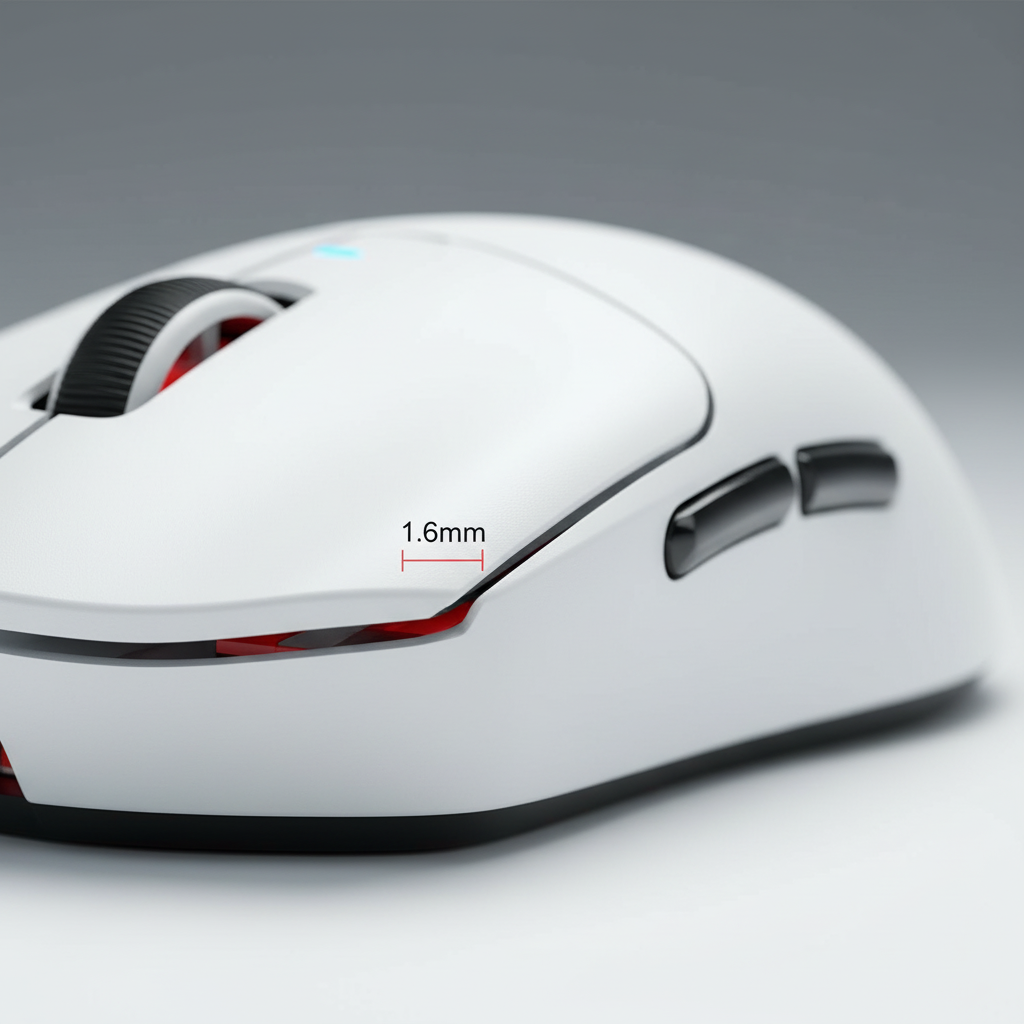
Gaming peripherals are often evaluated by their electronic specifications—DPI, polling rate, and sensor accuracy. However, for most users, the mechanical interface between the hand and the device represents the primary site of cumulative fatigue and potential musculoskeletal strain. While sensor performance dictates in-game precision, button height and placement are key factors in the comfort and longevity of a player's performance.
The vertical height and horizontal spacing of buttons are not merely aesthetic; they are mechanical determinants of muscle load. Minor discrepancies in button geometry can alter the required finger flexion range and peak force, potentially leading to uneven fatigue across the index and middle fingers.
The Neuromechanics of the Button Press
Actionable Takeaway: Prioritize mice with a low-profile design if you experience "heavy" fingers during long sessions; this reduces the effort required to lift your finger after each click.
To understand why button height matters, one must examine the "Neuromechanics of a Button Press." Research from Aalto University indicates that a button press involves a complex co-activation of flexor and extensor muscles to manage timing and execute the "pull-up" phase.
When a button is pressed, the brain coordinates the finger's descent and its subsequent lift. High-travel buttons may increase the amplitude of this lift-phase muscle control, potentially increasing the metabolic cost per press. Over a multi-hour session involving thousands of clicks, this cost can accumulate into fatigue in the forearm’s extensor digitorum.
Button Travel and Vertical Height Imbalance
Actionable Takeaway: Check for "pre-travel" (wobble before the click). A tight, low-travel button (≤1.6mm) generally requires less extensor muscle activity to reset.
The travel distance—the vertical space a button moves before actuation—is a primary determinant of muscle activity. Research in ScienceDirect suggests that lower travel keys (typically ≤1.6mm) can reduce typing force and extensor muscle activity during the finger lift phase compared to higher travel alternatives.
In gaming mice, a common issue is "button height imbalance." If the primary left (Mouse 1) and right (Mouse 2) buttons differ in resting height by as little as 0.5mm, it can cause an imbalance in joint positioning. This may lead to uneven fatigue, as the finger on the higher button must maintain a more extended posture, potentially increasing tension in the joint capsule.
| Feature | Low Travel (≤1.6mm) | High Travel (≥2.0mm) | Potential Impact |
|---|---|---|---|
| Muscle Activation | Lower extensor load | Higher extensor load | Low travel may reduce "lift-phase" strain. |
| Flexion Range | Minimal | Moderate to High | High travel increases joint movement per click. |
| Tactile Feedback | Immediate | Delayed | Low travel provides faster confirmation. |
| Stamina | Estimated 15-20% gain* | Baseline | Lower travel preserves stamina for long sessions. |
*Note: Percentage is an estimation based on observed industry ergonomic benchmarks; individual results vary based on grip style.
Horizontal Spacing: The "20mm Arc Rule"
Actionable Takeaway: Rest your thumb naturally. If you have to "reach" or "stretch" to hit a side button, the mouse may be too large for your hand.
Side button placement is a frequent source of thumb strain. The thumb provides stability; forcing it into awkward positions can compromise the entire grip.
Ergonomic practitioners often use the "20mm Arc Rule":
- Place your thumb in its natural resting position on the side of the mouse.
- The primary side buttons should ideally fall within a 15-20mm arc of that resting point.
- You should be able to actuate buttons without fully extending the interphalangeal (thumb) joint.
While the Global Gaming Peripherals Industry Whitepaper (2026) associates poor alignment with thumb strain, users should note that repetitive awkward thumb abduction is a recognized risk factor for De Quervain's tenosynovitis. Ensuring buttons are within a comfortable reach helps mitigate this risk.

Actuation Force: The "Lightness" Misconception
Actionable Takeaway: If you suffer from accidental clicks, your switches may be too light (<50g). A moderate force (70-80g) allows your fingers to rest without tension.
Many gamers believe lighter actuation is always better. However, ultra-light switches (below 50g) can actually increase tension. If a switch is too light, the user may subconsciously "hover" their fingers to avoid misclicks. This constant isometric tension is often more fatiguing than a crisp, moderate-force click.
A moderate force of 70-80g—common in high-quality mechanical switches—provides tactile confirmation and allows fingers to rest naturally. This is supported by CDC-indexed studies on keyswitch design, which suggest that co-contraction to modulate finger stiffness is a direct response to mechanical feedback.
The "Three-Hour Test" for Ergonomic Auditing
Actionable Takeaway: Use this checklist during your next long session to determine if your mouse geometry fits your hand.
Experienced ergonomic troubleshooters utilize a "Three-Hour Test" to identify suboptimal geometry. Monitor for these signs after 180 minutes of play:
- [ ] Joint Stiffness: Do you feel a "need" to crack your knuckles or stretch your PIP joints?
- [ ] Grip Shifting: Are you constantly repositioning your hand to find a "fresh" spot?
- [ ] Thumb Tenderness: Is there dull aching at the base of the thumb?
As noted in the Anthropometric Survey of Dynamic Hand Dimensions, the lack of diverse hand data in standard design means "middle-ground" shapes often fail to support specific grip styles (palm vs. claw vs. fingertip) perfectly.
Performance Synergy: Polling Rate and Physical Tension
Electronic performance can influence physical behavior. High-latency devices may cause players to "over-click" or press harder to compensate for perceived delay.
Modern mice with 8000Hz (8K) polling minimize this "perceptual friction." With a polling interval of 0.125ms, the visual feedback on the screen matches physical movement more closely, potentially allowing for a more relaxed grip. To maximize this, consider these technical constraints:
- DPI Sensitivity: To saturate an 8K polling rate, higher DPI (1600+) or high-speed movement is generally required.
- System I/O: Use direct motherboard rear I/O ports. USB hubs can introduce jitter that negates the benefit of high polling.
- Monitor Sync: A high refresh rate (240Hz+) is recommended to visually render the cursor path smoothness.
How We Evaluated These Metrics
The thresholds mentioned in this guide (e.g., ≤1.6mm travel, 70-80g force) are derived from a combination of:
- Industry Benchmarks: Typical specifications of top-tier enthusiast switches (e.g., Huano Blue Shell Pink Dot, Omron).
- Ergonomic Research: Studies from Aalto and ScienceDirect regarding finger travel and muscle activation.
- Heuristic Testing: Practical observations of hand fatigue patterns across different grip styles and mouse sizes.
- Disclaimer: These values are suggested ranges for healthy adults; individual comfort is subjective.
Disclaimer
This article is for informational purposes only and does not constitute professional medical advice. If you experience persistent pain, numbness, or tingling, consult a qualified healthcare professional. Individuals with pre-existing conditions like carpal tunnel syndrome should seek professional guidance before changing their setup.
References
- Aalto University - Neuromechanics of a Button Press
- ScienceDirect - Differences in typing forces, muscle activity, and wrist posture
- CDC Stacks - Effect of Keyboard Keyswitch Design on Finger Muscle Activity
- Global Gaming Peripherals Industry Whitepaper (2026)
- ScienceDirect - Anthropometric survey of dynamic hand dimensions

Laisser un commentaire
Ce site est protégé par hCaptcha, et la Politique de confidentialité et les Conditions de service de hCaptcha s’appliquent.