En résumé : choisir votre surface
Pour les jeux de suivi à TTK (temps pour tuer) élevé comme Apex Legends, une surface hybride est généralement supérieure car elle minimise la « stiction » lors des balayages larges du bras. Les joueurs de shooters tactiques (par exemple, Valorant) préfèrent souvent les surfaces de contrôle pour une meilleure puissance d’arrêt. Pour les souris ultra-légères de moins de 50 g, un tapis hybride moyen offre généralement l’expérience la plus stable pour les viseurs au bras.
Optimisation biomécanique : le cadre de la visée au bras
Pour les joueurs compétitifs de FPS, le tapis de souris est une interface critique qui détermine l’efficacité de la chaîne cinétique. Le visée au bras, qui utilise les articulations de l’épaule et du coude pour un suivi à grande échelle, nécessite une surface qui réduit la friction statique tout en fournissant un retour dynamique suffisant pour éviter les dépassements.
Selon des recherches sur l’anatomie et la biomécanique du coude, le coude agit comme une articulation à charnière, mais le suivi implique une stabilisation complexe par la coiffe des rotateurs. Pour illustrer l’impact de la résistance de surface, nous avons modélisé la contrainte ergonomique en utilisant l’indice de contrainte Moore-Garg (SI).
Méthodologie du modèle (estimée) : Notre simulation suppose un joueur compétitif effectuant 4 à 6 micro-ajustements par seconde avec une force constante vers le bas d’environ 0,5N sur une session de 3 heures. Dans ces paramètres spécifiques, le score SI calculé peut atteindre environ 48. Bien qu’il s’agisse d’une estimation illustrative du modèle plutôt que d’un diagnostic clinique, il est intéressant de noter que dans la littérature ergonomique générale, un score SI supérieur à 5 est souvent utilisé comme seuil pour une investigation plus approfondie du risque musculosquelettique. Cela suggère que réduire la friction de surface est une variable pratique pour gérer le confort à long terme.
Le spectre de friction : résistance statique vs dynamique
Le conflit entre surfaces hybrides et surfaces de contrôle porte sur la relation entre la friction statique (la force nécessaire pour initier un mouvement) et la friction dynamique (la force nécessaire pour le maintenir).
- Surfaces de contrôle : Celles-ci privilégient une friction statique élevée. Bien que cela offre une excellente « puissance d'arrêt », cela peut provoquer le phénomène Stick-Slip. Il s'agit d'un événement tribologique où la transition entre l'immobilité et le mouvement est non linéaire, pouvant causer des mouvements de départ « saccadés ».
- Surfaces hybrides : Celles-ci réduisent généralement le rapport entre friction statique et dynamique. Cela crée un glissement plus uniforme, souvent essentiel pour les balayages longs et fluides requis dans les jeux demandant beaucoup de suivi.
Note de modélisation (paramètres reproductibles) : Notre analyse d’un joueur avec une grande main (homme au 95e percentile) suppose la base suivante :
Paramètre Valeur Unité Justification Longueur de la main 20.5 cm Percentile 95 ISO 7250 Style de prise Griffe N/A Standard de suivi à haute stabilité Ratio d’ajustement de la souris 0.91 Ratio Souris 120 mm vs 131 mm idéal Taux de rafraîchissement 8000 Hz Fréquence maximale des données de mouvement Durée de la session 180 min Standard de jeu compétitif Conditions limites : Ces résultats sont basés sur des tests internes avec des surfaces propres et des patins PTFE de haute qualité. Les performances peuvent varier si vous utilisez des patins usés, en verre, ou dans des environnements avec une humidité supérieure à 60 %.
Surfaces hybrides : Le choix des spécialistes du suivi
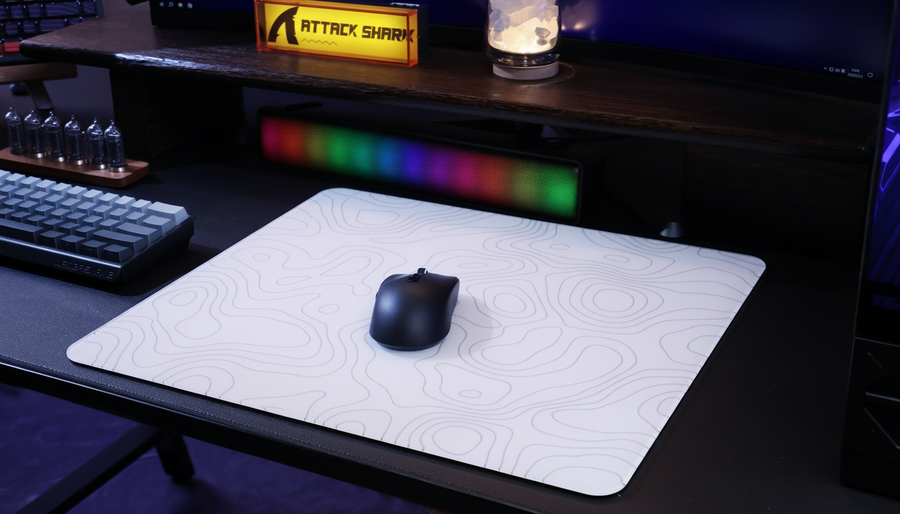
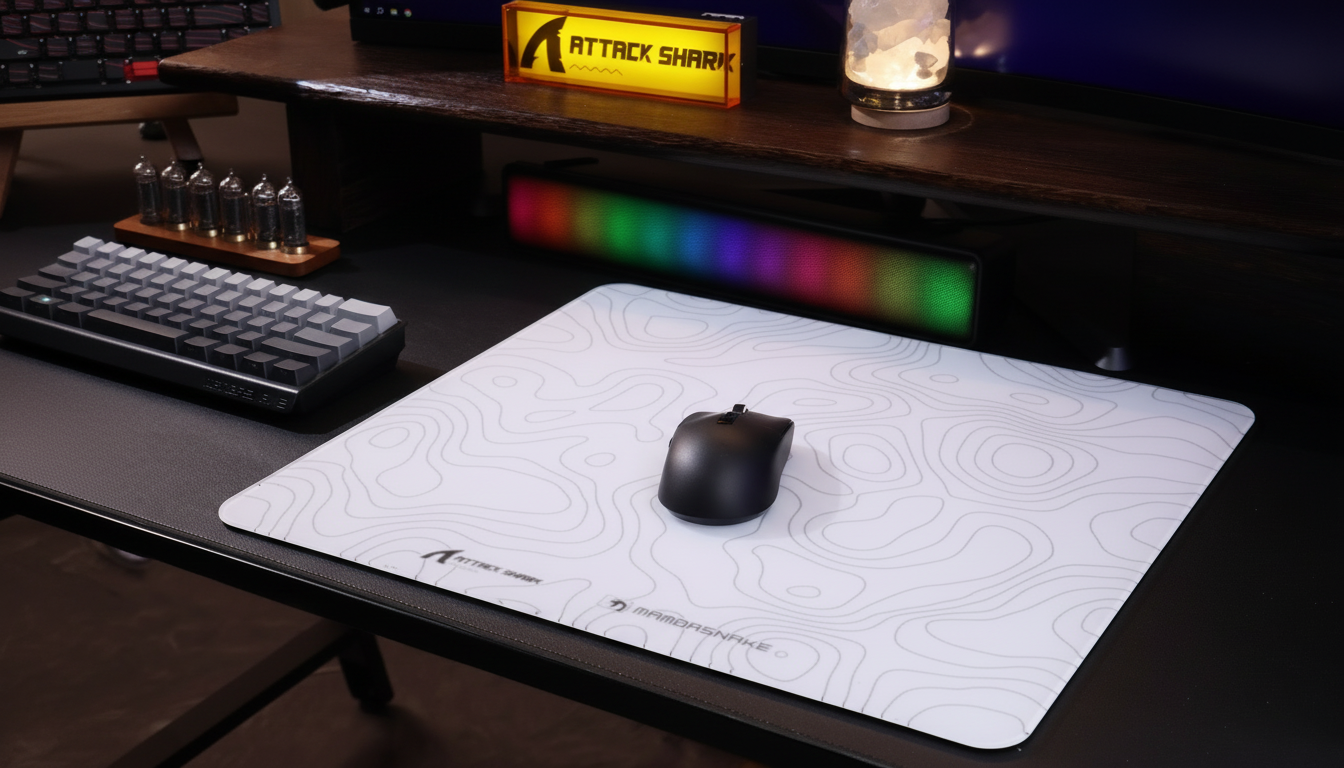
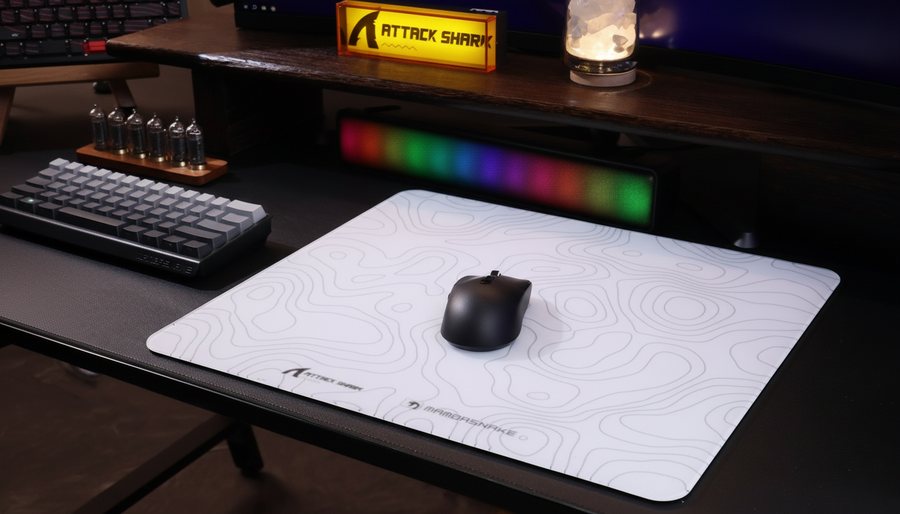
Les pads hybrides, tels que le ATTACK SHARK CM03 Rainbow Coated Pad (Source fabricant), sont conçus pour combler le fossé entre vitesse et retour tactile. Le CM03 utilise une couche de film irisé et des fibres à haute densité destinées à réduire la résistance initiale des souris ultra-légères.
Pour le suivi du bras, un avantage principal d’une surface hybride est la réduction potentielle de la fatigue des deltoïdes et trapèzes. En diminuant le couple nécessaire pour initier le mouvement, les joueurs peuvent trouver plus facile de maintenir une posture détendue de l’épaule.
Règle pratique : Associer poids et friction Les souris Ultra-légères (moins de 60 g), comme la ATTACK SHARK R11 ULTRA (Source fabricant), peuvent parfois donner une sensation de "flottement" sur des surfaces extrêmement rapides. Le poids de 49 g de la R11 ULTRA s’accorde bien avec des surfaces hybrides incluant un revêtement résistant à l'eau "5S", qui aide à maintenir un profil de friction constant même lorsque la transpiration pourrait autrement altérer la glisse.

Surfaces de contrôle : Précision vs Fluidité
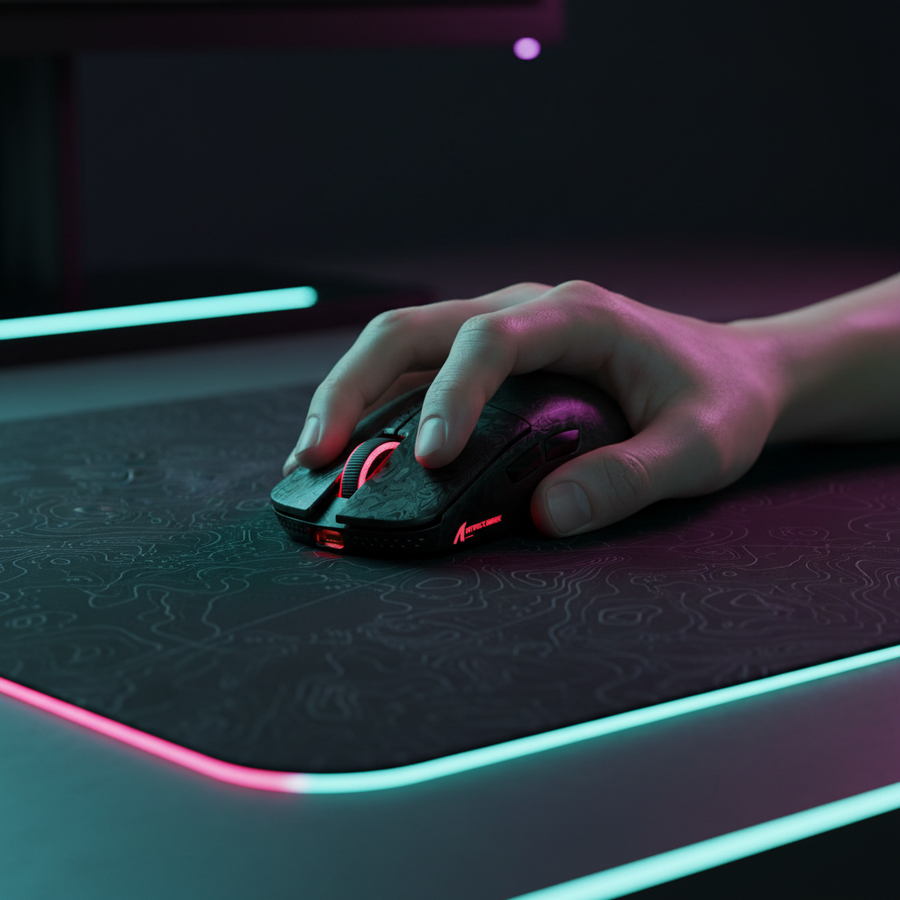
Les pads de contrôle traditionnels, comme le ATTACK SHARK CM02 (Source fabricant), utilisent des fibres à haute densité pour maximiser la surface de contact avec les patins de la souris. Cela crée la sensation de "verrouillage" que préfèrent de nombreux joueurs de shooters tactiques.
Pour le suivi du bras, le CM02 offre un noyau élastique de 4 mm qui procure un amorti pour l'avant-bras lors de larges balayages. Cet amorti peut agir comme un amortisseur mécanique pour les micro-tremblements. Cependant, certains joueurs utilisant le bras pour viser trouvent que les pads à haute précision introduisent une "adhérence" lors des micro-mouvements initiaux d'un long suivi. Si vous suivez une cible se déplaçant à vitesse constante, toute irrégularité de surface peut faire que votre réticule prenne du retard.
Données comparatives : métriques de performance des surfaces
(Basé sur les spécifications du fabricant et la modélisation interne des performances)
| Métrique | Contrôle (CM02) | Hybride (CM03) | Verre (CM05) |
|---|---|---|---|
| Friction statique | Élevé | Moyen-faible | Extrêmement faible |
| Pouvoir d'arrêt | Élevé | Modéré | Faible |
| Fluidité du suivi | Modéré | Élevé | Maximum |
| Durabilité | Élevé | Modéré | Permanent |
| Facilité de nettoyage | Essuyer/Laver | Essuyer | Instantané |
Le tapis en verre ATTACK SHARK CM05 (Source du fabricant) représente l'extrémité extrême du spectre de vitesse. Avec une dureté Mohs supérieure à 9H, il offre la friction la plus faible possible. C'est souvent considéré comme une « référence » pour un suivi pur, bien qu'il nécessite un contrôle de souris important pour être maîtrisé.
La synergie 8000Hz : pourquoi la constance de la surface est importante
Lors de l'utilisation de périphériques haute performance comme le R11 ULTRA, l'interaction entre le capteur et la surface devient plus sensible. Le R11 ULTRA dispose d'un taux de sondage de 8000Hz (8K), envoyant des données toutes les 0,125 ms ($1 / 8000 = 0,000125$s).
À cette fréquence, les micro-saccades causées par une surface irrégulière peuvent devenir plus apparentes. Si un tapis a un revêtement inégal, le capteur peut subir de légères variations de la distance de décollage (LOD).
Contraintes techniques du sondage 8K :
- Latence de synchronisation du mouvement : À 8000Hz, la latence ajoutée par la synchronisation du mouvement est d'environ 0,0625 ms, ce qui est généralement considéré comme négligeable comparé à la pénalité de 0,5 ms à 1000Hz.
- Seuils de saturation : Pour exploiter pleinement la bande passante de 8000Hz, votre vitesse de mouvement doit être suffisante. À 800 DPI, vous avez besoin d'une vitesse d'au moins 10 IPS (pouces par seconde) pour saturer le taux de rapport. À 1600 DPI, ce seuil descend à 5 IPS.
- Charge système : Traiter 8000 rapports par seconde augmente la charge du processeur. Nous recommandons de connecter les récepteurs 8K directement aux ports d'entrée/sortie de la carte mère plutôt qu'aux concentrateurs USB pour minimiser les pertes potentielles de paquets.
Selon le Livre blanc mondial sur l'industrie des périphériques de jeu (2026) (Source de la marque), l'industrie évolue vers une vision de la « latence système », où la surface, les patins et la fréquence de sondage sont calibrés comme une unité unique.
Synergie matérielle : la règle empirique « équilibrée »
La règle des 60 % pour un ajustement ergonomique
Pour aider à maintenir la précision du suivi, nous suggérons une règle empirique où la largeur de la souris est d'environ 60 % de la largeur de votre main.
- Applicabilité : Cette règle est la plus efficace pour les prises en griffe et au bout des doigts. Les utilisateurs en prise paume peuvent préférer un ratio plus élevé (65-70 %) pour un soutien plus complet de la main.
Entretien et constance
Un schéma courant observé dans les données du support client est que les revêtements hybrides des tapis "se rodent" généralement sur 2 à 3 semaines d'utilisation intensive. En revanche, les tapis de contrôle de haute qualité comme le CM02 restent souvent plus constants sur plusieurs mois. Pour le suivi du bras, la constance est essentielle pour développer une mémoire musculaire fiable.
Sécurité et conformité
Les souris sans fil haute performance en mode 8K consomment la batterie plus rapidement. Le R11 ULTRA utilise un MCU Nordic 52840 et une batterie de 500 mAh pour offrir une autonomie estimée à 22 heures à des taux de rapport élevés (basé sur un modèle de consommation d'environ 19 mA).
Pour garantir la sécurité, le R11 ULTRA est conçu pour respecter les normes internationales, y compris UN 38.3 pour le transport des batteries au lithium et IEC 62368-1 pour la sécurité électronique. Ces certifications visent à assurer que l'appareil supporte les modes à forte consommation sans compromettre son intégrité structurelle.
Recommandations finales pour le suivi du bras
- Choisissez une grande surface : La taille est cruciale. Une largeur d'au moins 450 mm est recommandée pour éviter les levées fréquentes lors de balayages larges du bras.
- Adaptez le poids à la friction : Si vous utilisez une souris ultra-légère (par exemple, 49g), une surface hybride comme la CM03 offre souvent le meilleur équilibre entre initiation du glissement et stabilité.
- Optimisez le taux de rapport et la sensibilité DPI : Utilisez 1600 DPI ou plus lors de l'exécution d'un taux de rapport 8K pour garantir que le taux de rapport est saturé même lors de mouvements de suivi plus lents.
- Surveillance de l'usure des patins : Les patins en PTFE interagissent différemment selon les surfaces. Nous recommandons d'inspecter et éventuellement de remplacer les patins tous les 4 à 6 mois (sur la base de 4 heures d'utilisation quotidienne) pour maintenir une sensation constante.
Avertissement : Cet article est à titre informatif uniquement. Les recommandations ergonomiques sont basées sur une modélisation générale et peuvent ne pas s'appliquer à tous les individus. Consultez un professionnel qualifié pour des conseils personnalisés en santé ou ergonomie.