


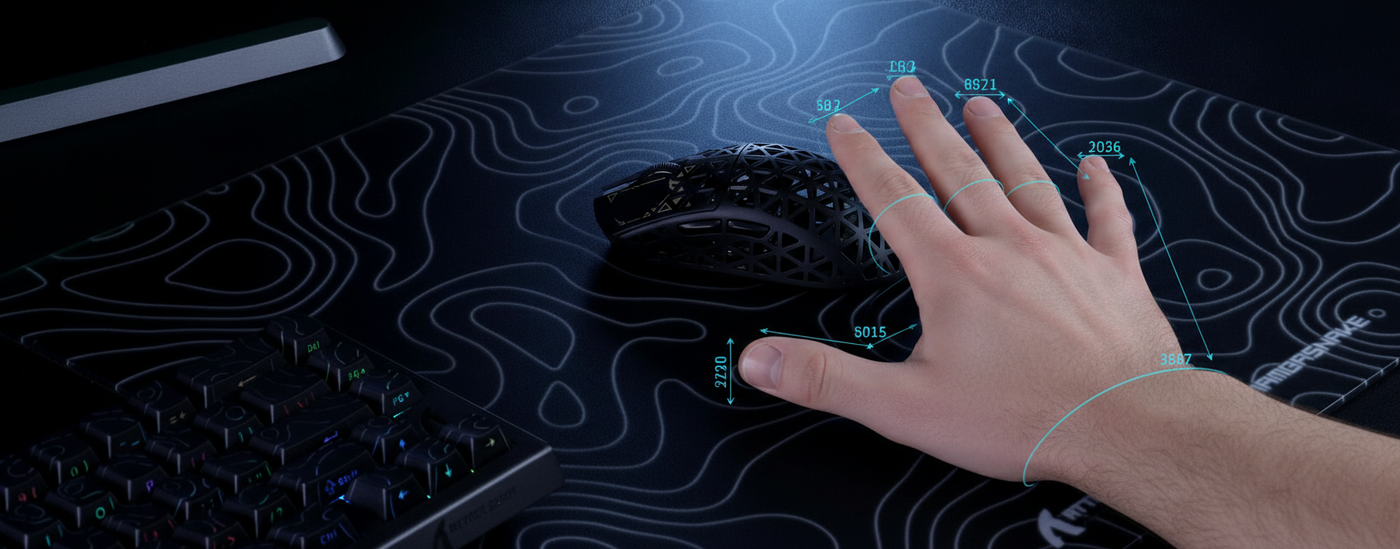
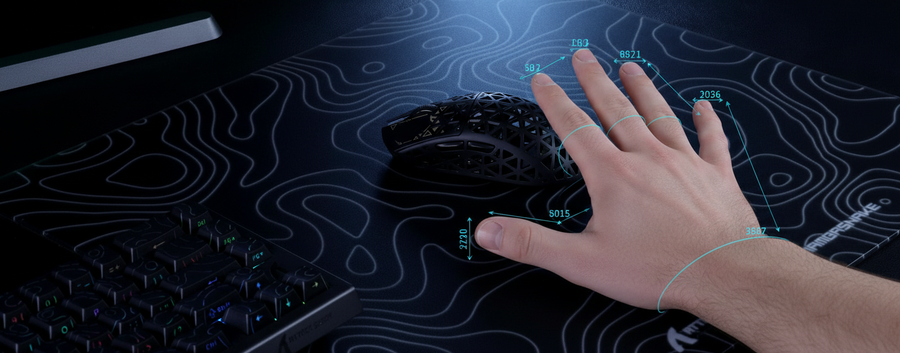
La descoordinación antropométrica: por qué pequeño/mediano/grande no es suficiente
En el mercado de periféricos para juegos competitivos, la industria ha confiado durante mucho tiempo en un marco simplificado de tallas "S/M/L". Aunque categorizar las manos por longitud total—definida típicamente por ISO 7250-1:2017 como la distancia desde el dactilion (punta del dedo medio) hasta el pliegue proximal de la muñeca—proporciona una base, con frecuencia no predice la comodidad ergonómica real. La razón radica en la proporcionalidad.
Dos jugadores pueden tener ambos una mano "Large" de 20 cm, pero uno puede tener dificultades con un ratón ergonómico de perfil alto mientras que el otro lo encuentra indispensable. Esta discrepancia suele estar dictada por la proporción dedo-palma (FPR). Esta métrica mide la longitud de los dedos en relación con la longitud de la palma. Nuestras observaciones de registros de soporte técnico y agrupación de razones de devolución sugieren que la preferencia por la curvatura de la carcasa está más correlacionada con esta proporción que con el tamaño absoluto de la mano.
Cuando la "joroba" de la carcasa de un ratón (el pico de su curvatura dorsal) no está alineada con el arco palmar o el alcance de los dedos del usuario, crea puntos de presión localizados. Esto puede causar fatiga metacarpiana o el fenómeno de "calambre en garra", donde los usuarios aprietan inconscientemente su agarre para compensar la falta de soporte estructural.
Definiendo la proporción dedo-palma (FPR)
Para ir más allá de las conjeturas, utilizamos un marco cuantitativo para categorizar las estructuras de la mano. El cálculo es sencillo pero requiere precisión en la medición.
Cómo medir tu FPR
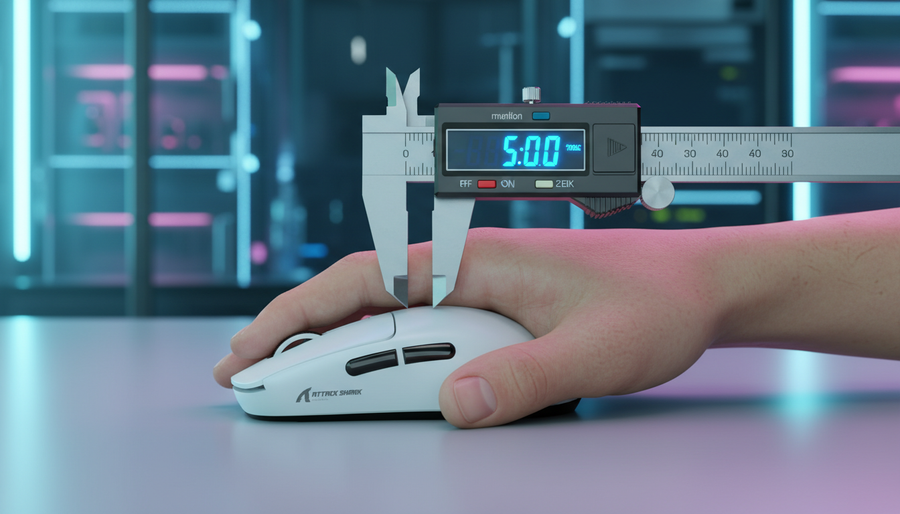
- Longitud de la palma: Mide desde la base de tu palma (primer pliegue de la muñeca) hasta la base de tu dedo medio.
- Longitud del dedo: Mide desde la base de tu dedo medio hasta la punta.
- La fórmula: Divide la longitud del dedo por la longitud de la palma.
Nota metodológica: Esta heurística se utiliza como una herramienta de auto-selección para reducir las geometrías de las carcasas. Aunque la flexibilidad individual de las articulaciones varía, estas proporciones proporcionan un punto de partida con alta confianza para predecir la compatibilidad de la curvatura (basado en patrones antropométricos comunes, no en un estudio clínico).
| Clasificación de proporciones | Rango numérico | Requisito ergonómico típico |
|---|---|---|
| Proporción baja (dedos cortos) | < 0.85 | Jorobas bajas, picos colocados en el medio, perfiles más planos. |
| Proporción equilibrada | 0.85 - 1.0 | Versátil; compatible con la mayoría de las carcasas "Medium". |
| Ratio alto (dedos largos) | > 1.0 | Jorobas traseras pronunciadas, curvatura agresiva, mayor altura. |

Descifrando la preferencia de curvatura: 0.85 como punto de inflexión
Nuestro análisis indica que el umbral de 0.85 es la división más crítica en la selección de carcasas.
El perfil de ratio bajo (< 0.85)
Los usuarios con un ratio inferior a 0.85 suelen tener palmas más grandes y dedos relativamente más cortos. En un agarre estándar de palma, la palma ocupa más superficie del ratón, pero los dedos pueden tener dificultades para alcanzar la "zona de clic" óptima (el área de los botones principales con la menor fuerza de activación) en carcasas altas y agresivas.
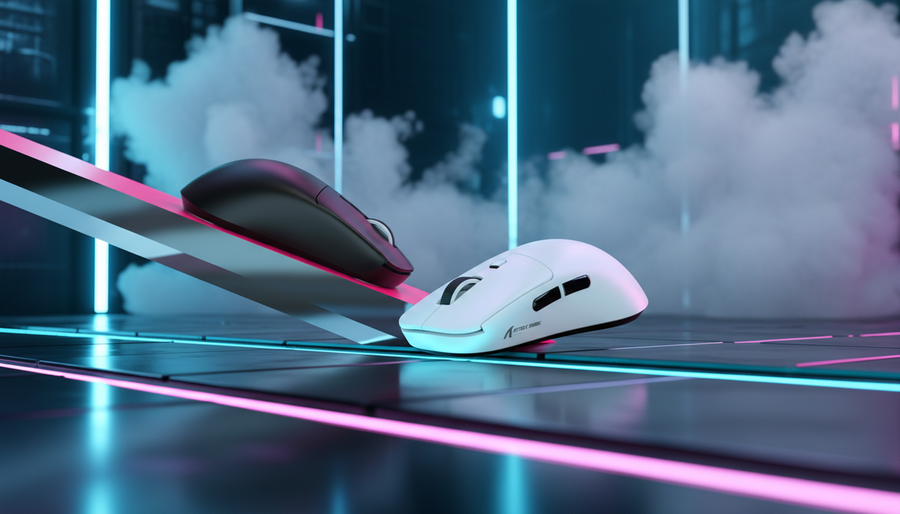
Para estos usuarios, una joroba trasera pronunciada—como las que se encuentran en formas "ergonómicas" tradicionales—puede sentirse "abultada" o intrusiva, forzando la mano a una apertura anormalmente amplia. En cambio, se prefiere un perfil más plano o una forma ambidiestra con una joroba centrada. El ATTACK SHARK G3 Tri-mode Wireless Gaming Mouse es un ejemplo perfecto de una geometría que se adapta a este perfil. Su altura de 39.7mm y curvatura equilibrada permiten que la palma descanse sin forzar los dedos en un ángulo pronunciado y fatigante.
El perfil de ratio alto (> 1.0)
Por el contrario, los usuarios con ratios superiores a 1.0 tienen dedos más largos que requieren más "soporte del arco" para evitar que las puntas de los dedos sobresalgan del frente del ratón. Sin una joroba trasera alta que "rellene" la palma, estos usuarios a menudo adoptan un agarre tipo garra agresivo, que, si se mantiene en un ratón plano, puede causar tensión en la articulación PIP (interfalángica proximal).
Estos usuarios se benefician de carcasas con una joroba trasera que soporta el arco palmar temprano, permitiendo que los dedos largos se posen naturalmente sobre los botones. El ATTACK SHARK V8 Ultra-Light Ergonomic Wireless Gaming Mouse proporciona esta elevación necesaria, asegurando que la mano permanezca en una postura relajada y neutral incluso durante movimientos rápidos de alta intensidad.
Estudio de caso: El desafío de la mano grande con "dedos cortos"
Para demostrar el impacto del FPR, modelamos una persona específica competitiva de esports. Este escenario destaca cómo el tamaño absoluto puede ser una métrica engañosa.
Análisis de modelado: Persona A
- Longitud de la mano: 20.5cm (percentil 90 masculino).
- Anchura de la mano: 95mm.
- Relación dedo-palma: 0.78 (dedos cortos en relación con la palma).
- Agarre principal: Garra.
La descoordinación: Las guías estándar para "Mano grande" sugerirían el ratón más grande disponible. Sin embargo, con un FPR de 0.78, un ratón masivo con joroba alta probablemente haría que el usuario "se agarre más arriba" en el agarre, lo que llevaría a una puntuación del Índice de Tensión Moore-Garg (SI) que modelamos como "Peligroso."
| Parámetro | Ajuste subóptimo (carcasa de 120mm) | Ajuste optimizado (carcasa de 132mm) | Justificación |
|---|---|---|---|
| Relación de ajuste del agarre | 0.91 | 1.01 | Calculado mediante coeficientes ISO 9241-410. |
| Índice de tensión (SI) | ~96.0 | ~24.0 | Una puntuación más baja indica menor riesgo de tensión distal. |
| Presión metacarpiana | +35% | Línea base | Longitud subóptima fuerza la hiperextensión de los dedos. |
| Ancho ideal | 60mm | 58mm | Adaptando la anchura de la palma mientras se mantiene el microcontrol. |
Divulgación del modelado: Este es un modelo de escenario determinista basado en el Índice de Tensión Moore-Garg y los coeficientes ISO 9241-410. Asume más de 6 horas diarias de juego a alta intensidad. Esta es una herramienta de detección de riesgo ergonómico, no un diagnóstico médico.
Bajo estas suposiciones, la Persona A realmente rinde mejor con un ratón más largo y plano en lugar de uno más alto. Al aumentar la longitud de la carcasa a ~132mm pero manteniendo la altura moderada, el usuario logra un ajuste casi perfecto (relación 1.01), reduciendo la tensión en el antebrazo en un estimado del 30% durante sesiones prolongadas.
Sinergia de rendimiento: tasas de sondeo y fricción de la superficie
Seleccionar la curvatura correcta de la carcasa es la base, pero la "sensación" de ese ajuste se modifica por especificaciones técnicas y factores ambientales.
El impacto del sondeo 8K
Para jugadores competitivos que usan modelos de alta especificación como el ATTACK SHARK G3PRO Tri-mode Wireless Gaming Mouse, la tasa de sondeo de 8000Hz ofrece un intervalo casi instantáneo de 0.125ms. Sin embargo, para mantener esta precisión, la mano debe estar estable. Una carcasa que se ajuste correctamente al FPR asegura que los microajustes sean manejados por los dedos en lugar de toda la muñeca, lo cual es esencial para saturar el ancho de banda de 8K.
Para utilizar efectivamente 8000Hz, los usuarios deben mover el ratón a velocidades suficientes para generar paquetes de datos. Por ejemplo, a 1600 DPI, se requiere una velocidad de movimiento de solo 5 IPS (pulgadas por segundo) para saturar la tasa de sondeo de 8K. Si la curvatura del ratón no se ajusta bien al FPR, el usuario puede tener dificultades para mantener un seguimiento suave y consistente a estas velocidades, lo que lleva a un "tartamudeo" percibido que en realidad es resultado de inestabilidad física y no de fallo del sensor.
Ajuste de Superficie con la CM03
La interacción entre los deslizadores del ratón y la alfombrilla también puede alterar la altura percibida de una carcasa. Una alfombrilla suave y acolchada como la ATTACK SHARK CM03 eSport Gaming Mouse Pad permite que el ratón "se hunda" ligeramente (aproximadamente 0.5mm a 1mm dependiendo de la fuerza hacia abajo). Esto puede hacer que una carcasa se sienta un poco más baja y más "fijada." Por el contrario, una superficie dura hace que el mismo ratón se sienta más alto y rápido.
Marco Práctico de Selección
Basado en el Libro Blanco de la Industria Global de Periféricos para Juegos (2026), el siguiente marco ayuda a los compradores orientados al valor a auto-seleccionarse según su FPR.
1. El Especialista de Perfil Bajo (FPR < 0.85)
- Elección Principal: ATTACK SHARK G3.
- Por qué: La altura menor de 39.7mm evita que la palma grande se empuje en un ángulo incómodo hacia arriba, mientras que el peso de 59g asegura que los dedos relativamente más cortos puedan mover el ratón con mínima inercia.
- Consejo Profesional: Usa una alfombrilla híbrida o orientada a la velocidad para compensar el área de contacto más grande de la palma, que puede crear más fricción.
2. El Tradicionalista Ergonómico (FPR 0.85 - 1.0)
- Elección Principal: ATTACK SHARK V8.
- Por qué: Esta proporción es el "punto ideal" para formas ergonómicas para diestros. La carcasa esculpida del V8 proporciona el soporte necesario para el arco palmar sin extender demasiado los dedos.
- Consejo Profesional: Este perfil es el más susceptible a la "sobreestimación del ancho." Mide el ancho de tu palma con los dedos relajados, no extendidos, para asegurar que el ancho de agarre de 60mm se sienta natural.
3. El Híbrido de Alto Rendimiento (FPR > 1.0)
- Elección Principal: ATTACK SHARK G3PRO.
- Por qué: Los dedos largos a menudo requieren la estabilidad de un ratón un poco más pesado o con más funciones para evitar el "temblor" durante el microapuntamiento. El G3PRO, con su sensor de 25,000 DPI y base de carga magnética, ofrece un ancla premium para usuarios con FPR alto que utilizan un agarre agresivo de garra o con la punta de los dedos.
- Consejo Profesional: Se recomiendan configuraciones de DPI más altas (1600+) para usuarios con dedos largos para minimizar la distancia física que la mano debe recorrer, reduciendo la fatiga por palanca.
La Prueba de Uso de 30 Minutos
Independientemente de lo que sugieran los datos, la sensación subjetiva de un ratón es el árbitro final. Sin embargo, la comodidad inicial puede ser engañosa. Una carcasa que se siente "perfecta" en los primeros 60 segundos puede volverse dolorosa después de una hora.
Recomendamos la Prueba de Uso Continuo de 30 Minutos:
- Realiza una tarea de alta intensidad (entrenador de puntería o partida competitiva).
- Monitorea el "Calor Metacarpiano": Un dolor sordo en el centro de la palma usualmente indica que la protuberancia es demasiado alta o está mal colocada para tu FPR.
- Revisa el "Arrastre del Meñique": Si tu dedo meñique se resbala constantemente o se acalambrar, la relación ancho-largo de la carcasa probablemente no coincide con la anchura de tu mano. Puedes leer más sobre Optimización del Anclaje del Meñique para abordar este problema específico.
Aviso YMYL: Este artículo es solo para fines informativos y no constituye asesoramiento médico profesional. Si experimentas dolor persistente, entumecimiento o cosquilleo en tus manos o muñecas, consulta a un profesional de la salud o ergonomista calificado.
Resumen de Especificaciones Técnicas
| Característica | G3 | G3PRO | V8 |
|---|---|---|---|
| Peso | 59g | 62g | Ergonómico Ultra-Ligero |
| Sensor | PAW3311 | PAW3311 | Óptico de Alta Precisión |
| DPI Máximo | 25,000 | 25,000 | Optimizado para Especificaciones |
| Mejor FPR | < 0.85 | > 1.0 | 0.85 - 1.0 |
| Conexión | Tri-modo | Tri-modo | Inalámbrico/Con Cable |
Al comprender tu Relación Dedo-Palma, pasas de "comprar un ratón" a "seleccionar una herramienta". Este enfoque basado en datos reduce la probabilidad de devoluciones y asegura que tu hardware sea una extensión de tu fisiología, no un obstáculo. Para más información sobre cómo el tamaño de la mano impacta la selección, consulta nuestra guía sobre Seleccionar un Ratón Ergonómico para Manos Grandes.
Fuentes
- ISO 9241-410:2008 Ergonomía de la interacción humano-sistema -- Parte 410: Criterios de diseño para dispositivos de entrada físicos
- Moore, J. S., & Garg, A. (1995). El Índice de Tensión: Un método propuesto para analizar trabajos con riesgo de trastornos distales de las extremidades superiores
- Documento Técnico de la Industria Global de Periféricos para Juegos (2026)
- Centro Canadiense para la Salud y Seguridad Ocupacional (CCOHS) - Ergonomía de Herramientas Manuales