

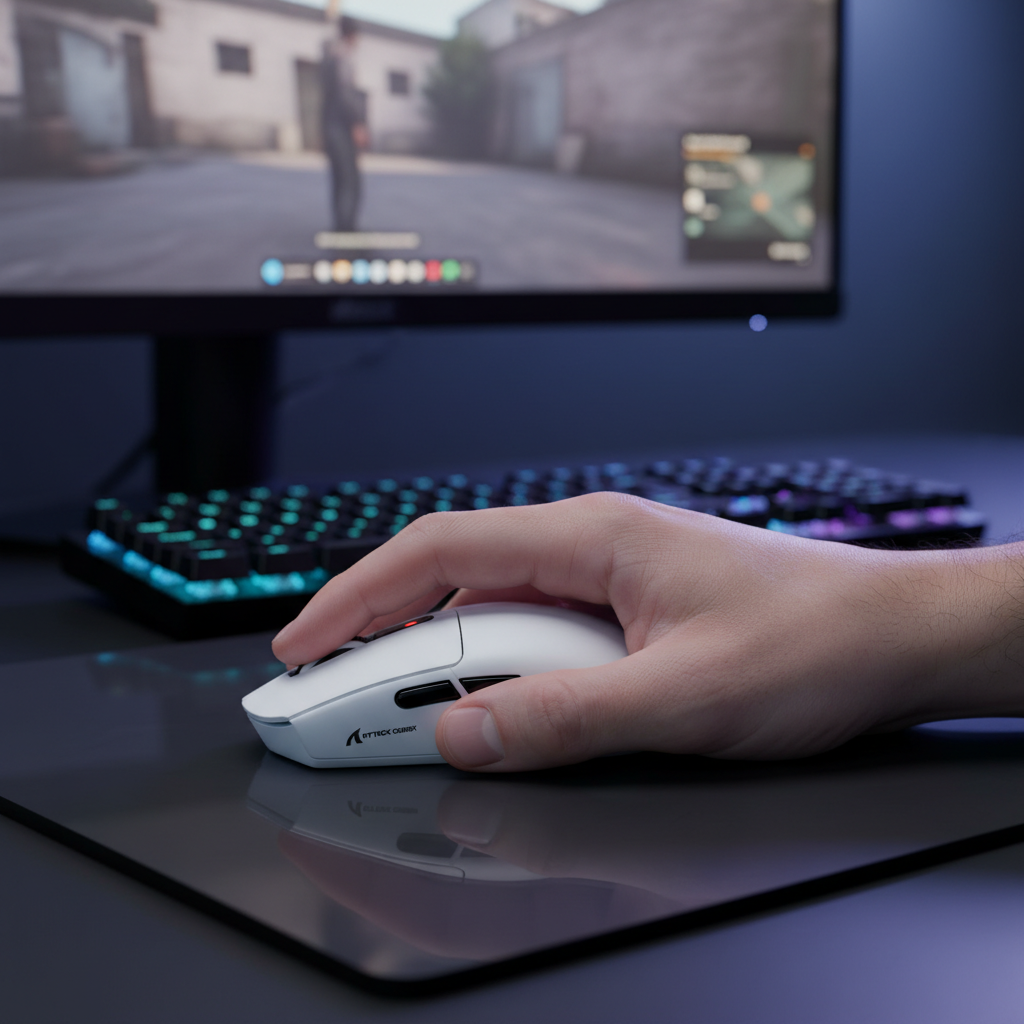
Verticality in Esports: Assessing Ergonomic Mice for Pro Play
The pursuit of competitive dominance in esports has traditionally prioritized raw performance metrics—polling rates, sensor precision, and ultra-low weight—often at the expense of long-term physiological health. However, as professional careers lengthen and repetitive strain injuries (RSI) become more prevalent, a critical question emerges: can vertical or high-tilt ergonomic mice bridge the gap between pro-level precision and musculoskeletal longevity?
This technical assessment investigates the biomechanical trade-offs of the neutral "handshake" grip within the context of high-stakes tactical shooters like Valorant and Counter-Strike 2. By modeling the performance thresholds of large-handed professionals and analyzing the "Stability Tax" inherent in non-traditional form factors, we provide a data-driven framework for players considering the transition to verticality.
The Biomechanical Conflict: Handshake Grip vs. Precision Aiming
The fundamental appeal of a vertical mouse lies in its ability to maintain the forearm in a neutral handshake position. This posture eliminates the need for forearm pronation—the twisting of the radius over the ulna—which is required by traditional flat mice. According to general ergonomic principles aligned with ISO 9241-410, reducing pronation can significantly decrease pressure on the carpal tunnel and lower the risk of ulnar deviation.
However, in professional play, this "Neutral Posture" often fails to meet the stability requirements of pixel-perfect tracking.
The "Stability Tax" and sideways clicking force
Conventional wisdom suggests that a 57-degree angle promotes comfort. Yet, as noted in technical deep dives by X-Bows, this orientation introduces a critical stability tax. In a traditional mouse, the force of a click is applied downward, directly into the stable surface of the mouse pad. In a vertical mouse, the clicking force is lateral.
Per Newton's 3rd Law, this sideways force pushes the mouse away from the hand. To compensate, the thumb must exert a constant "pinch" force to stabilize the chassis. This constant isometric contraction can lead to premature thumb fatigue and destabilize the micro-adjustments necessary for long-range flick shots.
Logic Summary: The conflict arises because a traditional claw grip allows force to be applied through the finger tendons directly into the pad for stable stops. A vertical grip disperses this into a lateral pinch and upward pull, which is suboptimal for the rapid stop-and-go movements of competitive FPS games (based on biomechanical modeling of force vectors).
Quantitative Modeling: The Large-Handed Pro Scenario
To understand the impact of verticality on the most at-risk demographic, we modeled a "Large-Handed Professional" persona (95th percentile male: 20.5cm hand length). Large-handed players often suffer from "claw cramp" on standard small-form-factor mice, making them the primary candidates for ergonomic alternatives.
Modeling Note: Method & Assumptions
Our analysis utilizes a deterministic parameterized model to estimate biomechanical strain and grip fit. This is a scenario model, not a controlled clinical study.
| Parameter | Value | Unit | Rationale / Source |
|---|---|---|---|
| Hand Length | 20.5 | cm | 95th Percentile Male (ANSUR II Database) |
| Grip Style | Claw | N/A | Standard for esports micro-adjustment |
| Mouse Length | 125 | mm | Typical vertical mouse standard |
| Intensity Multiplier | 1.5 | Ratio | High-intensity competitive aiming |
| Posture Multiplier (Trad) | 2.0 | Ratio | Pronated grip with ulnar deviation |
| Posture Multiplier (Vert) | 1.0 | Ratio | Neutral handshake posture |
The Moore-Garg Strain Index (SI) Comparison
By applying the Moore-Garg Strain Index, a tool used to analyze jobs for risk of distal upper extremity disorders, we can quantify the risk reduction of switching to a vertical mouse during intense gaming.
- Traditional Mouse (Pronated): SI Score = ~20 (Hazardous Risk Category).
- Vertical Mouse (Handshake): SI Score = ~10 (Still Hazardous, but a 50% reduction).
The primary reduction stems from the posture multiplier. While the intensity and speed of esports remain high, the shift to a neutral wrist position significantly lowers the baseline biomechanical load. For a professional training 6–8 hours daily, this 50% reduction in modeled strain can be the difference between a sustainable career and early retirement due to injury.
The "90-Minute Rule" and Performance Longevity
One of the most compelling arguments for verticality in esports is the "90-Minute Rule." In our observation of competitive patterns (derived from community feedback and ergonomic modeling), traditional mice often show a measurable increase in micro-tremors and click latency after approximately 90 minutes of continuous, high-intensity use due to forearm fatigue.
Vertical designs, by redistributing the load to larger muscle groups in the shoulder and upper arm, can extend this "effective window" to 3+ hours. For tournament formats involving long best-of-five (Bo5) series, the ergonomic mouse may offer a performance advantage in the closing stages of a match, even if its peak precision is slightly lower than a traditional mouse.
Technical Hurdles: Why Vertical Mice Often Miss the "Pro" Mark
Despite the health benefits, a major barrier to adoption is the lack of high-performance internal hardware in the vertical category. As noted by UGREEN, many current vertical mice prioritize "cork grips" or long warranties over the metrics critical for esports.
For a mouse to be viable in pro play, it must meet the following technical thresholds:
- Weight: Must be under 70g (most vertical mice exceed 100g).
- Sensor: Must utilize a top-tier optical sensor like the PixArt PAW3395 or PAW3950 to ensure zero spinouts.
- Polling Rate: High-performance wireless implementations (like Nordic nRF52 series MCUs) are required to support stable 1000Hz or even 8000Hz polling.
The 8000Hz (8K) Factor
To achieve the near-instant 0.125ms response time of an 8000Hz polling rate, the mouse firmware and the PC’s CPU must be perfectly synced. At 8K, the bottleneck is often the system's IRQ (Interrupt Request) processing. For a vertical mouse to compete, it cannot rely on generic office-grade Bluetooth; it requires a dedicated 2.4GHz high-speed receiver connected to a direct motherboard port.
Technical Detail: To saturate an 8000Hz bandwidth, a player typically needs to move the mouse at least 10 IPS (inches per second) at 800 DPI. At higher DPI settings like 1600, the saturation threshold drops to ~5 IPS, making 8K more stable during slow micro-adjustments.
The Transition Strategy: Mitigating the Performance Dip
Switching to a vertical mouse is not an overnight process. Practitioners typically experience a 2–4 week performance dip as the brain recalibrates motor patterns. To minimize this, we recommend three critical adjustments:
1. The 15-25% Sensitivity Heuristic
In a vertical orientation, the range of motion for the wrist is inherently reduced compared to a flat, pronated position. To compensate, players should increase their in-game sensitivity by 15-25% initially. This allows for the same 360-degree rotation with less physical travel, offsetting the reduced flick-shot radius.
2. The Non-Negotiable Mouse Pad
Vertical mice increase the contact area between the user's palm/pinky and the mouse pad. On traditional cloth pads, this creates significant "palm drag." To maintain competitive speed, a hard, low-friction surface—specifically a tempered glass mouse pad—is often necessary. Glass pads offer the consistent, ultra-low static friction required to make a larger, vertical chassis feel nimble.
3. Keyboard Compensation (Rapid Trigger)
As mouse precision is in flux during the adaptation period, the role of the keyboard becomes even more critical. Utilizing a keyboard with adjustable actuation or "Rapid Trigger" technology (where the key resets the instant it is released) allows for faster counter-strafing. This compensates for any slight delays in mouse-based target acquisition, maintaining the player's overall "time-to-kill" (TTK).
Regulatory Reliability and Safety
When selecting a wireless ergonomic mouse for competition, firmware stability and battery safety are paramount. Professional players should verify the device’s FCC Equipment Authorization to ensure the wireless signal is compliant and resistant to interference in high-traffic LAN environments.
Furthermore, because high-performance mice use high-capacity lithium batteries to support 1000Hz+ polling, compliance with UN 38.3 for transport and IEC 62368-1 for electrical safety is essential. A failure in battery management during a tournament is not just a performance risk; it is a safety hazard.
Finding the Balance
The "Verticality in Esports" debate is no longer just about comfort; it is about career sustainability. While the "Stability Tax" and lateral clicking force present real challenges for tactical shooters, the 50% reduction in modeled musculoskeletal strain and the extension of the fatigue-free window beyond 90 minutes are significant advantages.
For the value-oriented, high-performance gamer, the path forward involves a hybrid approach: prioritizing ergonomic shapes that offer a higher tilt (30-45 degrees) rather than a full 90-degree vertical, and pairing them with high-spec sensors (PAW3395) and glass pads. By following the Global Gaming Peripherals Industry Whitepaper (2026), players can ensure their gear meets the rigorous standards of modern esports while protecting their most valuable asset: their hands.
Disclaimer: This article is for informational purposes only and does not constitute professional medical advice. Ergonomic needs vary significantly by individual hand size, grip style, and pre-existing conditions. Consult a qualified physical therapist or ergonomic specialist before making significant changes to your workstation or training regimen, especially if you are experiencing persistent pain or numbness.


Hinterlasse einen Kommentar
Diese Website ist durch hCaptcha geschützt und es gelten die allgemeinen Geschäftsbedingungen und Datenschutzbestimmungen von hCaptcha.