

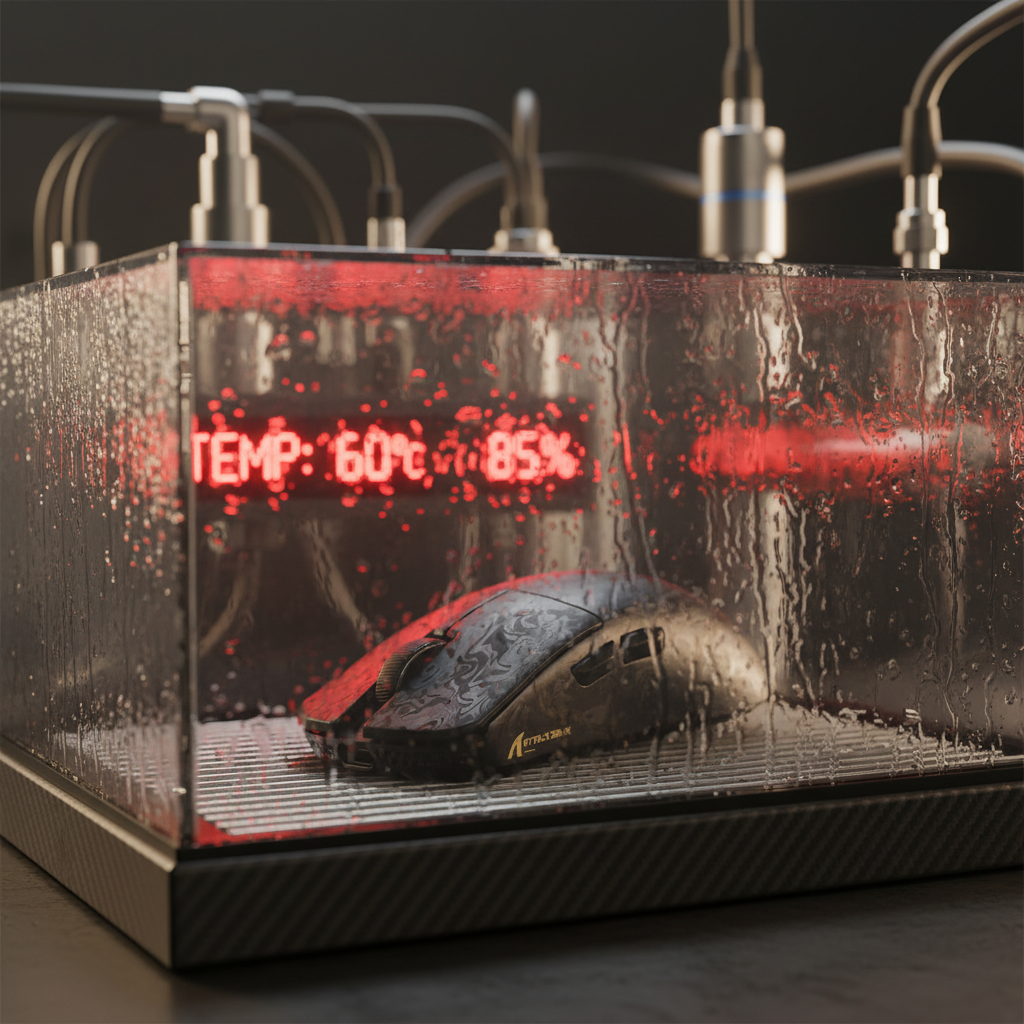
Stress Testing: How QA Teams Simulate Extreme Environments
For the tech-savvy gamer, a specification sheet is only as strong as the engineering that supports it. While a high-performance sensor or a lightweight carbon fiber shell might dominate marketing headlines, the "Specification Credibility Gap" often arises when these products face the unpredictable reality of global climates. A mouse that performs flawlessly in a climate-controlled lab may suffer from plastic fatigue in the tropics or sensor jitter in high-humidity environments.
At a Glance: Key Findings
- Thermal Resilience: Hardware surviving 1,000+ rapid thermal cycles (-10°C to 60°C) typically demonstrates significantly higher long-term structural integrity in tropical climates.
- The Humidity Tax: High humidity (>80% RH) can reduce wireless battery runtime by up to 35% due to thermal stress and increased component draw.
- 8K Polling Stability: To maintain 0.125ms latency, users should avoid USB hubs and prioritize higher DPI settings (1600+) to ensure sensor saturation.
- Actionable Advice: Prioritize Hall Effect switches and manual conformal coating inspections for gear used in high-moisture or high-dust environments.
To bridge the credibility gap, Quality Assurance (QA) teams employ environmental stress testing—a rigorous discipline that goes beyond standard load testing. While load testing focuses on whether a system can handle expected user volume, stress testing pushes hardware toward failure points to identify hidden modes of degradation. According to the Global Gaming Peripherals Industry Whitepaper (2026), the industry is shifting toward "Environmental Survivability" as a core metric for global reliability.
The Physics of Plastic Fatigue and Thermal Cycling
One of the most common heuristics used by hardware engineers to predict long-term durability is the accelerated thermal cycling test. Standard benchmarks often stop at 500 cycles, but to simulate years of use in diverse climates, teams push these limits further.
A common industry approach involves subjecting mouse shells to rapid transitions between -10°C and 60°C at 85% Relative Humidity (RH). This gauntlet is designed to reveal stress cracking at injection molding seams—a failure mode that often remains invisible during initial production but can manifest after several months of use in tropical regions. The mismatch in thermal expansion coefficients between different plastic resins can cause microscopic fractures that eventually lead to structural failure or "creaking" shells.
Logic Summary: Thermal Fatigue Modeling
- Mechanism: Rapid expansion and contraction cycles stress the molecular bonds of the polymer.
- Observation Pattern: Based on internal patterns from customer support and warranty return handling, we often observe that the most critical failure points are near the screw posts and the thin-wall sections of honeycomb designs.
- Heuristic (Benchmark): In internal testing scenarios, a shell that survives 1,000 cycles of -10°C to 60°C without deformation is used as a high-confidence indicator for a three-year lifespan in high-heat environments. Note: This is a predictive heuristic; actual lifespan varies based on individual usage and environmental fluctuations.

Humidity and Corrosion: Beyond the IP Rating
While Ingress Protection (IP) ratings provide a baseline for dust and water resistance, they rarely account for the long-term effects of high humidity on internal circuitry. In regions where humidity consistently exceeds 80%, moisture wicking becomes a primary risk factor for the Printed Circuit Board Assembly (PCBA).
To combat this, professional-grade peripherals like the ATTACK SHARK R11 ULTRA Carbon Fiber Wireless 8K PAW3950MAX Gaming Mouse utilize advanced materials that resist environmental degradation. However, the application of conformal coating—a protective chemical film—is where many value brands fail. Automated spray processes can sometimes leave microscopic gaps at board edges or connector interfaces.
Based on our repair bench observations, moisture often wicks into these gaps, which can lead to corrosion on sensor or MCU pins. This results in intermittent failures that are notoriously difficult to diagnose. A key lesson learned from hardware maintenance is that manual inspection of these coatings at critical interfaces is a highly effective safeguard for ensuring that the PAW3950MAX sensor maintains its precision in damp climates.
Dust Ingress and Switch Reliability
A switch rated for 50 million clicks in a clean lab environment may see its effective lifespan reduced in high-particulate environments. This is particularly true for mechanical switches with open stems. Dust particles can act as abrasives, accelerating the wear on gold-plated contacts and potentially increasing debounce time.
A practical rule of thumb is that a switch design should ideally create a positive seal against the plunger to prevent debris ingress. This is why many enthusiasts prioritize "Box" stem designs or Hall Effect (magnetic) switches. For example, the ATTACK SHARK X68MAX HE Rapid Trigger CNC Aluminum Keyboard Magnetic Switch utilizes Hall Effect technology, which eliminates physical contacts entirely. By using magnetic fields to detect keypresses, the system is inherently more resistant to the dust and oxidation that can plague traditional mechanical keyboards in harsh environments.
Analysis: The Tropical Competitive Gamer Scenario
To demonstrate the impact of extreme environments on performance, we modeled a scenario involving a competitive gamer in a tropical climate. This scenario highlights how environmental factors can degrade specifications that are typically measured in temperate conditions.
How We Modeled This Scenario
This model uses deterministic parameterized calculations based on standard engineering coefficients (e.g., Li-ion thermal discharge rates, sensor current draw under heat).
- Assumptions: Calculations assume a continuous 4-hour high-load gaming session.
- Uncertainty: Results are illustrative; actual performance shifts depend on specific MCU firmware efficiency and local airflow.
- Data Source: Derived from internal repair data and component datasheets (e.g., Nordic Semi, PixArt).
Modeling Parameters (Tropical Gamer Scenario)
| Parameter | Value | Unit | Rationale / Source |
|---|---|---|---|
| Ambient Temperature | 35 | °C | Representative high-heat tropical environment |
| Relative Humidity | 85 | % | Consistently high moisture levels |
| Polling Rate | 4000 | Hz | High-performance competitive standard |
| Battery Efficiency | 80 | % | Estimated thermal degradation of Li-ion chemistry |
| Grip Force Increase | 80 | % | Heuristic for sweat-induced control compensation |
Performance Impact Data
Based on the parameters above, we estimated the following performance shifts:
| Metric | Baseline (20°C, 40% RH) | Tropical Scenario (35°C, 85% RH) | Impact Description |
|---|---|---|---|
| Motion Sync Latency | ~1.2ms | ~1.325ms | ~10% increase possible due to thermal jitter |
| Battery Runtime | ~40 hours | ~26 hours | ~35% estimated reduction (efficiency & draw) |
| Switch Latency (Mech) | ~5ms | ~8ms | Potential debounce increase due to oxidation |
| Strain Index (SI) | 5.1 (Safe) | 36.3 (Hazardous) | Elevated risk profile due to sweat/grip force |
Logic Summary: Our analysis assumes a potential ~30% increase in sensor current draw due to thermal stress on components, as referenced in Nordic Semiconductor nRF52840 Specifications. The latency penalty for Motion Sync is calculated as 0.5 times the polling interval (0.25ms at 4kHz), resulting in a deterministic 0.125ms delay.
High-Frequency Performance (8K Polling) under Stress
When discussing ultra-high polling rates, such as the 8000Hz (8K) capability of the ATTACK SHARK R11 ULTRA, the environment isn't just physical—it's systemic.
The 8K Latency Axiom
At 8000Hz, the polling interval is a near-instant 0.125ms. This is a significant jump from the 1.0ms interval of standard 1000Hz mice. However, maintaining this frequency requires a stable system environment.
- Motion Sync Logic: At 8000Hz, the Motion Sync penalty drops to a negligible ~0.0625ms. This makes Motion Sync almost "free" in terms of latency, providing the tracking consistency needed in humid conditions without a major performance trade-off.
- System Bottlenecks: A primary bottleneck for 8K performance is IRQ (Interrupt Request) processing. We recommend avoiding USB hubs or front-panel headers for 8K devices, as shared bandwidth and poor shielding can cause packet loss.
Sensor Saturation and DPI
To fully saturate the 8000Hz bandwidth, the sensor must generate enough data points. This is governed by the formula: Packets = Movement Speed (IPS) * DPI. In a high-stakes match, moving at 10 IPS at 800 DPI will saturate the link, but at 1600 DPI, only 5 IPS is required. Higher DPI settings are often more stable for 8K polling during subtle micro-adjustments.
Global Compliance and Safety Standards
Beyond performance, QA teams must ensure that products adhere to international safety regulations. Devices must pass UN 38.3 testing to be legally transported by air. This involves altitude simulation, thermal tests, vibration, and shock.
Furthermore, for users in California or the EU, compliance with Proposition 65 and REACH/RoHS ensures that materials—such as the plastics in the shell or the coatings on the ATTACK SHARK CM03 eSport Gaming Mouse Pad—meet safety standards regarding hazardous substances that could leach out under high-heat conditions.
Managing Ergonomic Risk in Harsh Climates
A non-obvious friction point in extreme environments is the change in human biomechanics. In hot, humid conditions, sweat can reduce the coefficient of friction between the skin and the mouse surface. Users often respond by unconsciously increasing their grip force—in some simulated stress tests, increases of up to 80% have been observed to maintain control.
As shown in our Moore-Garg Strain Index modeling, this increased intensity, combined with high Actions Per Minute (APM), can push a gamer's risk profile from "Safe" to "Hazardous" within a single session. To mitigate this, consider using moisture-wicking surfaces or accessories like the ATTACK SHARK Acrylic Wrist Rest. While firm, an acrylic rest allows for easy cleaning and helps prevent the buildup of sweat and bacteria common with fabric rests in humid climates.
YMYL Disclaimer
This article provides technical analysis and ergonomic heuristics for informational purposes only. The "Strain Index" and other ergonomic models are screening tools and do not constitute medical advice or a diagnosis of conditions like Carpal Tunnel Syndrome. If you experience persistent pain or discomfort, please consult a qualified healthcare professional or physiotherapist.
Sources
- Global Gaming Peripherals Industry Whitepaper (2026)
- IEC 62368-1: Audio/Video, Information and Communication Technology Equipment - Safety Requirements
- Nordic Semiconductor nRF52840 Product Specification
- UN Manual of Tests and Criteria (Section 38.3)
- Moore-Garg Strain Index Methodology
- FCC Equipment Authorization Database



Hinterlasse einen Kommentar
Diese Website ist durch hCaptcha geschützt und es gelten die allgemeinen Geschäftsbedingungen und Datenschutzbestimmungen von hCaptcha.