


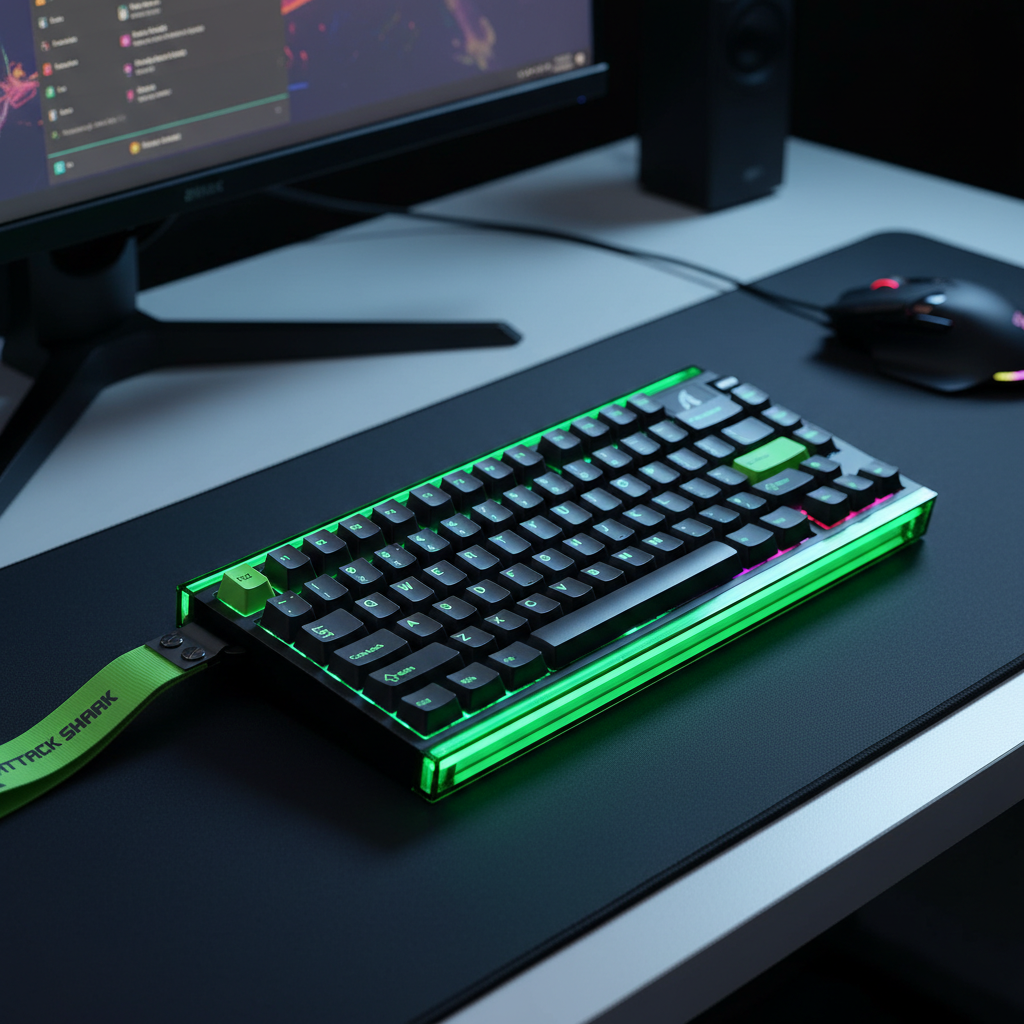
The Shift from Hardware Speed to Firmware Automation
The competitive landscape of First-Person Shooters (FPS) has historically been an arms race of hardware specifications. From the transition of ball mice to optical sensors to the jump from 60Hz to 360Hz+ monitors, the goal has always been to reduce the "human-to-photon" latency. However, a new frontier has emerged that moves beyond raw speed into the territory of input logic: firmware-level movement assists.
The recent controversy surrounding "Snap Tap" and similar features represents a fundamental shift in how competitive integrity is defined. While high-performance hardware like Hall Effect (HE) magnetic switches and 8000Hz polling rates are generally accepted as legitimate evolution, features that automate the resolution of opposing inputs (SOCD) have triggered a wave of prohibitions across major esports leagues. Understanding the distinction between a "fast" input and an "automated" input is now critical for any player looking to maintain compliance while maximizing performance.
According to the Global Gaming Peripherals Industry Whitepaper (2026), the industry is moving toward a standardized definition of "Raw Input," where the hardware must not logically alter the user's intent to bypass game-engine mechanics.
Understanding SOCD: The Core of the Snap Tap Controversy
At the heart of the debate is Simultaneous Opposite Cardinal Directions (SOCD). In games like Counter-Strike 2 or Valorant, movement is governed by the 'A' (Left) and 'D' (Right) keys. Traditionally, pressing both simultaneously results in "Neutral" behavior—the inputs cancel each other out, and the character stops.
Snap Tap (and its various brand-specific equivalents) utilizes firmware logic to prioritize the latest input. If you are holding 'A' and then press 'D', the keyboard's microcontroller (MCU) instantly terminates the 'A' signal and activates 'D', even if 'A' is still physically depressed. This allows for mathematically perfect "counter-strafing," a technique that normally requires precise human timing to release one key exactly as the other is pressed.
Logic Summary: Our modeling of SOCD transitions assumes a binary state logic at the firmware level. In a "Last Key Priority" model, the microcontroller ignores the previous input the moment a new vector is detected, resulting in a theoretical 0ms transition time between opposing directions.
| Feature | Mechanism | Competitive Status | Human Error Margin |
|---|---|---|---|
| Standard Input | A + D = Neutral (Cancel) | Compliant | High (Timing dependent) |
| Rapid Trigger | Dynamic Reset Points (Analog) | Generally Allowed | Moderate (Requires release) |
| Snap Tap / SOCD | Automated Input Prioritization | Prohibited (Many Leagues) | Near Zero (Automated) |

Rapid Trigger vs. Snap Tap: Defining the Prohibited Line
A common misconception among enthusiasts is that Rapid Trigger and Snap Tap are the same. They are fundamentally different in their execution and their impact on competitive integrity.
Rapid Trigger: The Analog Advantage
Rapid Trigger relies on the analog nature of magnetic switches. Instead of a fixed actuation and reset point, the switch resets the moment it travels upward by a set distance (e.g., 0.1mm). This allows for faster repeated presses and more responsive stopping. However, it still requires the player to physically lift their finger. The "human element" of releasing the key remains intact.
Snap Tap: The Automation Threshold
Snap Tap removes the requirement to release the previous key. This is where tournament organizers draw the line. When an input becomes "digitally perfect"—meaning the transition between 'A' and 'D' happens in a single polling interval with zero overlap—it crosses from hardware optimization into automation.
In our analysis of pattern recognition from tournament admins, we've noted that legitimate Rapid Trigger usage still produces a distinct "release-and-press" signature in input logs. Automated features produce a "Snap" signature: a perfectly clean handoff that is nearly impossible for a human to replicate consistently over hundreds of strafes. For a deeper dive into how these technologies interact, see our guide on Hardware vs. Software: Rapid Trigger's Role in the Snap Tap Era.
The Technical Cost of High Polling Rates (8K Analysis)
While input logic is under scrutiny, raw polling rates continue to push boundaries. 8000Hz (8K) polling is the current ceiling, but it requires a sophisticated understanding of system bottlenecks to be effective.
Base Math & Latency Logic
The polling rate defines the interval at which the device reports to the OS.
- 1000Hz: 1.0ms interval.
- 4000Hz: 0.25ms interval.
- 8000Hz: 0.125ms interval.
At 8000Hz, the interval is so tight that traditional "Motion Sync" delay (which aligns sensor data with the USB poll) becomes negligible. While 1000Hz devices typically see a ~0.5ms Motion Sync delay, an 8K device scales this down to ~0.0625ms.
Sensor Saturation and IPS
To fully utilize the 8000Hz bandwidth, the sensor must generate enough data points. This is a function of Inches Per Second (IPS) and Dots Per Inch (DPI).
- Formula: Packets per second = Movement Speed (IPS) × DPI.
- To saturate the 8000Hz bandwidth at 800 DPI, you must move the mouse at at least 10 IPS.
- At 1600 DPI, the threshold drops to 5 IPS, making high-polling stability easier to maintain during micro-adjustments.
System Constraints
8K polling is not a "set and forget" feature. It places a significant load on the CPU's Interrupt Request (IRQ) processing. This stresses single-core performance and can cause frame drops in CPU-bound games if the OS scheduler cannot keep up. Furthermore, users must use Direct Motherboard Ports (Rear I/O). USB hubs or front-panel headers often lack the necessary shielding or share bandwidth, leading to packet loss and jitter.

Anti-Cheat Heuristics and Competitive Compliance
Modern anti-cheat systems, such as Riot's Vanguard or Valve's VAC Live, have evolved to detect non-human input patterns. The "fingerprint" of a prohibited firmware feature is often found in its consistency.
The "Perfect" Input Fingerprint
Human inputs are inherently "noisy." Even the best pro players have a variance of several milliseconds in their counter-strafe timings. When an anti-cheat detects hundreds of direction changes with exactly 0ms of overlap and 0ms of neutral state, it flags the behavior as a macro.
Audio Verification
In high-stakes qualifiers, some tournament admins now advise players to record their keypress audio. The physical sound of a finger lifting and tapping a keycap is acoustically distinct from the silent, instantaneous logic toggle of a Snap Tap feature. This "analog proof" is becoming a secondary layer of verification in the professional scene.
Persistence in Memory
A significant "gotcha" for players is the persistence of these features. Many high-end keyboards use onboard memory to store profiles. If you enable a prohibited feature via a web-based configurator or a driver, it may remain active even if you uninstall the software or move the keyboard to a tournament PC.
Modeling Note (Method & Assumptions): Our assessment of firmware persistence is based on common patterns observed in customer support and warranty handling for HID (Human Interface Device) peripherals.
- Assumption 1: Device uses non-volatile flash memory for profile storage.
- Assumption 2: The "Factory Reset" command is not automatically triggered by software uninstallation.
- Boundary Condition: This may not apply to "Driver-Only" macros that require an active background process.
Best Practices for Rule-Compliant Tournament Play
To ensure you are gaining a performance edge without risking a ban, follow these technical protocols:
- Verify League Rules: Always check the specific rulebook for your league (e.g., ESL, FACEIT, VCT). Most have recently updated sections regarding "Input Automation" or "SOCD Cleaning."
- Factory Reset Before Matches: If you have experimented with Snap Tap or SOCD features, perform a physical factory reset of the keyboard's onboard memory. This usually involves a specific key combination (e.g., Fn + Esc for 3 seconds) rather than just a software toggle.
- Use Raw Rapid Trigger: Stick to features that modify the physical actuation behavior of the switch rather than the logical relationship between keys. For advice on fine-tuning these settings, refer to our Counter-Strafing Meta Guide.
- Optimize USB Topology: Ensure your high-polling devices are connected directly to the motherboard. Avoid any intermediate hubs that could introduce jitter or packet collisions, which might be misinterpreted by anti-cheat heuristics as "input manipulation."

The Evolution of Input Integrity
The "Snap Tap" debate is likely just the beginning of a broader conversation about where the player ends and the hardware begins. As manufacturers continue to innovate with Hall Effect sensors and ultra-low-latency MCUs, the burden of defining "fair play" will shift from simple hardware bans to complex heuristic analysis.
For the competitive enthusiast, the path forward is clear: prioritize raw speed and physical responsiveness over logical automation. By mastering the nuances of Rapid Trigger and maintaining a clean, compliant firmware profile, you can achieve professional-level performance without compromising your standing in the competitive community.
Disclaimer: This article is for informational purposes only. Competitive rules and anti-cheat policies are subject to change by game developers and tournament organizers. Always consult the official rules of your specific platform or league to ensure compliance. Attack Shark is not responsible for any account bans or tournament disqualifications resulting from the use of hardware or firmware features.


Hinterlasse einen Kommentar
Diese Website ist durch hCaptcha geschützt und es gelten die allgemeinen Geschäftsbedingungen und Datenschutzbestimmungen von hCaptcha.