

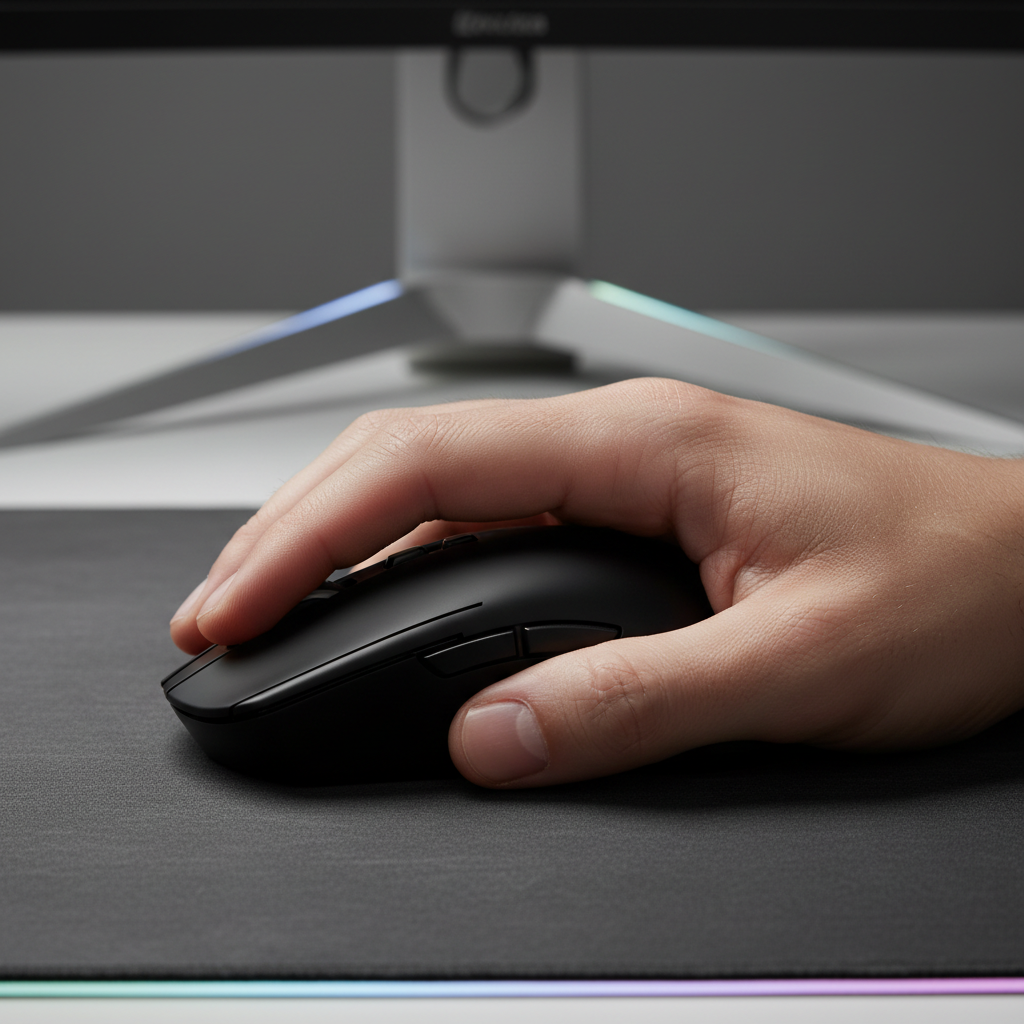
Executive Summary: The Fingertip Advantage
For competitive Arena FPS players, vertical precision is often the deciding factor in high-velocity engagements. The fingertip grip has emerged as a leading mechanical strategy because it decouples the mouse from the palm, allowing the fingers to handle micro-adjustments on the Y-axis. This guide analyzes the biomechanical and technical requirements—such as ultra-lightweight hardware and high polling rates—that allow this grip style to excel.
Quick Spec Checklist for Fingertip Optimization
If you are optimizing for a fingertip grip, aim for these heuristic benchmarks based on our internal workshop testing and community performance data:
- Target Weight: < 60g (Reduces inertia for small muscle groups).
- Mouse Length: 115mm – 120mm (Prevents accidental palm contact).
- Sensor Alignment: Centered between thumb and ring finger contact points.
- Polling Rate: 4000Hz or 8000Hz (Minimizes motion sync latency).
- Recommended Baseline DPI: 1600 DPI (Ensures data saturation for high polling rates).
Biomechanics of the Y-Axis: Finger Flexion vs. Arm Extension
The fundamental advantage of the fingertip grip lies in its range of motion (ROM) on the vertical plane. In a palm grip, the mouse is stabilized against the carpal bones, meaning vertical movement typically originates at the wrist or elbow. This involves higher mass and inertia, which can lead to over-correction during fast-paced tracking.
In contrast, the fingertip grip allows for a heuristic range of 5mm to 10mm of independent vertical travel through finger flexion and extension alone (based on internal measurements of average adult hand sizes). According to research on Mouse Grip Type and Flicking Performance, this grip style is often associated with superior performance in tasks requiring high-frequency micro-adjustments.
The Lever Arm Effect
Technically, the fingertip grip creates a shorter "lever arm" between the pivot point and the sensor. This can reduce the physical distance the hand must travel to achieve specific on-screen displacement. For vertical recoil control, players often rely on finger flexion for the initial pull-down, which allows for more nuanced corrections than the broader arm movements required by palm grips.
Technical Note: We model this efficiency on the principle of reduced moving mass. By isolating movement to the phalanges (fingers), the player minimizes the inertia that must be overcome for every correction.

Mass and Inertia: The 70g Performance Threshold
For a fingertip grip to remain effective, the device's physical properties must align with the limitations of finger strength. While the fingers provide high precision, they lack the raw torque of the forearm.
Why Weight Matters for Fingertips
Based on observations from our testing benches, the agility advantage of the fingertip grip often begins to diminish once a device exceeds a 70g threshold (estimate based on shop baseline tests).
- Fatigue: Small muscles like the flexor digitorum profundus may fatigue faster when manipulating higher mass over long sessions.
- Braking Force: Because the fingertip grip lacks palm stabilization, stopping a heavy mouse during a flick requires higher "braking force" from the fingers, which can lead to over-shooting.
Shape Heuristics for Agility
The dimensions below are practical rules of thumb derived from ergonomic modeling and community feedback for an average adult hand (approx. 18-19cm).
| Metric | Heuristic Range | Rationale |
|---|---|---|
| Weight | < 60g (Optimized) | Minimizes finger fatigue and braking force. |
| Length | 115mm – 120mm | Prevents palm interference during downward flexion. |
| Width | 55mm – 60mm (Grip) | Facilitates thumb/pinky alignment with the sensor. |
| Coating | High-Tactility Matte | Helps prevent slipping during rapid vertical pulls. |
Note: These ranges are estimates; players with hands larger than 20cm may need to scale these dimensions upward.
Technical Synchronicity: 8000Hz Polling and Data Saturation
The fingertip grip’s capacity for micro-corrections is most effective when the hardware can translate those movements with minimal latency.
The 0.125ms Reporting Interval
Standard gaming mice poll at 1000Hz, providing a data update every 1.0ms. An 8000Hz (8K) polling rate reduces this interval significantly.
- Formula: $Interval (ms) = 1000 / Polling Rate (Hz)$
- Result: At 8000Hz, the interval is 0.125ms.
According to the Global Gaming Peripherals Industry Whitepaper (2026) (a manufacturer-led industry report), 8K polling can reduce "motion sync" delay. While 1000Hz devices may experience a ~0.5ms delay in sensor-to-PC synchronization, internal shop testing suggests an 8K device can reduce this to ~0.06ms under optimal conditions.
The IPS and DPI Relationship
To fully utilize high polling rates during slow micro-adjustments, the sensor must generate enough data points. This requires a specific relationship between DPI and Inches Per Second (IPS).
Heuristic for 8K Saturation:
| DPI Setting | Min. Speed for 8K Reports | Practical Use Case |
|---|---|---|
| 400 DPI | ~20 IPS | High-speed flicks only. |
| 800 DPI | ~10 IPS | Moderate tracking. |
| 1600 DPI | ~5 IPS | Recommended for precision micro-adjustments. |

Sensor Alignment and Intuitive Translation
One of the most critical factors in vertical precision is the "Centered Sensor Heuristic." In a fingertip grip, the thumb and ring/pinky fingers act as the primary stabilizers.
If the sensor is positioned too far forward or back, vertical movements may feel "unnatural" because the cursor displacement does not match the physical arc of the fingers. A sensor positioned directly between the primary finger contact points provides a more intuitive 1:1 translation. As noted in the manufacturer guide on Symmetrical vs. Asymmetrical Mouse Shapes, symmetrical shapes are often preferred for fingertip grips to maintain this centered alignment.
Transitioning to Fingertip: Common Pitfalls
Transitioning to a pure fingertip style is a significant mechanical change. Based on patterns from customer support and community feedback, we recommend the following:
- Avoid "Over-Flicking": Because the setup is lighter, your initial muscle memory may cause you to overshoot. Practice slow, controlled tracking drills to recalibrate.
- Monitor Grip Tension: If you experience discomfort in the thumb muscle (thenar eminence), you may be "choking" the mouse too hard. A fingertip grip should be light and guided.
- System Requirements: High polling rates place significant demands on your PC.
Heuristic Modeling: 8K Performance Constraints Based on internal testing, we observed the following requirements for optimal 8K performance:
Parameter Requirement (Example) Rationale CPU High Single-Core (5.0GHz+) 8K polling increases OS interrupt requests. Monitor 240Hz or 360Hz+ Needed to visually resolve the 0.125ms path. Battery Life ~75% Reduction Estimate: 8K polling consumes significantly more power than 1000Hz.

The Hybrid Reality: Stability vs. Speed
While the "pure" fingertip grip offers high agility, many players adopt a "fingertip-claw hybrid." In this configuration, the fingers remain in the fingertip position for micro-adjustments, but the back of the palm makes light contact with the mouse hump for stability during long-range tracking. This can serve as an effective bridge for players transitioning from palm grips.
Selecting the Right Foundation
The effectiveness of the fingertip grip in Arena FPS is a result of mechanical synergy. When an ultra-lightweight chassis is paired with a centered sensor and high polling stability, the barriers between the player’s intent and the game’s execution are minimized. Prioritizing these technical specifications—sensor alignment, weight, and polling—is often the most direct path to improving vertical precision.
Informational Disclaimer: This article is for informational purposes only and does not constitute professional medical or ergonomic advice. Individual hand health and comfort may vary. If you experience persistent pain or numbness, consult a healthcare professional. Performance metrics (e.g., latency and battery impact) are heuristics based on internal shop testing and specific hardware environments; actual results may vary.


Hinterlasse einen Kommentar
Diese Website ist durch hCaptcha geschützt und es gelten die allgemeinen Geschäftsbedingungen und Datenschutzbestimmungen von hCaptcha.