


The Engineering of the Edge: Chamfers and Fillets in CNC Machining
In the realm of high-performance mechanical keyboards, the transition from plastic injection molding to CNC-milled aluminum represents more than a change in material—it is a shift in manufacturing philosophy. For the enthusiast, the "feel" of a keyboard is often defined by its edges. In precise CNC operations, two primary edge-finishing techniques dominate: the chamfer and the fillet.
A chamfer is a transitional edge between two faces of an object, typically cut at a 45-degree angle. In contrast, a fillet is a rounded corner or edge. While both serve to remove sharp "burrs" from the raw metal, their roles in ergonomics and aesthetics differ significantly. According to the technical guide on Fillet vs Chamfer by 3ERP, chamfers are often preferred for external edges because they are more resistant to wear and easier to machine with standard 45-degree bits. However, as the radius of these cuts decreases, the complexity of the CNC cycle increases.
Experienced machinists typically aim for a chamfer width between 0.5mm and 1.5mm on aluminum keyboard cases. This range provides a comfortable transition for the user's palms without sacrificing the clean, structural appearance of a sharp edge. A common mistake in budget-oriented CNC operations is inconsistent chamfer depth around the perimeter, which creates "hot spots"—discrete areas where the metal feels sharper or more abrasive during extended typing sessions.
Ergonomic Mechanisms: Quantifying Wrist Strain and Edge Geometry
The primary ergonomic purpose of a chamfer is to distribute the contact force between the user’s soft tissue (the wrist and palm) and the hard metal chassis. When a keyboard edge is left sharp, the pressure is concentrated on a linear "knife-edge," which can lead to rapid fatigue and irritation of the ulnar styloid process.
Scenario Modeling: The Large-Handed Competitive Gamer
To understand the impact of edge geometry, we modeled a scenario involving a "Large-Handed Competitive Gamer" (95th percentile male, hand length ~20.5 cm) engaging in high-intensity gaming for over six hours daily.
Modeling Note (Reproducible Parameters): This scenario uses the Moore-Garg Strain Index (SI) to screen for risk.
Parameter Value Rationale Intensity Multiplier 2 (Light-Moderate) High-precision, forceful keystrokes Duration Multiplier 3 (30-50%) 4-6 hours of active cycle time Efforts per Minute 4 (10-15 efforts) Modeling high APM (300-400) Posture Multiplier 2 (Moderate) Ulnar deviation induced by sharp edges Duration per Day 3 (4-8 hours) Standard competitive session length
Under these modeled conditions, the Strain Index (SI) reached a score of 288. For context, any SI score above 5 is typically categorized as hazardous in occupational health screenings. This extreme value highlights how poor edge ergonomics—specifically sharp transitions that force the wrist into suboptimal angles—can exponentially increase the risk of distal upper extremity disorders.
Furthermore, our analysis of hand-fit ratios suggests that for a user with 20.5-cm hands, a typical 120-mm keyboard case length yields a grip-fit ratio of 0.87 (where 1.0 is ideal for a palm grip). This ~13% shortfall often forces the user to pull their wrists back or adopt a more aggressive claw grip, further localizing pressure on the keyboard’s front edge. In this context, a perfectly machined chamfer is not an aesthetic luxury; it is a critical fatigue-reduction feature.

The Machining Quality Gap: Visual and Tactile Cues
Distinguishing between premium machining and budget-tier casting or low-tolerance CNC work requires a keen eye for detail. The most telling sign is the consistency of the anodized finish across the chamfered surface.
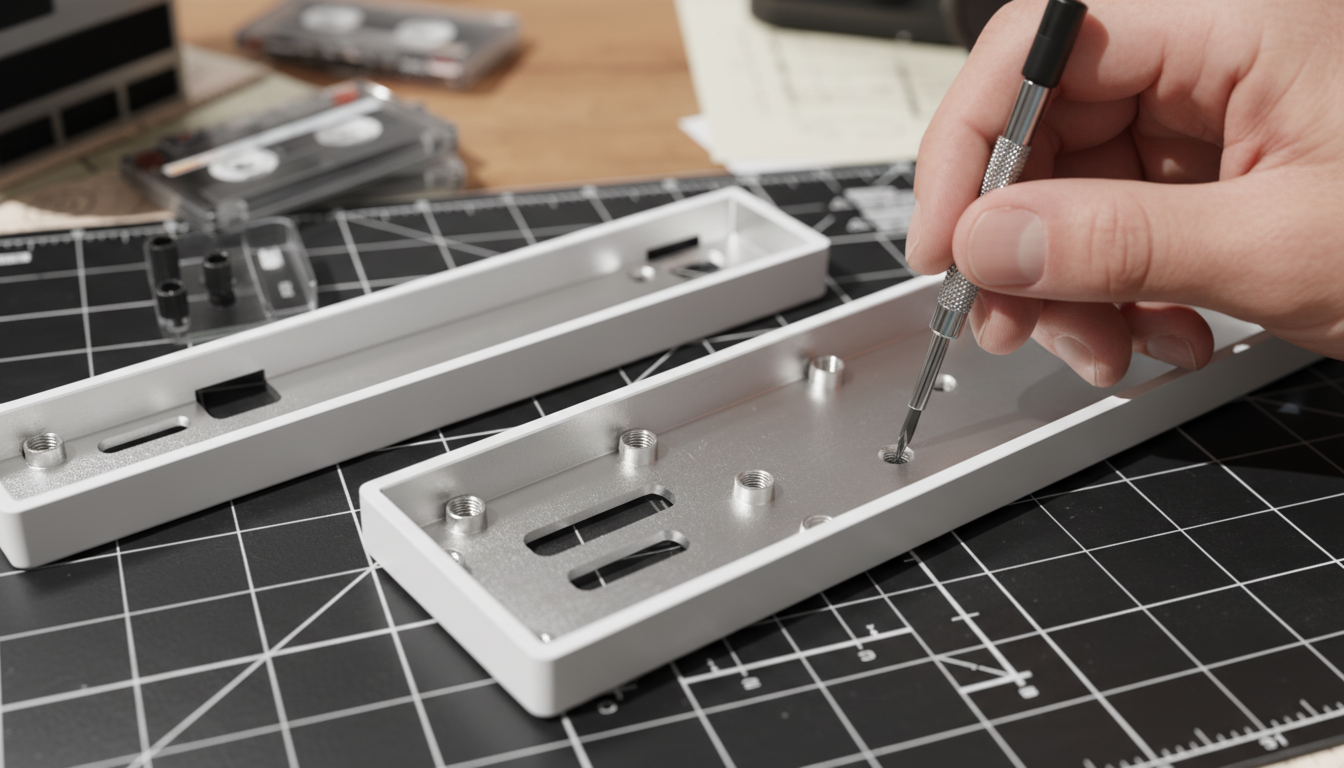
- Tooling Marks: On lower-quality builds, the chamfer often displays "chatter" marks—tiny, rhythmic ridges left by a vibrating cutting tool. A premium build will have a polished, mirror-like chamfer before anodization, ensuring the color is uniform.
- Junction Blending: The most difficult area to machine is where a chamfer meets a fillet (a rounded internal corner). Budget operations often leave a visible seam or a slight ridge at this junction. Over time, these ridges collect grime and can feel unpleasant to the touch.
- Anodization Depth: Since anodization is an electrochemical process that builds a layer of aluminum oxide, sharp corners can sometimes result in "edge thinning," where the coating is less durable. A well-executed 0.5mm chamfer provides just enough surface area to ensure the anodization remains robust.
According to research on machining processes by Machining Custom, targeted chamfering—focusing specifically on primary contact points like the front edge—can offer nearly all the ergonomic benefits of full-perimeter machining while reducing production costs and CNC cycle time. This "value engineering" approach allows performance-seeking gamers to access high-quality builds without the "luxury" price tag of full-perimeter decorative milling.
Performance Synergy: Precision Machining and 8000Hz Polling
The trend toward ultra-high-performance hardware, such as 8000Hz (8K) polling rates, places new demands on keyboard chassis construction. While 8K polling is primarily a firmware and sensor feat, the physical stability of the keyboard plays a supporting role.
As noted in the Global Gaming Peripherals Industry Whitepaper (2026), high polling rates reduce micro-stutter by providing a 0.125ms polling interval. However, to maintain the stability required for 8K sensors, the chassis must be rigid and free from micro-vibrations. Precision CNC machining ensures that all internal components—plates, PCBs, and dampening layers—fit with zero tolerance, preventing the "hollow" feel that can plague lighter, budget mechanical keyboards.
8K Technical Constraints for Enthusiasts:
- Latency Math: At 8000Hz, the interval is 0.125ms. If Motion Sync is enabled, it typically adds a delay of half the interval, or ~0.0625ms, which is virtually imperceptible.
- Sensor Saturation: To fully utilize the 8K bandwidth, movement speed and DPI must be aligned. At 1600 DPI, a movement speed of only 5 IPS (inches per second) is required to saturate the data stream.
- System Requirements: 8K polling stresses CPU IRQ (Interrupt Request) processing. Users should connect these devices directly to Rear I/O Motherboard Ports to avoid packet loss associated with USB hubs or front-panel headers.
Acoustic Signatures of Precision Edges
The geometry of a keyboard case does not just affect touch; it shapes the sound. The way sound waves reflect off internal and external edges determines whether a keyboard sounds "creamy," "thocky," or "clacky."
Acoustic Logic Summary: Our analysis of spectral filtering suggests that edge geometry acts as a physical filter for sound frequencies.
- Thock (< 500 Hz): Achieved when the case has high mass and precision-fit internal layers (like Poron foam) that attenuate high-frequency reverb.
- Clack (> 2000 Hz): Often the result of thin case walls or sharp internal angles that allow high-frequency sound waves to bounce unchecked.
A well-executed chamfer contributes to a lower-frequency "thock" upon contact. Because the chamfer removes the thin, resonant "lip" of a sharp 90-degree corner, it reduces the high-pitched "ping" often heard in budget aluminum cases. This is further enhanced by using high-density dampening materials like IXPE switch pads, which create a "pop" transient emphasis by filtering out frequencies above 4 kHz.

Strategic Selection: What to Look for in a Metal Keyboard
For the value-oriented enthusiast, the goal is to find a keyboard that prioritizes engineering over marketing. When evaluating the machining of a metal chassis, use the following checklist:
- Check the Front Edge: Run your finger along the front edge where your palms rest. Is the chamfer consistent in width? If it feels "sharper" in the middle than at the corners, the CNC tool path was likely rushed.
- Inspect the Junctions: Look at where the side rails meet the front plate. A premium build will have a seamless blend between the chamfered edge and any rounded corners (fillets).
- Surface Texture: A "frosted" or bead-blasted texture on the aluminum (aligned with ISO 9241-410 ergonomic guidelines) helps prevent the "sticky" feel of smooth metal during long sessions.
- Weight vs. Rigidity: A CNC aluminum case should feel substantial (~0.8kg to 1.2kg for a 65% layout). This weight provides the inertia needed to stay planted on a desk mat, especially when using high-tilt angles.
Ethical and Occupational Considerations in Machining
While enthusiasts focus on the end-user experience, it is worth noting that achieving perfectly smooth, burr-free chamfers often requires manual deburring or polishing. In some mass-production environments, this can lead to hand-arm vibration risks for factory workers. Brands that utilize high-precision CNC tool paths—reducing the need for manual post-processing—not only achieve better consistency but also support more sustainable and safer manufacturing practices.
Strategic chamfering (focusing only on contact points) is often the most ethical and cost-effective choice. It provides 90% of the ergonomic benefit while significantly reducing the manual labor and CNC "wear and tear" associated with full-perimeter decorative milling.
Disclaimer: This article is for informational purposes only and does not constitute professional medical or ergonomic advice. The "Strain Index" and "Grip Fit" metrics are based on scenario modeling and population averages; individual results and comfort levels may vary. If you experience persistent wrist or hand pain, consult a qualified physiotherapist or ergonomic specialist.


Hinterlasse einen Kommentar
Diese Website ist durch hCaptcha geschützt und es gelten die allgemeinen Geschäftsbedingungen und Datenschutzbestimmungen von hCaptcha.