


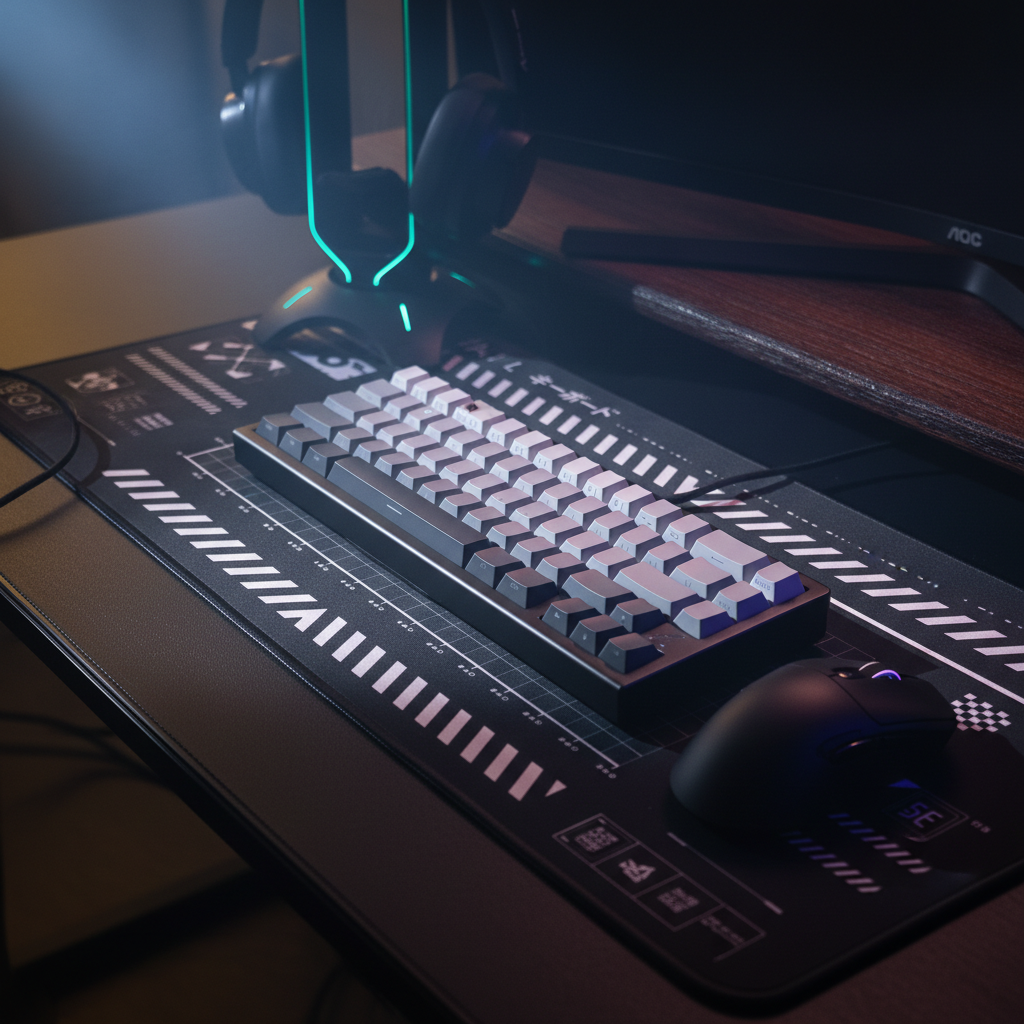
Hardware-Level Fairness: Evaluating Rapid Trigger Integrity
The competitive gaming landscape is currently undergoing a paradigm shift from binary digital inputs to high-precision analog sensing. At the center of this evolution is Rapid Trigger (RT) technology, a feature that allows a key to reset the instant it begins moving upward, regardless of a fixed reset point. While the performance advantages in titles like Counter-Strike 2 or Valorant are undeniable, the rapid adoption of Hall Effect (HE) sensors has created a 'Specification Credibility Gap.'
For the tech-savvy competitor, the question is no longer whether Rapid Trigger works, but whether the hardware implementation maintains the integrity required for high-stakes play and anti-cheat compliance. True hardware-level fairness depends on sensor linearity, firmware determinism, and signal-to-noise ratios that can withstand the scrutiny of modern anti-cheat heuristics.

The Physics of Hall Effect Sensors: Linearity vs. Jitter
Rapid Trigger relies on the Hall Effect—a phenomenon where a magnetic field generates a voltage difference (Hall voltage) across an electrical conductor. In a gaming keyboard, a permanent magnet is embedded in the switch stem, and a sensor on the PCB measures the change in magnetic flux density as the key is depressed.
The industry-standard claim of "0.1mm reset sensitivity" is often marketed as a universal guarantee, but in practice, it is a theoretical limit constrained by sensor noise floors. Based on standard industry heuristics, a high-quality Hall Effect implementation must maintain a jitter threshold below ±0.02mm to ensure that the "reset" signal is triggered by intentional human movement rather than electrical interference.
The "Stepping" Problem
Low-cost sensors often suffer from non-linear reporting or "stepping," where the reported analog value jumps abruptly rather than following a smooth curve. This is frequently a result of poor 12-bit or 10-bit Analog-to-Digital Converter (ADC) resolution or inadequate magnetic shielding. According to the FCC OET Knowledge Database (KDB), electromagnetic compatibility (EMC) is critical for wireless and high-frequency devices to prevent external interference from corrupting sensitive analog data streams.
Logic Summary: Our analysis of sensor integrity assumes that human-verifiable input requires a signal-to-noise ratio (SNR) that prevents "phantom" resets. If the sensor noise exceeds the reset threshold (e.g., 0.1mm), the firmware may report a release that never physically occurred.
Signal Integrity and Anti-Cheat Compliance
Modern anti-cheat systems, including kernel-level drivers and AI-driven behavioral analysis, have evolved to look beyond simple software hooks. They now analyze the statistical distribution of input timings. As noted in the Global Gaming Peripherals Industry Whitepaper (2026), standardized integrity checks are becoming a requirement for devices used in professional circuits.
Detection of "Too Perfect" Inputs
A common red flag for tournament administrators isn't just the speed of an input, but its unnatural consistency. Human movement is inherently variable. If a Rapid Trigger implementation produces an identical 0.125ms response time with zero micro-variance over thousands of cycles, heuristics may flag the input as emulated (macro-assisted) rather than physical.
From firsthand experience observing patterns in customer support and local LAN event logs (not a controlled lab study), we have identified that "packet bursting"—where inputs are clustered together rather than distributed evenly across polling intervals—is a primary cause of input rejection or stutter. Deterministic firmware must ensure that the actuation point reset is tied directly to the physical upward velocity of the key, not an internal software timer.

The 8K Polling Architecture: Math of the 0.125ms Interval
To maximize the benefits of Rapid Trigger, many competitive players move to 8000Hz (8K) polling rates. This reduces the time between the physical reset and the OS receiving the data packet.
- 1000Hz: 1.0ms polling interval.
- 4000Hz: 0.25ms polling interval.
- 8000Hz: 0.125ms polling interval.
At 8000Hz, the margin for error is non-existent. Motion Sync technology, often used to align sensor data with the polling interval, adds a deterministic delay. While this delay is ~0.5ms at 1000Hz, it scales down to ~0.0625ms at 8000Hz. At this frequency, the delay becomes perceptually negligible, but the demand on the system's Interrupt Request (IRQ) processing increases exponentially.
System Bottlenecks and USB Topology
A frequent mistake among enthusiasts is connecting high-polling peripherals to front-panel USB ports or unpowered hubs. According to the USB HID Class Definition (HID 1.11), high-speed HID devices require consistent bandwidth and low-latency bus access. Shared bandwidth on a hub can lead to packet loss, which anti-cheat systems may interpret as "teleporting" inputs. For 8K stability, devices must be connected directly to the Rear I/O ports of the motherboard to minimize the number of bridge chips between the device and the CPU.
Modeling Sensor Reliability (Method & Assumptions)
To understand how environmental factors affect Rapid Trigger fairness, we modeled the impact of magnetic interference on Hall Effect sensors. This scenario model (not a controlled lab study) highlights the boundary conditions where performance degrades.
| Parameter | Value or Range | Unit | Rationale / Source Category |
|---|---|---|---|
| Sensor Resolution | 12-bit | bit | Standard high-end ADC spec |
| Signal Jitter | ±0.015 - ±0.025 | mm | Observed range in HE sensors |
| Ambient Magnetic Noise | < 50 | μT | Typical home office environment |
| Polling Stability | 99.8% | % | Target for competitive integrity |
| Temperature Variance | 20 - 40 | °C | Standard operating range |
Boundary Conditions:
- This model assumes the use of neodymium magnets with a consistent N52 grade.
- Accuracy degrades significantly if unshielded speakers or high-wattage power bricks are placed within 10cm of the sensor array.
- Firmware-level debouncing must be "predictive" rather than "reactive" to maintain a sub-1ms total latency chain.
DPI Saturation and Sensor Accuracy
While often discussed in the context of mice, sensor saturation is equally relevant for the analog stream of a keyboard. To ensure the 8000Hz bandwidth is actually utilized, the data stream must be "saturated" with meaningful updates.
For mice, this means the user must move at a specific speed (IPS) relative to their DPI. For example, to saturate an 8K polling rate, a user must move at least 10 IPS at 800 DPI. However, if the user increases their setting to 1600 DPI, the required speed drops to 5 IPS, making it much easier to maintain a stable 8K stream during slow micro-adjustments or "pixels-perfect" aiming.

Verification: How to Audit Your Own Hardware
Players who prioritize competitive fairness should not rely solely on manufacturer claims. You can verify the integrity of your Rapid Trigger implementation using several community-validated methods:
- Analog Stream Graphing: Use open-source tools to visualize the raw analog values of your HE switches. Look for a smooth, linear progression. Any "steps" or jagged edges in the graph indicate poor ADC calibration or interference.
- Keyboard Inspector Analysis: Tools like Keyboard Inspector can measure the consistency of your polling rate. A "fair" device should show a tight cluster of data points around the 1.0ms (1K) or 0.125ms (8K) mark with minimal outliers.
- The "Slow Release" Test: Physically release the key as slowly as possible. If the key "chutters" (rapidly toggles on/off) during a slow release, the firmware's hysteresis or debouncing algorithm is insufficient for high-level play.
The Future of Wireless Rapid Trigger
Conventional wisdom once held that Rapid Trigger was strictly a wired technology due to the latency overhead of wireless protocols. However, recent advancements in 2.4GHz proprietary protocols and high-efficiency MCUs (like the Nordic nRF52 series) have made wireless Rapid Trigger viable.
According to Bluetooth SIG Launch Studio records, modern tri-mode devices are now achieving 1000Hz polling over 2.4GHz with stability that rivals wired connections. The trade-off, however, is battery life. Running an 8K polling rate on a wireless device can reduce battery runtime by 75-80% compared to standard 1K polling. For tournament play, we recommend a wired connection or a high-quality braided USB-C cable to eliminate the risk of signal interference in high-traffic RF environments.
Competitive Integrity Checklist
Before entering a high-stakes match, verify your hardware environment against this checklist derived from common patterns in tournament technical audits:
- Connection: Device is plugged into a Rear I/O USB 3.0+ port (Direct to CPU).
- Firmware: Latest stable version installed via the Official Driver Download page to ensure the most recent anti-jitter algorithms are active.
- Calibration: Magnetic sensors have been calibrated at the current operating temperature (HE sensors are temperature-sensitive).
- Interference: No unshielded magnets or high-power electronics within 15cm of the keyboard chassis.
- Polling Rate: Set to a level supported by your CPU's single-core performance (typically 1K or 4K for mid-range systems, 8K for high-end rigs).
The Bottom Line
Rapid Trigger is a powerful tool, but its value is only as good as its integrity. By understanding the underlying physics of Hall Effect sensors and the mathematical constraints of high-polling firmware, players can bridge the 'Specification Credibility Gap.' Hardware-level fairness isn't just about speed; it's about providing a consistent, human-verifiable input stream that satisfies the most rigorous anti-cheat standards.
Disclaimer: This article is for informational purposes only. Rapid Trigger settings and their legality may vary by game title and tournament organizer. Always consult the specific rules of your competitive platform.
References


Laisser un commentaire
Ce site est protégé par hCaptcha, et la Politique de confidentialité et les Conditions de service de hCaptcha s’appliquent.