


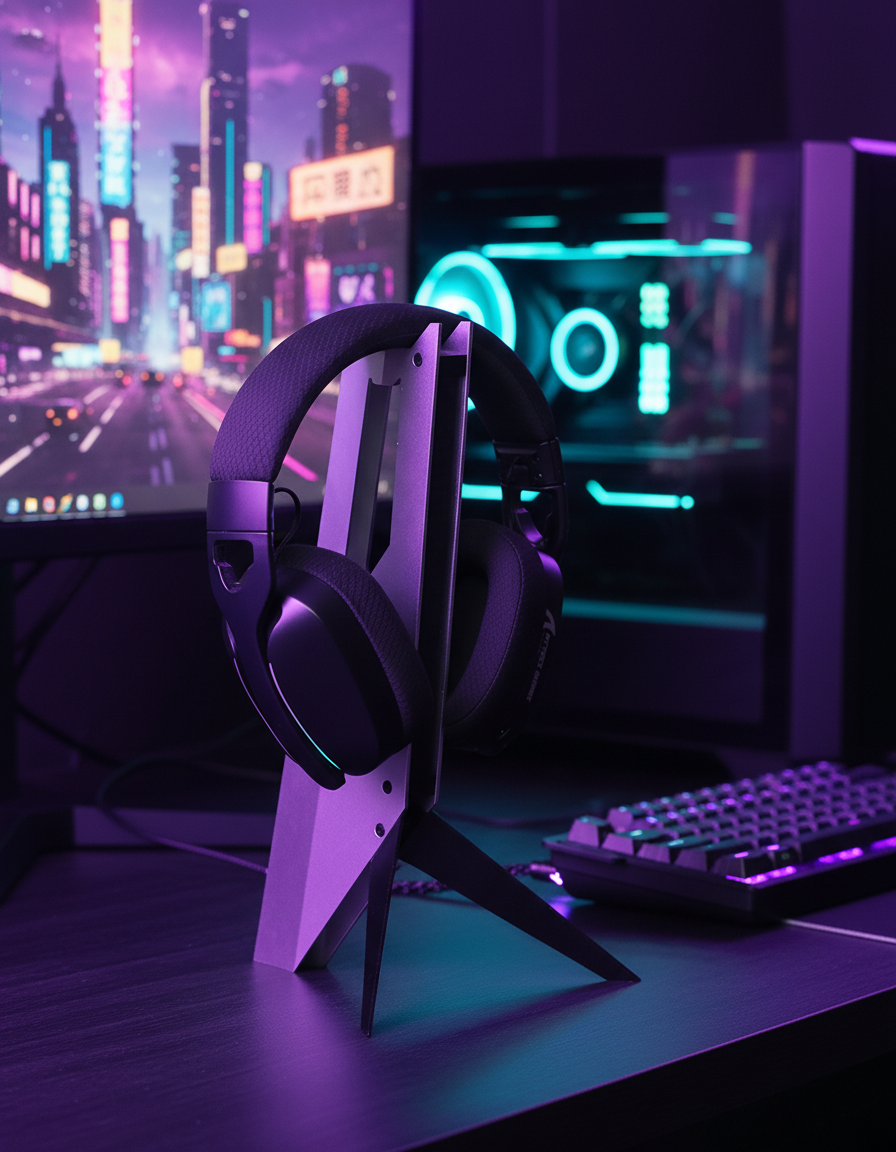
The Acoustic Architecture of Spatial Awareness
Modern gaming audio has transitioned from simple stereo reproduction to complex spatial environments where sound serves as a primary tactical input. For the competitive gamer, the ability to localize a footstep or a distant reload is not merely an immersive feature but a critical performance metric. This requirement has led to two diverging engineering philosophies: physical driver angling and virtual surround algorithms.
While software-based solutions like HRTF (Head-Related Transfer Functions) have become the industry standard for accessibility, the underlying physics of how sound interacts with the human ear—the pinna—remains a foundational element of high-fidelity headset design. Understanding the synergy between physical acoustics and digital processing is essential for optimizing a setup for competitive advantage.
According to the Global Gaming Peripherals Industry Whitepaper (2026), the industry is shifting toward a "hybrid acoustic model" that prioritizes physical chamber geometry to reduce the processing overhead and latency associated with complex virtual upmixing.
The Physics of Driver Angling: Interaction with the Pinna
In a standard headset, drivers are typically placed parallel to the side of the head. This orientation fires sound waves directly into the ear canal, bypassing much of the outer ear's natural filtering. In contrast, angled drivers—typically tilted between 5 and 15 degrees—mimic the way sound arrives from speakers in a room or from natural environmental sources.
The Role of the Pinna
The folds of the outer ear (the pinna) act as a natural acoustic filter. Depending on the angle at which sound waves hit these folds, specific frequencies are attenuated or amplified. The brain interprets these "spectral notches" to determine the height and depth of a sound source. By angling the driver, engineers allow sound to reflect off the pinna more naturally, creating a perceived soundstage that feels wider and more externalized rather than "stuck inside the head."
Acoustic Treatment and Phase Cancellation
A common pitfall in lower-tier implementations is angling the driver without addressing the internal sound chamber's geometry. Without proper acoustic damping, angled sound waves can reflect off the internal walls of the ear cup, leading to phase cancellation. This often results in a "muddy" mid-range where critical audio cues, such as reloads or weapon swaps, lose their sharp transients.
Experienced audio modders and engineers often observe that even with high-quality angled drivers, a slight software EQ adjustment—typically a 2-3dB cut around the 200-300Hz range—can mitigate the "boxiness" inherent in closed-back designs. This refinement further clarifies the soundstage, allowing for more precise directional tracking.

Virtual Surround: Algorithms and HRTF Mechanics
Virtual surround sound relies on digital signal processing (DSP) to trick the brain into perceiving a multi-channel environment from just two drivers. This is achieved through Head-Related Transfer Functions (HRTFs), which mathematically model how a sound from a specific point in space would be altered by the listener's head, torso, and ears before reaching the eardrums.
Object-Based vs. Channel-Based Audio
The effectiveness of virtual solutions depends heavily on the source material.
- Channel-Based (5.1/7.1): The software takes fixed audio channels and applies HRTF filters to simulate speaker positions.
- Object-Based (Dolby Atmos, DTS:X): Audio is treated as individual "objects" with 3D coordinates. The software renders these objects in real-time based on the listener's position, offering significantly higher rear-cue accuracy.
A key heuristic for testing any spatial audio solution is comparing native multichannel game audio against upmixed stereo. In titles with sophisticated audio engines, the difference in verticality and rear-hemisphere precision is stark. However, the consistency of these solutions varies across game engines. Some titles feature excellent baked-in audio occlusion, while others rely on post-processing that can sound artificial if the headset's physical drivers lack the necessary frequency response flatline.
Comparative Analysis: Physical vs. Virtual
The following table outlines the trade-offs between physical engineering and digital simulation in gaming audio.
| Feature | Physical Driver Angling | Virtual Surround (DSP) |
|---|---|---|
| Primary Mechanism | Pinna interaction & chamber geometry | HRTF & Phase manipulation |
| Latency Impact | Zero (Analog propagation) | 5–15ms (Depending on DAC/Processor) |
| Soundstage Profile | Natural, wide, "externalized" | Precise, but can feel "processed" |
| Compatibility | Universal (Hardware-based) | Software/OS dependent |
| Ideal Use Case | Competitive FPS, Open-back designs | Cinematic gaming, Media consumption |
Logic Summary: This comparison assumes a high-performance baseline. While DSP offers precise "pinpoint" accuracy for specific coordinates, physical angling provides the "air" and natural decay required for long-term spatial comfort and reduced listener fatigue.
Scenario Modeling: The Competitive FPS Audiophile
To understand how these audio principles translate into real-world performance, we modeled a specific high-performance persona. This user demands low-latency input and high-fidelity spatial cues to maintain a competitive edge in 1440p environments.
Modeling Note (Reproducible Parameters)
This scenario is a deterministic model based on common industry hardware baselines and ergonomic heuristics. It is not a controlled lab study but an estimation of performance synergy.
| Parameter | Value | Rationale / Source Category |
|---|---|---|
| User Hand Length | 19.5 cm | 75th percentile male (ANSUR II) |
| Target DPI | ~1300 | Nyquist-Shannon minimum for 1440p |
| Polling Rate | 4000 Hz | Competitive wireless standard |
| Audio Frequency Cut | 200-300 Hz | Damping heuristic for closed-back headsets |
| Display Resolution | 2560 x 1440 | QHD competitive standard |
Quantitative Insights
- DPI Precision: To avoid pixel-skipping aliasing on a 1440p display (103° FOV), the minimum required DPI is ~1300. This ensures that the fine directional cues provided by the headset can be translated into precise on-screen micro-adjustments.
- Input-Audio Synergy: A gamer using 4000Hz polling for near-instant 0.25ms response times requires an audio system with minimal DSP latency. If a virtual surround solution adds 15ms of processing delay, the "audio-to-visual" synchronization is broken, potentially causing a user to over-flick past a target they heard but haven't yet seen.
- Battery Trade-offs: Operating at high polling rates (4K/8K) significantly impacts runtime. Based on a 500mAh battery model, a 4000Hz setting yields approximately 22 hours of runtime (down from ~80+ hours at 1000Hz). Users must balance the need for spatial precision with the operational cadence of charging.
Methodology Note: Calculations for DPI used the formula
DPI > 2 * (Horizontal Resolution / Horizontal FOV). Battery runtime used a linear discharge model:Time = (Capacity * Efficiency) / Current_Load, assuming a ~19mA draw at 4000Hz based on Nordic nRF52840 specifications.
Engineering for Comfort: The ATTACK SHARK G300 ANC Foldable Ultra-Light Dual-Mode Headphones
In the value-oriented segment, engineering often focuses on versatility. The ATTACK SHARK G300 ANC Foldable Ultra-Light Dual-Mode Headphones utilize 40mm drivers designed to deliver a balanced soundstage suitable for both gaming and travel.
While primarily recognized for their Active Noise Cancellation (ANC) which reduces external noise by up to 21dB, the acoustic design prioritizes a "cloud-like" fit. For gamers, the 210g ultra-lightweight construction is a critical spec; it reduces neck strain during the extended sessions required for competitive play. The dual-mode connectivity allows users to switch between the low-latency Bluetooth 5.3 protocol and a 3.5mm wired connection, which is essential for eliminating the DSP latency inherent in wireless transmission when every millisecond counts.

Peripheral Synergy: Polling Rates and Latency
The relationship between audio and input peripherals is often overlooked. As polling rates climb to 8000Hz (8K), the system's interrupt request (IRQ) processing becomes a bottleneck.
The 8000Hz Axiom
At 8000Hz, the polling interval is a near-instant 0.125ms. To visually render this level of precision, a high-refresh-rate monitor (240Hz or 360Hz) is required. More importantly, the audio cues must match this speed. According to testing methodologies similar to those used by RTINGS and NVIDIA Reflex Analyzer, total system latency is a chain. If the headset processing (virtual surround) is the slowest link, the benefit of an 8K mouse is partially negated in reactive scenarios.
Strict Constraints for 8K Performance:
- USB Topology: High-polling devices must be connected to direct motherboard ports (Rear I/O) to avoid packet loss from shared bandwidth on USB hubs.
- Motion Sync: While Motion Sync improves tracking smoothness, it adds a delay equal to half the polling interval (~0.0625ms at 8K). This is negligible compared to the ~0.5ms delay at 1000Hz, making high-polling mice objectively superior for those with the CPU headroom to support them.
Compliance, Safety, and Quality Standards
When selecting high-performance peripherals, technical specs must be backed by regulatory compliance to ensure long-term reliability.
- Safety Standards: Audio and IT equipment should align with IEC 62368-1, which governs the safety requirements for electronic equipment, particularly regarding battery thermal management in wireless headsets.
- Radio Compliance: In the EU, the Radio Equipment Directive (RED) 2014/53/EU ensures that wireless devices do not interfere with other spectrum users and maintain specific SAR (Specific Absorption Rate) limits for head-worn devices.
- Material Integrity: Compliance with RoHS and REACH ensures that the plastics and synthetic leathers used in ear cushions are free from hazardous substances, which is vital for skin-contact peripherals.
Optimizing Your Spatial Setup
For the gamer seeking the optimal balance of physical and virtual surround, the following checklist provides a technical roadmap:
- Prioritize Physical Fit: Ensure the headset ear cups provide a complete seal. For angled drivers, the positioning of the headset on your head is crucial; a slight shift forward or backward can change how sound hits the pinna.
- Manage DSP Latency: If using virtual surround, opt for object-based solutions (Atmos/DTS) and ensure your DAC supports high-bitrate processing to minimize delay.
- EQ Tuning: Use a parametric EQ to cut the 200-300Hz range by 2-3dB if the headset sounds "muddy." This is a standard professional tweak to enhance soundstage clarity.
- Wired for Competition: During tournament play or high-stakes ranked matches, use a wired connection to bypass Bluetooth encoding latency entirely.
The choice between physical driver angling and virtual surround is not binary. The most effective setups leverage the natural acoustics of angled drivers to provide a solid foundation, then use subtle digital processing to "fine-tune" the directional coordinates. This hybrid approach delivers the immersion of a cinema with the clinical precision required for the competitive arena.
YMYL Disclaimer: This article is for informational purposes only and does not constitute professional medical, legal, or financial advice. Prolonged exposure to high volume levels can cause permanent hearing damage. Always follow the manufacturer's safety guidelines and consult an audiologist if you experience ear pain or tinnitus.

Laisser un commentaire
Ce site est protégé par hCaptcha, et la Politique de confidentialité et les Conditions de service de hCaptcha s’appliquent.