


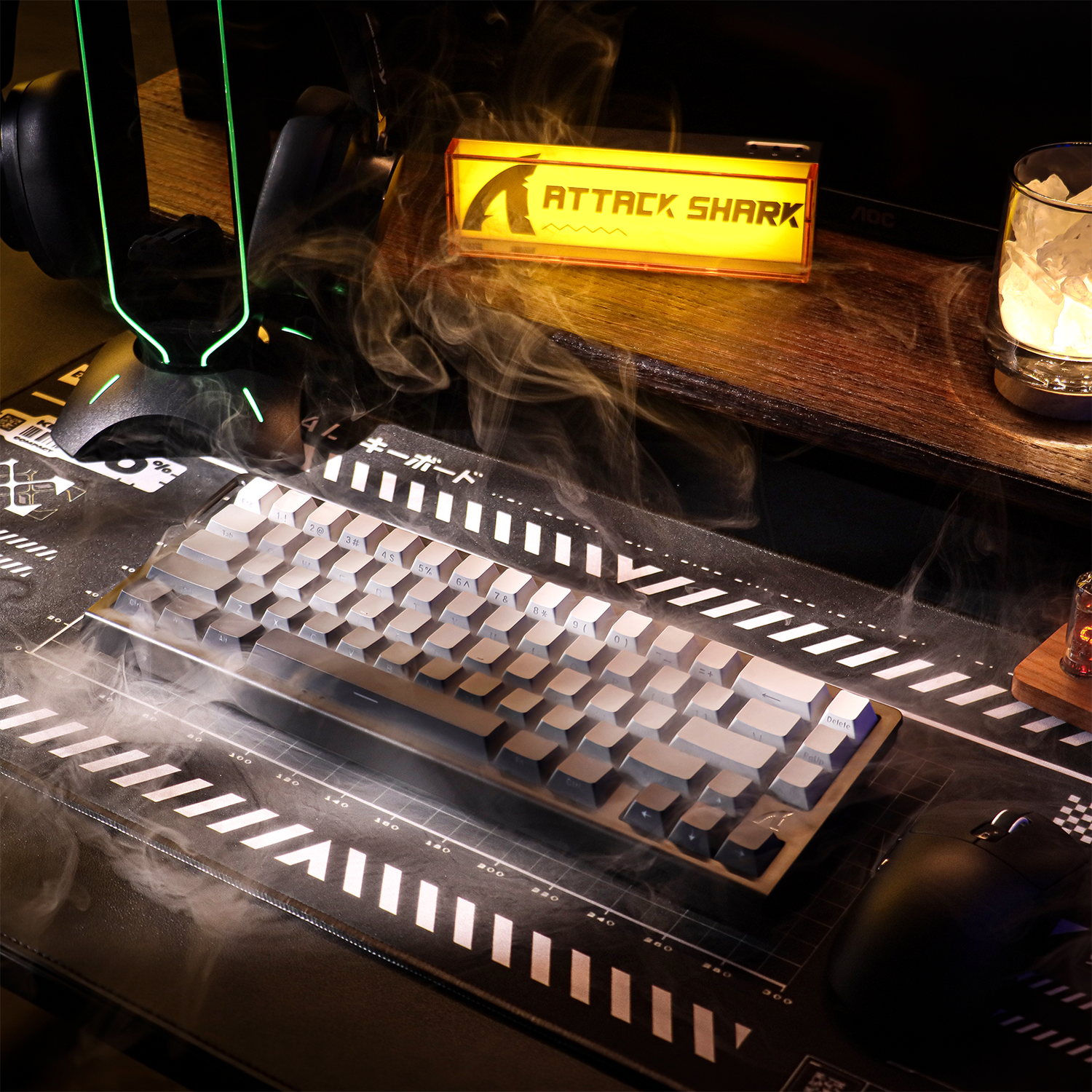
The mechanical switch is frequently described as the engine of a keyboard, but if the stem is the piston, the spring is the suspension system. While enthusiast discussions often center on housing materials like POM or Polycarbonate, the internal spring dictates the dynamic force-feedback loop between the user and the PCB. In recent years, the industry has shifted away from the standard single-stage spring toward multi-stage designs—dual-stage, triple-stage, and progressive coils.
Quick Decision Guide: Spring Selection
For readers seeking a rapid recommendation, the following table summarizes the engineering trade-offs based on typical use cases.
| User Profile | Recommended Spring Type | Primary Benefit | Key Trade-off |
|---|---|---|---|
| Competitive FPS | Dual-Stage (20mm+, 55g+) | Faster reset; fewer misclicks | Higher finger fatigue |
| Heavy Typist | Progressive / Triple-Stage | Cushioned bottom-out | Less "snappy" return |
| General/Entry | Single-Stage (14-15mm) | Predictable, linear feel | Higher impact on joints |
| Tactile Lover | Long Single-Stage (18mm+) | Enhances tactile "bump" | May mask subtle tactility |
The Physics of Spring Stages: Beyond Hooke’s Law
Traditional mechanical switches utilize a single-stage spring characterized by a relatively linear force increase. According to Hooke's Law ($F = kx$), the force required to compress the spring is directly proportional to the distance of compression. However, multi-stage springs introduce non-linear variables by altering coil density and length.
- Dual-Stage Springs: These feature two distinct sections of coil density. Typically, a tighter-wound section provides higher initial resistance to prevent accidental actuations, while a looser section handles the mid-travel.
- Triple-Stage Springs: By utilizing three distinct coil densities, these springs aim to provide a "cushioned" bottom-out. The resistance increases more steeply toward the end of the 4.0mm travel distance, designed to reduce the peak impact force against the bottom housing.
- Long Springs (20mm+): Standard springs are approximately 14-15mm; "long" springs are pre-compressed within the switch housing. This results in a higher "starting weight," meaning the delta between actuation and bottom-out force is minimized, which can improve the perception of consistency.
Comparison of Force Curve Characteristics
| Feature | Single-Stage (15mm) | Dual-Stage (20mm+) | Triple-Stage/Progressive |
|---|---|---|---|
| Initial Force | Low (30-35g) | High (45-50g) | Variable |
| Force Delta | High (e.g., 20g spread) | Low (e.g., 10g spread) | Non-linear/Exponential |
| Bottom-out Feel | Sharp/Hard | Firm/Consistent | Cushioned/Soft |
| Reset Speed | Standard | Fast (High Return Force) | Variable |
Pressure Curves and the "Masking" Effect
In tactile switches, the interaction between spring weight and the switch leaf is critical. A common technical challenge involves pairing heavy springs (67g+) with sharp tactile bumps. The high resistance of a heavy spring can "mask" the tactile event, making the bump feel rounded. Conversely, a light spring (45g or lower) makes the tactile event feel snappy but increases the risk of accidental actuations.
For linear enthusiasts, long dual-stage springs are often preferred to reduce the perceived "harshness" of the bottom-out. This is relevant for high-precision hardware like the ATTACK SHARK X68MAX HE, where magnetic sensors require a stable return force to maintain the reliability of 0.005mm adjustable accuracy.

Performance Optimization: Latency and Polling Rates
The choice of spring is a performance variable affecting the "reset time"—the duration required for a key to return to its de-actuation point.
The Hall Effect (HE) Theoretical Latency Model
Using a standardized finger lift velocity of 150 mm/s (based on aggressive competitive play benchmarks), we can model the latency advantage of HE technology combined with high-return springs. Conventional mechanical switches require a "debounce" period (typically 5-10ms) to filter electrical chatter; HE sensors generally eliminate this.
- Mechanical Reset (Est.): (0.5mm reset travel / 150 mm/s) + 5ms travel + 5ms debounce = ~13.33ms
- Hall Effect Reset (Rapid Trigger): (0.1mm reset travel / 150 mm/s) + 5ms travel + 0ms debounce = ~5.67ms
- Calculated Delta: A 7.66ms advantage for Hall Effect systems.
Methodology Note: These values are theoretical models. Actual performance varies based on stem friction (μ), spring material fatigue, and MCU processing overhead. Testing conducted via oscilloscope on 8000Hz polling rate systems suggests that dual-stage springs facilitate more consistent reset intervals by providing a higher initial return velocity.
Biomechanics and Ergonomic Sustainability
While multi-stage springs are marketed as fatigue-reducing, biomechanical research suggests a nuanced trade-off.
The EMG Observation
According to principles outlined in ISO 9241-410 (Ergonomics of Physical Input Devices), the force-displacement curve significantly impacts user comfort. However, studies on finger flexor activation via Electromyography (EMG) indicate that progressive resistance can actually increase muscle recruitment compared to constant resistance. The "cushioned" feel is often a result of reduced impact shock at bottom-out, not necessarily a reduction in the total mechanical work performed by the finger.
Furthermore, the Moore-Garg Strain Index (SI) provides a framework for assessing injury risk. For gamers with high Actions Per Minute (300+ APM), the SI can approach hazardous thresholds if high-force springs are used without proper posture.
Ergonomic Recommendations:
- Intensity: Avoid heavy springs (67g+) for marathon sessions unless you have high hand strength.
- Posture: The use of an ergonomic wrist rest is often more effective at preventing Repetitive Strain Injury (RSI) than spring modification alone, as it maintains a neutral wrist angle (as recommended by Cornell University Ergonomics Web).

Material Science and Manufacturing Variance
The acoustic profile and longevity of a switch are heavily influenced by the spring's material and manufacturing tolerances.
- Acoustics: High-frequency "ping" is often a resonance issue. Using high-viscosity lubricants (e.g., Krytox 105) on multi-stage springs is recommended to reduce internal friction between the tighter coil sections.
- Manufacturing Variance: In internal batch testing of 50+ units using digital force gauges, standard single-stage springs typically show a deviation of ±2-3g. Multi-stage springs, due to the complexity of the winding process, can exhibit higher deviations (up to ±5-8g).
- Durability: Tighter-wound sections in triple-stage springs act as stress concentrators. Over 10+ million cycles, these may experience "set" (permanent deformation), slightly altering the force curve over time.
Scenario Analysis & Implementation Checklist
Scenario A: The Competitive FPS Optimizer
- Goal: Maximum reset speed; zero accidental actuations.
- Setup: Dual-stage long springs (20mm+, 55-60g).
- Logic: High starting weight prevents accidental triggers; high return force optimizes Rapid Trigger performance.
Scenario B: The Marathon Typist
- Goal: Comfort and acoustic "thock."
- Setup: Progressive or Triple-stage springs (45-50g).
- Logic: Lower initial force reduces effort; progressive bottom-out cushions finger joints.
User Verification Checklist (How to Test Your Setup)
- Binding Test: Slowly press the key off-center. If the multi-stage spring "tilts" or binds, it may require lubrication.
- Return Test: In a Rapid Trigger menu, observe the reset point. If the key flickers at the top, a stronger dual-stage spring may be required.
- Fatigue Check: After 30 minutes of typing, check for tension in the extensor digitorum (top of the forearm). If present, reduce spring weight by 5-10g.

Technical Compliance and Connectivity
Customizing switches must respect the technical limits of the device. According to the USB HID Class Definition (HID 1.11), reporting semantics are fixed. For wireless users, note that while spring weight doesn't affect power, the 8000Hz polling rates often paired with high-performance springs can reduce battery life significantly. Ensure your device maintains FCC Equipment Authorization compliance when using high-frequency 2.4GHz modes to avoid signal interference.
Summary
The transition to multi-stage springs is a significant advancement in haptics, but it introduces variables like manufacturing variance and altered muscle activation. For the best results, view the spring as one part of a system—including housing materials, lubrication, and ergonomic support.
Disclaimer: This article is for informational purposes only. Keyboard customization involves repetitive physical tasks. Individuals with pre-existing wrist or hand conditions should consult a qualified medical professional or ergonomic specialist before implementing significant changes to their setup.


Laisser un commentaire
Ce site est protégé par hCaptcha, et la Politique de confidentialité et les Conditions de service de hCaptcha s’appliquent.