


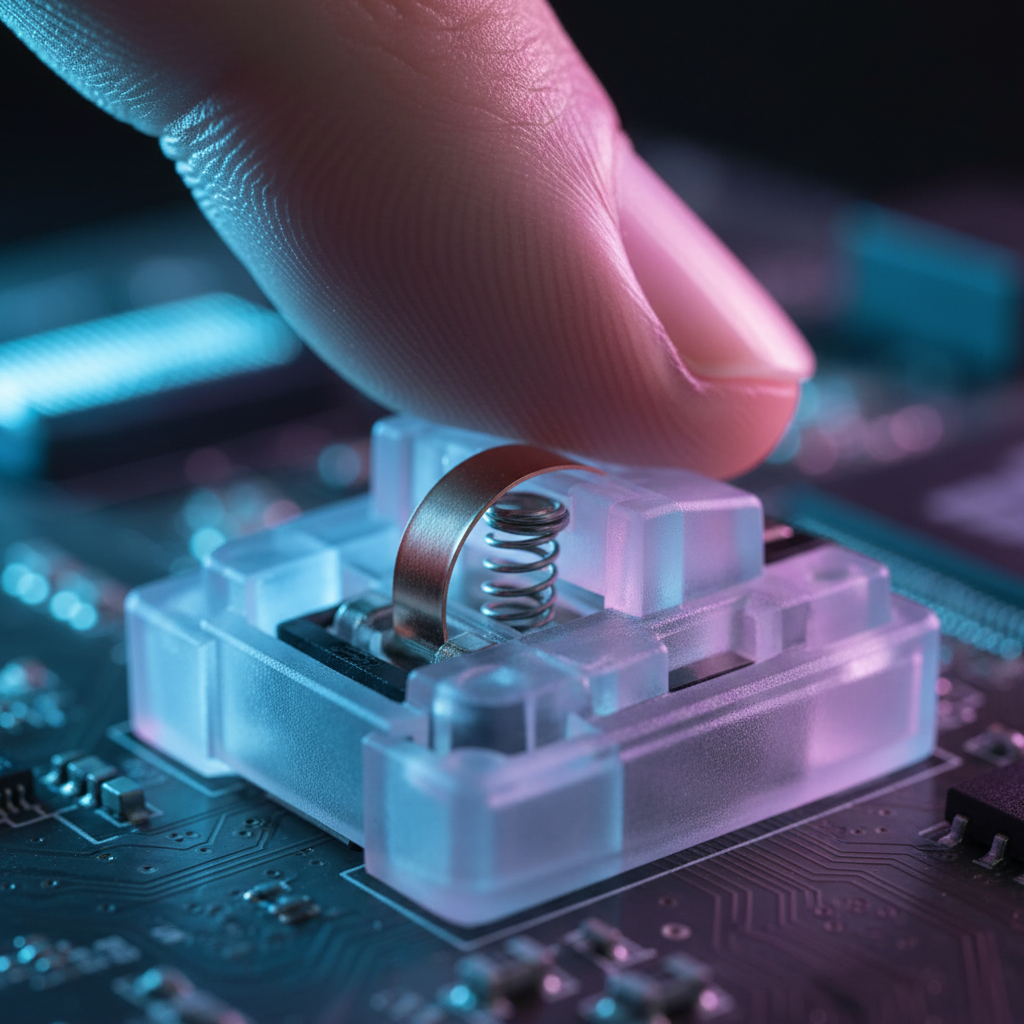
The Physiological Cost of Competitive Clicking: A Technical Analysis of Switch Weight
Executive Summary: For high-performance gamers, mouse switch actuation force is a major factor in biomechanical endurance. Model-based analysis suggests that using relatively heavy switches (around 80g and above) during high-frequency clicking (roughly 6+ CPS) can push cumulative strain into ranges that would be flagged as concerning in some industrial risk-assessment tools. To balance performance and fatigue, it is generally safer to treat recommended switch weights as model-based ranges, tuned to game genre—typically around or under 65g for MOBAs and roughly 70g–80g for tactical shooters, assuming average hand size and grip. This guide analyzes the biomechanical work required per click and provides a framework for matching hardware to hand physiology.
Quick Decision Table: Model-Based Switch Weight Ranges
| Game Genre | Clicks Per Second (CPS) | Model-Based Weight Range* | Primary Consideration |
|---|---|---|---|
| MOBA / RTS | High (5–10+) | ~50g – 65g | Reduce cumulative flexor fatigue at high CPS |
| Tactical FPS | Low to Moderate (1–3) | ~70g – 80g | Reduce accidental misclicks while keeping control |
| General Gaming | Varied | ~60g – 70g | Balance tactile feedback and endurance |
Important: These ranges are heuristic, model-based suggestions, not medical thresholds. Individual comfort can vary with hand size, grip style, and training.
The Biomechanics of the Click: Why Actuation Force Impacts Endurance
In competitive gaming, the mechanical interface between the player and the hardware often defines the boundary of sustainable performance. For players in high-action-per-minute (APM) genres, the actuation force of a switch—measured in grams (g) or Newtons (N)—is a significant factor in finger fatigue and long-term musculoskeletal comfort.
Data from the Global Gaming Peripherals Industry Whitepaper (2026) (Industry whitepaper, manufacturer-affiliated; methodology and sampling are industry-reported) suggests that as gaming sessions extend beyond two hours, the cumulative physical load on the finger flexor muscles (flexor digitorum superficialis) can increase non-linearly. Evaluating switch weight benefits from a framework grounded in biomechanical modeling rather than anecdotal preference alone.
The Physics of the Click: Work and Energy Expenditure
The energy required for a single actuation can be described by the work formula ($W = F \cdot d$), where $F$ is force and $d$ is the travel distance. According to Mark-10 force measurement material (Industry technical study; manufacturer measurement data), evaluating a switch solely by its peak force is incomplete; one must consider the entire force-distance curve.
A switch with a lower peak force but a long pre-travel distance may require more total mechanical work than a slightly heavier switch with a "hair-trigger" actuation point. For endurance, the goal is to minimize the integral of the force-distance curve—the total area under the curve—to reduce the muscular cost of each cycle.
Heuristic Note: Muscular fatigue is often more closely related to total work ($F \cdot d$ over time) than to peak force alone. This idea is consistent with occupational biomechanics, where repetitive tasks are commonly evaluated by cumulative load.

Modeling the Strain: The Moore-Garg Index in Gaming
To qualitatively benchmark fatigue risk, we can reference the Moore-Garg Strain Index (SI), a tool from industrial ergonomics used to evaluate the risk of distal upper extremity disorders in repetitive tasks.
Scope Note: The Strain Index was developed for industrial jobs (e.g., manual assembly). Applying it to gaming is a conceptual, model-based analogy, not a validated clinical or regulatory method for gamers.
The standard SI formula is:
$$SI = IM \times DE \times EM \times HW \times SW \times DD$$
Where the multipliers are:
- IM (Intensity of Exertion): Subjective intensity of the force required (scaled from very light to near-maximal effort for that muscle group).
- DE (Duration of Exertion): Proportion of the task cycle during which force is applied (e.g., how much of each second the finger is actually pressing).
- EM (Efforts per Minute): Number of exertions per minute (e.g., clicks per minute).
- HW (Hand/Wrist Posture): Quality of the hand/wrist posture (neutral vs. deviated or cramped).
- SW (Speed of Work): Overall work pace (slow, moderate, fast).
- DD (Duration per Day): Total task exposure time per day.
Scenario Modeling: The High-CPS Specialist (Illustrative)
In a modeled scenario of a MOBA specialist (maintaining roughly 6–8 clicks per second), the biomechanical load can reach levels that would be classified as "high" or "hazardous" in some industrial contexts if we plug the gaming parameters into the SI formula.
Illustrative Calculation (Modeled Scenario, Not a Clinical Metric):
For a player using an ~80g switch at 6–8 CPS for several hours, one possible way to assign multipliers—based on the original Moore-Garg scaling tables and typical gaming assumptions—might be:
- Intensity of Exertion (IM): ~2.0 (80g switch, perceived as moderate effort for small finger flexor muscles; heuristic mapping, not lab-measured)
- Duration of Exertion (DE): ~1.5 (finger actively pressing for an estimated 30–50% of the click cycle at high CPS)
- Efforts Per Minute (EM): ~4.0 (Moore-Garg scales saturate once efforts exceed a certain threshold; high-CPS gaming can fall in this upper band)
- Hand/Wrist Posture (HW): ~2.0 (aggressive claw grip with some deviation from neutral wrist; assumption for a compact mouse and large hand)
- Speed of Work (SW): ~2.0 (rapid work pace typical of sustained MOBA team fights)
- Duration Per Day (DD): ~1.5 (several hours of play, e.g., 4–8 hours with breaks)
Using these illustrative values, the product of multipliers falls in a high range (on the order of tens). This is not intended as an exact or validated SI score for gamers but as a way to show that high-CPS play with relatively heavy switches can, in modeling, resemble high-strain industrial tasks.
For context, Moore & Garg (1995) (peer-reviewed occupational ergonomics study) report that an SI > 5 is associated with an increased risk of strain in industrial settings. Because gaming involves different postures, rest patterns, and muscle recruitment, this threshold should not be treated as a medical cutoff for players, only as a qualitative reference point.
Model-Based Effect of Reducing Switch Weight
If we hold other factors constant (CPS, posture, daily duration) and reduce switch weight in the model, the main change is a reduction in the intensity of exertion (IM) multiplier. For example, moving from ~80g to ~60g might move IM down by one scale step in the Moore-Garg mapping, which in turn reduces the product of all multipliers.
Modeling Heuristic: In the type of scenario above, decreasing switch weight by roughly 20g (e.g., from ~80g to ~60g) can plausibly reduce the modeled SI product by on the order of 20–30%, assuming posture, speed, and daily duration do not worsen. This is a model-based estimate, not a controlled experimental result.
For players, this kind of reduction can be the difference between maintaining peak performance and experiencing noticeable fatigue or "click lag"—the subjective feeling that muscles struggle to reset quickly enough between actions.
Genre-Specific Requirements: Matching Weight to Frequency
The optimal switch weight is not universal; it depends strongly on the "click frequency" of the game and the player’s biomechanics.
- High-Frequency Genres (MOBA, RTS): For games requiring sustained rates of over about 5 CPS, many players find that switches under roughly 70g feel more sustainable. Lower resistance allows for rapid oscillation without driving the modeled fatigue score as high. In simple models, fatigue risk increases sharply when actuation force climbs above about 0.6–0.7 N (≈60–70g) at high CPS, especially with non-neutral posture.
- Low-Frequency/High-Precision Genres (Tactical FPS): In tactical shooters, where the penalty for an accidental discharge is high, a somewhat heavier switch (around 70g–80g) can be preferable. The added resistance provides a tactile "buffer" against accidental actuations during fine crosshair adjustments.
Individual Variation: These genre-based ranges are rules of thumb derived from mechanical modeling and common patterns in player feedback, not from randomized trials. Players with stronger grip or different habits may prefer outside these ranges.
The Role of Rebound and Reset
The "snappiness" of the switch reset is as important for endurance as the actuation force. A switch with a fast, clean rebound allows the finger to relax sooner between clicks. Conversely, a sluggish or "mushy" reset can force the user to exert more effort or overtravel to ensure the switch has fully returned, increasing both cognitive and physical load.
Ergonomic Synergy: How Mouse Geometry Exacerbates Fatigue
Switch weight does not operate in isolation; its effect is influenced by mouse shell ergonomics.
The Grip Fit Ratio
Using principles broadly related to the ISO 9241-410 standard (International ergonomics standard; used here conceptually for sizing, not as a mandated formula), we can talk about a "Grip Fit Ratio"—how well the mouse length matches a user’s hand.
For a user with large hands (~21.5cm), a standard 120mm mouse yields a length fit ratio of about 0.56 (mouse length / hand length), which is shorter than many ergonomic rules of thumb for claw grip.
- Heuristic Formula (Rule of Thumb): Ideal Mouse Length (Claw) $\approx$ Hand Length $\times 0.64$.
- Example: For a 21.5cm hand, this heuristic gives an ideal length of about 13.8cm. A 12.0cm mouse would be roughly 13% shorter than this heuristic target.
- Risk Mechanism (Modeled): This length deficit tends to promote increased flexion at the finger joints and more static tension in the intrinsic hand muscles. When combined with a heavier (e.g., ~80g) switch, it can create compounded risk factors for fatigue: muscles must both maintain a cramped posture and repeatedly overcome higher actuation forces.
These relationships are based on general ergonomic principles and modeling assumptions rather than personalized measurements for every reader.
Neuromuscular Adaptation vs. Long-Term Strain
The human body is capable of neuromuscular adaptation. A player transitioning from a lighter (~50g) switch to a heavier (~70g) switch will often experience increased muscle activity initially. Over several weeks, motor learning and conditioning can reduce the perceived exertion.
However, adaptation has limits. If the force consistently exceeds the user’s comfortable range—shaped by factors such as typing habits, training history, and hand strength—the risk shifts from simple, reversible fatigue toward more problematic strain.
For aggressive clickers who frequently "bottom out," an overly light switch can also be counterproductive, as kinetic energy is transferred into the joints and soft tissues rather than being dissipated by switch resistance. In modeling terms, there is a "Goldilocks" zone of switch weight and travel: heavy enough to mitigate bottom-out shock, but light enough to maintain target CPS without excessive cumulative work.
Strategic Checklist for Endurance Optimization
To help apply the concepts in this article, you can use the following checklist as a self-assessment tool:
- [ ] Audit Your CPS: If your primary game requires sustained rates above roughly 5 CPS, consider testing switches in the approximate 55g–65g range to see whether your finger fatigue improves over multi-hour sessions.
- [ ] Check Your Fit: Estimate your ideal mouse length using Hand Length × 0.64 (for claw grip) as a rough heuristic. If your mouse length differs by more than about 10–15%, you may be holding a more cramped or overstretched posture, which can amplify the effect of heavier switches.
- [ ] Monitor the 90-Minute Mark: In modeling and practical observation, many players first notice endurance issues after about 60–90 minutes of continuous high-intensity play. If your accuracy or click speed drops noticeably around this point, your current combination of switch weight, geometry, and posture may be exceeding your sustainable threshold.
- [ ] Prioritize Consistency: A moderately heavier switch with a consistent, crisp actuation and reset can be less fatiguing over time than a nominally lighter switch that has developed inconsistent or "mushy" behavior.
How to Self-Test (Practical Steps):
- Measure your hand length (wrist crease to tip of middle finger) and compare your mouse length to the Hand Length × 0.64 heuristic.
- Use a CPS tester in your main game or a browser tool to estimate your sustained CPS over 30–60 seconds.
- Note your perceived effort (e.g., 0–10 scale) at the start of a session and after 60–90 minutes.
- If possible, test a lighter and a heavier switch (or different mouse) for a week each, keeping session length similar, and track which setup leaves your hand feeling less fatigued. Treat this as personal calibration, not a medical test.
Appendix: Modeling Methodology & Source Notes
Moore-Garg Strain Index Parameters (Modeled Scenario)
The high SI-range example for a "High-CPS Specialist" session is a representative, model-based calculation, constructed by mapping typical gaming values to the published Moore-Garg scales. It is intended as a decision aid and conceptual benchmark, not as a medical diagnostic or an authoritative risk rating for individual players.
- Intensity of Exertion (≈2.0): Heuristic mapping of ~80g actuation force to a "moderate" subjective intensity level for small finger flexors, based on Moore-Garg description ranges, not direct EMG data.
- Efforts per Minute (≈4.0): High-CPS play (e.g., 6–8 CPS) falls in the upper band of the Moore-Garg effort-frequency scale; assigned as a high category, not a precise measurement.
- Duration per Day (≈1.5): Represents several hours of play (e.g., 4+ hours including breaks), mapped to a mid-range daily exposure category.
Source Types & Attribution:
- Mark-10 Force Measurement: (Industry technical study / manufacturer data) Keyswitch actuation force measurement methods and sample curves.
- Global Gaming Peripherals Whitepaper (2026): (Industry whitepaper, manufacturer-affiliated) Reported performance standards and endurance trends; may reflect commercial perspectives and internal datasets.
- Moore, J. S., & Garg, A. (1995): (Peer-reviewed academic research) The Strain Index: A Proposed Method to Analyze Jobs for Risk of Distal Upper Extremity Disorders. Published in the American Industrial Hygiene Association Journal.
- ISO 9241-410:2008: (International standard) Ergonomics of human-system interaction – Device design and input interface guidelines. Applied here as conceptual background for fit and posture, not as a prescriptive formula for gamers.
Disclaimer: This article is for informational and educational purposes only and does not constitute professional medical, diagnostic, or treatment advice. The models and numerical examples are heuristic and illustrative. If you experience persistent pain, numbness, weakness, or tingling in your hands or wrists, consult a qualified healthcare professional or ergonomic specialist for personalized assessment.


Laisser un commentaire
Ce site est protégé par hCaptcha, et la Politique de confidentialité et les Conditions de service de hCaptcha s’appliquent.