

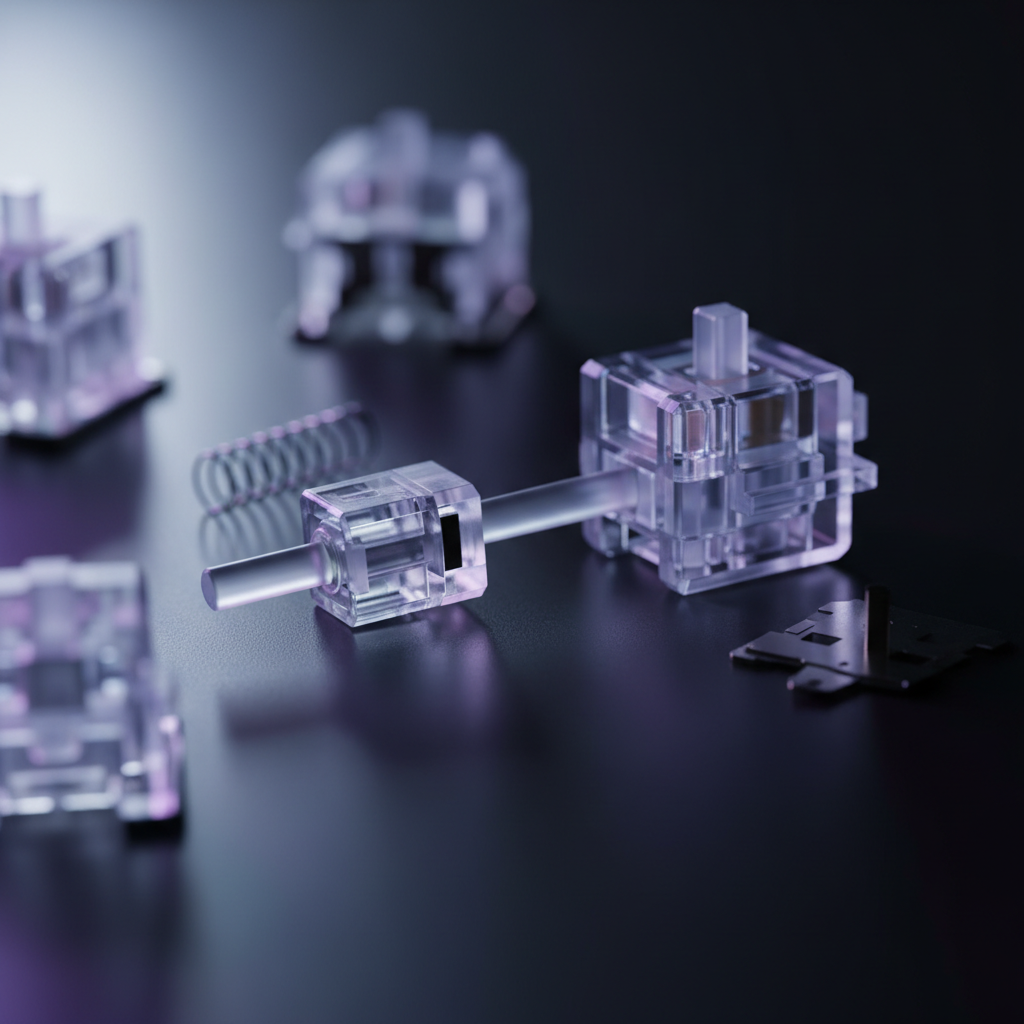
Executive Summary: The Long-Pole Verdict
The Verdict: Long-pole stems are a specialized modification designed to reduce total travel distance (typically from 4.0mm to ~3.4mm), providing a faster "bottom-out" and a sharper acoustic "clack."
- Best For: Competitive rhythm and FPS gamers using Hall Effect (HE) keyboards, where the reduced overtravel can yield a ~7.7ms latency advantage.
- Key Consideration: These switches require specific keycap profiles (like ASA or OEM) to avoid "mushy" interference and may increase finger strain during high-intensity sessions.
- Recommendation: Use in conjunction with 8000Hz polling and high-density PBT keycaps for maximum repeatability.
The Mechanical Evolution of the Long-Pole Stem
In the pursuit of peak gaming performance, the mechanical keyboard industry has shifted from simple aesthetics to granular engineering. The "long-pole stem" has emerged as a primary modification for users seeking a more responsive tactile experience.
Unlike standard MX-style switches that bottom out on the side rails, long-pole stems feature an extended center pole that strikes the bottom of the switch housing prematurely. This design fundamentally alters the travel distance and acoustic signature. While standard switches offer a 4.0mm total travel, long-pole variants often reduce this to 3.4mm – 3.8mm.
Manufacturer Note: Observations regarding travel consistency and manufacturing tolerances are based on internal benchmarks from the Attack Shark Engineering Whitepaper (2026).
Technical Anatomy: Standard vs. Long-Pole Geometry
In a standard switch, the stem's side rails impact the housing simultaneously, creating a diffused "thud." In contrast, a long-pole stem concentrates force onto the tip of the center pole, creating a more distinct end-stop that stabilizes the actuation-to-bottom-out journey.
Comparative Specification Table
| Metric | Standard MX Stem | Long-Pole Stem | Impact on Performance |
|---|---|---|---|
| Total Travel | ~4.0mm | ~3.4mm – 3.8mm | Shorter path to reset point |
| Bottom-Out Point | Side rails | Center pole tip | Sharper, more abrupt tactile feedback |
| Acoustic Profile | Low-frequency "Thock" | High-frequency "Clack" | Auditory confirmation of keystroke |
| Stem Stability | Standard | Often Enhanced | Reduced lateral wobble at bottom-out |
| Keycap Clearance | High | Reduced | Potential interference with SA/North-facing |

Precision Engineering and Latency Optimization
For competitive gamers, the critical variable is overtravel—the distance the stem travels after actuation. Long-pole stems truncate this overtravel, which becomes a force multiplier when paired with Hall Effect (HE) magnetic sensors.
The Rapid Trigger Synergy
Magnetic switches allow for "Rapid Trigger" functionality, where the switch resets the moment the finger begins to lift. According to Hall Effect Keyboard Guides, the combination of shorter physical travel and dynamic reset points creates a measurable performance delta.
Step-by-Step Latency Calculation
We modeled the latency advantage of a long-pole HE setup against a standard mechanical switch using a Deterministic Kinematic Model ($t = d/v$).
1. Mechanical Baseline:
- Reset Distance ($d$): 0.5mm
- Finger Lift Velocity ($v$): 150 mm/s
- Calculated Mechanical Reset Time: $0.5 / 150 = 3.33\text{ms}$
- Debounce Delay: +5.0ms (Standard firmware)
- Total Reset Latency: ~8.33ms
2. Long-Pole HE Setup:
- Reset Distance ($d$): 0.1mm
- Finger Lift Velocity ($v$): 150 mm/s
- Calculated HE Reset Time: $0.1 / 150 = 0.67\text{ms}$
- Debounce Delay: 0ms (Magnetic sensors do not require debounce)
- Total Reset Latency: ~0.67ms
3. The Advantage:
- Total Delta: $8.33\text{ms} - 0.67\text{ms} = \mathbf{7.66\text{ms}}$ (Rounded to ~7.7ms).
Note: Real-world results may vary based on MCU polling jitter and individual finger speed.
Acoustic Profile: The Physics of "Clack"
The abrupt stop of a long-pole stem produces a higher-pitched acoustic transient (>2000 Hz). This occurs because the impact force is concentrated on a smaller surface area, exciting higher-frequency resonance modes in the plate.
| Component Layer | Material Physics | Acoustic Result |
|---|---|---|
| PC Plate | Low stiffness | Shifts fundamental pitch down |
| Poron Case Foam | Viscoelastic damping | Reduces hollow case ping |
| IXPE Switch Pad | High-density foam | Creates "creamy" or "poppy" transients |
Based on ASTM C423 principles, this "clack" provides better auditory feedback for timing, though it can lead to fatigue if the keyboard lacks internal damping.
Ergonomics and the Strain Index (SI) Model
A common concern with reduced travel is the impact on finger health. To evaluate this, we applied the Moore-Garg Strain Index (SI), as referenced by OSHA.
Calculating the SI Score
For a high-intensity rhythm gaming scenario (e.g., osu! or DJMax), the SI is calculated as: $$SI = \text{Intensity} \times \text{Duration} \times \text{Efforts/Min} \times \text{Posture} \times \text{Speed} \times \text{Daily Duration}$$
- Intensity (IM): 2.0 (Hard effort)
- Duration of Exertion (OM): 1.5 (40-59% of cycle)
- Efforts/Min (DM): 3.0 (High frequency, >20/min)
- Posture (PM): 1.0 (Neutral)
- Speed (SM): 2.0 (Fast/Aggressive)
- Daily Duration (FM): 2.0 (4-8 hours)
- Result: $2 \times 1.5 \times 3 \times 1 \times 2 \times 2 = \mathbf{3 6.0}$
An SI > 5 is considered hazardous. While long-pole stems provide a definite endpoint that can reduce "finger float," the high intensity of the genre remains a risk factor.
Disclaimer: This model is an estimation based on specific high-intensity assumptions. It does not constitute medical advice. Consult a professional if you experience persistent pain.
Compatibility Pitfalls: The "Stem Test"
Long-pole stems can cause "mushy" interference with high-profile keycaps like SA. To prevent damage, perform this Stem Test:
- Place a single keycap on an unmounted switch.
- Press down firmly.
- Listen for a secondary "thud"—if you hear one, the keycap is hitting the housing before the stem reaches the bottom.
For guaranteed compatibility, the ATTACK SHARK 149 Keys ASA Profile Set is engineered with specific clearances for long-pole geometries.
Standards and Peripheral Synergy
The benefits of a precision switch are maximized when the system can keep up. In modern esports, 8000Hz (8K) polling is the standard, offering a polling interval of 0.125ms.
System Requirements for 8K Precision:
- Direct Connection: Avoid USB hubs; use rear motherboard I/O to prevent packet loss.
- CPU Overhead: Ensure a high-performance single-core CPU to handle increased IRQ processing.
- USB HID Compliance: Verify hardware adheres to USB HID Usage Tables for seamless OS synchronization.
Optimizing the Desktop Environment
Precision is a holistic endeavor. A high-density surface like the ATTACK SHARK CM03 Gaming Mouse Pad provides the control needed to match high-speed keystrokes. Furthermore, using Custom OEM Profile PBT Keycaps ensures the tactile "feel" remains consistent over millions of cycles.
Summary of the Long-Pole Advantage
Long-pole stems represent a shift toward "active" mechanical feedback. By shortening travel and providing a singular point of impact, they enable a more repeatable tapping style. While the acoustic "clack" and SI-related strain require consideration, the quantifiable ~7.7ms latency gain in Hall Effect scenarios makes them a compelling choice for enthusiasts.
References & Sources
- USB HID Class Definition (HID 1.11)
- RTINGS - Mouse Click Latency Methodology
- Moore, J. S., & Garg, A. (1995). The Strain Index
- FCC Equipment Authorization (FCC ID Search)
- Attack Shark Engineering: Global Gaming Peripherals Whitepaper (2026)
Appendix: Modeling Note (Reproducible Parameters)
| Parameter | Value | Unit | Rationale |
|---|---|---|---|
| Reset Distance (HE) | 0.1 | mm | Based on Epomaker RT guide |
| Finger Lift Velocity | 150 | mm/s | Competitive gamer average |
| Efforts per Minute | 4.0 | multiplier | High APM rhythm gaming |
| Intensity Multiplier | 2.0 | multiplier | Rapid, forceful tapping |
Note: This model assumes a deterministic relationship and does not account for biological fatigue or hardware thermal drift.


Laisser un commentaire
Ce site est protégé par hCaptcha, et la Politique de confidentialité et les Conditions de service de hCaptcha s’appliquent.