



Le décalage entre les dimensions marketing et la réalité cinétique
Sur le marché des périphériques de jeu compétitifs, les spécifications techniques servent de principal lien entre un produit et les attentes du consommateur. Cependant, un point de friction persiste : les joueurs achètent souvent une souris en se basant sur les spécifications de largeur indiquées, pour découvrir que la sensation « en main » est totalement différente de ce que les chiffres laissaient entendre. Ce décalage entraîne souvent un taux de retour élevé et une fatigue localisée, en particulier chez les utilisateurs soucieux de performance qui privilégient la précision des micro-ajustements.
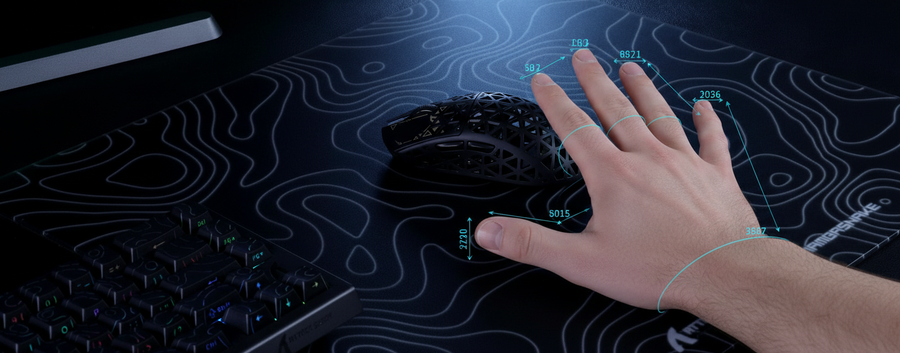
Le cœur du problème réside dans la distinction entre la « Largeur maximale de la coque » (le chiffre généralement indiqué sur une fiche marketing) et la « Largeur effective de la prise » (la distance réelle entre le pouce et les doigts annulaire/auriculaire pendant le jeu actif). Alors qu'un fabricant peut indiquer une souris de 65 mm de large, cette mesure capture souvent la partie la plus large de l'évasement arrière ou des boutons latéraux saillants. Pour un joueur compétitif, la seule dimension qui dicte le contrôle est la largeur aux points de contact spécifiques — une mesure qui peut varier de 5 à 8 mm par rapport à la spécification officielle.
Cadres anthropométriques : aller au-delà de la longueur et de la largeur
Pour comprendre pourquoi les mesures standard échouent, il faut examiner les normes anthropométriques utilisées dans la conception professionnelle de matériel. Selon la norme ISO 9241-410:2008 pour les dispositifs d'entrée physiques, la conception ergonomique doit prendre en compte la posture dynamique de la main plutôt que ses seules dimensions statiques.
La plupart des supports marketing classent les tailles de main en « Petite », « Moyenne » et « Grande » selon la longueur linéaire. Cependant, les données de ANSUR II (Enquête anthropométrique du personnel de l'armée américaine) suggèrent que la largeur de la main et le tour des doigts sont tout aussi essentiels pour déterminer la stabilité de la prise. Une erreur courante est de mesurer la taille de la main dans un état détendu, paume ouverte. Cela a peu de rapport avec la forme dynamique et contractée d'une prise de jeu.
Observation d'expert : D'après les tendances observées dans le support technique et la gestion des retours, l'heuristique la plus fiable pour la taille est la méthode en « C ». Demandez à l'utilisateur de former un « C » lâche avec sa main, comme s'il tenait un verre, et mesurez la largeur interne au niveau des articulations de l'index et du pouce. Cette « Largeur active » correspond plus étroitement à la sélection optimale de la souris que la longueur totale de la main.
La géométrie de la désorientation : rétrécissement, évasement et revêtement
Trois variables mécaniques déforment fréquemment la largeur perçue d'une souris de jeu, rendant les spécifications marketing peu fiables :
- Rétrécissement vers l'intérieur : De nombreuses souris haute performance, conçues pour les prises au bout des doigts ou en griffe, présentent un rétrécissement important vers l'avant. Une souris indiquée à 60 mm peut en réalité mesurer 57 mm à la zone de prise principale. Pour les joueurs qui contactent la souris plus en avant, cette différence de 3 mm fait la différence entre un "verrouillage du petit doigt" stable et une fatigue chronique des doigts.
- Le facteur d'évasement : Les souris ergonomiques droitières ont souvent un large "évasement" à l'arrière pour soutenir la paume. Bien que cela augmente la "largeur maximale" indiquée, cela n'a aucun effet sur la largeur de prise. Si la zone de prise est étroite mais que l'évasement est large, la souris peut sembler "petite" malgré ses grandes dimensions.
- Dynamiques de surface : Le coefficient de friction du revêtement (mat vs. brillant) modifie la "largeur de prise effective". Une finition brillante par temps humide peut obliger l'utilisateur à serrer la coque plus fort pour garder le contrôle. Cela réduit effectivement la largeur utilisable et augmente l'indice de contrainte Moore-Garg — une mesure utilisée pour évaluer le risque de troubles musculosquelettiques lors de tâches à haute répétition.
Modélisation de l'ajustement : une étude de cas pour les joueurs à grandes mains utilisant une prise en griffe
Pour démontrer l'impact de ces variables, nous avons modélisé un persona utilisateur spécifique : un joueur compétitif de FPS avec de grandes mains (20,0 cm de longueur, 95 mm de largeur) utilisant une prise en griffe agressive. Ce persona représente le 80e-90e percentile des tailles de mains masculines et fait face au risque le plus élevé de "traînée du petit doigt" ou de soutien insuffisant de la coque.
En utilisant un modèle anthropométrique déterministe basé sur le Livre blanc de l'industrie mondiale des périphériques de jeu (2026), nous avons évalué trois géométries de souris différentes par rapport à "l'ajustement idéal" de cet utilisateur (calculé à environ 128 mm de longueur et 57 mm de largeur).
| Caractéristique | Souris A (moyenne typique) | Souris B (grande effilée) | Souris C (courte/large) |
|---|---|---|---|
| Dimensions indiquées | 120 x 60 mm | 125 x 58 mm | 118 x 62 mm |
| Largeur de prise effective | 59 mm | 55 mm (en raison du rétrécissement) | 61 mm (à cause de l’évasement) |
| Ratio de longueur | 0,93 (8 mm court) | 0,98 (Presque idéal) | 0,92 (10 mm court) |
| Risque de tension (SI) | Modéré | Élevé (sensation de pincement) | Extrême (crampe en griffe) |
| Impact sur le suivi | Instabilité du petit doigt | Fatigue du pouce (~45 min) | Micro-ajustement réduit |
Résumé logique : Cette analyse suppose un coefficient de prise en griffe de 0,64 selon ISO 9241-410 et une règle de largeur à 60 % d’après les données ANSUR II. Les résultats montrent que même une souris « grande » comme la Souris B peut provoquer de la fatigue si la largeur effective descend en dessous du seuil de 57 mm à cause du rétrécissement de la coque.

Relier la stabilité de la prise à la performance 8K
Pour le joueur soucieux de performance, la largeur de prise ne concerne pas seulement le confort ; c’est un prérequis pour exploiter la technologie à taux de polling élevé. Lors de l’utilisation d’une souris avec un taux de polling de 8000Hz (8K), comme la ATTACK SHARK R11 ULTRA Carbon Fiber Wireless 8K PAW3950MAX Gaming Mouse, le système traite les données toutes les 0,125 ms.
À cette fréquence, toute instabilité dans la prise — causée par une coque trop étroite ou un rétrécissement qui force une posture de « pincement » — se traduit par des micro-tremblements que le capteur haute résolution détectera. Pour saturer efficacement la bande passante 8000Hz, l’utilisateur doit maintenir un contact constant. Par exemple, à 1600 DPI, un utilisateur n’a besoin que de se déplacer à 5 IPS (pouces par seconde) pour fournir suffisamment de données pour l’intervalle de polling 8K. Cependant, si la prise est instable, ces 5 pouces de mouvement seront « bruyants », annulant les bénéfices du temps de réponse quasi instantané de 0,125 ms.
De plus, un polling à 8K augmente considérablement la charge CPU via le traitement des IRQ (Interruptions). Une prise instable entraîne des micro-mouvements « correctifs » plus fréquents, ce qui sollicite davantage la performance monocœur du CPU. Assurer une « Largeur de Prise Efficace » optimale est donc une étape d’optimisation matérielle pour l’ensemble du système.
Sélection stratégique du matériel pour des besoins spécifiques de prise en main
Pour les joueurs cherchant à combler le fossé entre les spécifications marketing et la performance réelle, choisir une souris avec la bonne « Prise Efficace » est primordial.
Pour ceux qui ont besoin d'une plateforme stable et ergonomique qui accueille des mains plus grandes sans l'effet de « pincement » des formes agressives, la souris gaming tri-mode ultra-légère ATTACK SHARK V3PRO avec station de charge propose une forme sculptée pour droitiers. Son design minimise le ratio évasement/prise, garantissant que la largeur indiquée correspond davantage à ce que l'utilisateur ressent réellement.
Si la priorité est l'agilité brute et un poids équilibré, la souris gaming sans fil ergonomique ultra-légère ATTACK SHARK V8 Ultra-Light offre une coque mate profilée. Ce revêtement est particulièrement efficace pour maintenir une « largeur active » constante en cas d'humidité variable, évitant la réduction de la largeur effective observée avec des alternatives plus brillantes.
Pour accompagner ces souris haute performance, une surface avec une friction constante est nécessaire. Le tapis de souris gaming en verre trempé ATTACK SHARK CM05 présente une texture nano-micro-gravée. Cette surface réduit le « clic statique » (la force nécessaire pour initier un mouvement), qui est souvent là où une prise mal adaptée cause le plus d'erreurs.

Identifier et résoudre les « pièges » courants
Lors du passage à une nouvelle souris basée sur la largeur effective, les utilisateurs rencontrent souvent deux obstacles peu évidents :
- Le problème du « verrouillage du petit doigt » : Sur les souris symétriques trop étroites, les doigts annulaire et auriculaire se chevauchent souvent ou traînent sur le tapis de souris. Cela crée une friction que le capteur interprète comme du « bruit » de mouvement. Si vous rencontrez ce problème, vous avez probablement besoin d'une souris avec une « zone de prise effective » plus large, peu importe la largeur maximale indiquée pour la coque.
- Le goulot d'étranglement du taux de sondage CPU : Si vous passez à une souris 8K haute performance comme la ATTACK SHARK R11 ULTRA Carbon Fiber Wireless 8K PAW3950MAX Gaming Mouse, assurez-vous qu'elle est connectée à un port direct de la carte mère (I/O arrière). L'utilisation de hubs USB ou de connecteurs en façade peut provoquer une perte de paquets, ce qui donne l'impression d'un « décalage de prise en main » mais est en réalité un problème d'intégrité du signal.
Pour approfondir l'optimisation de votre configuration, consultez nos guides sur Choisir une souris ergonomique pour grandes mains : guide budget ou Optimiser la prise en griffe : trouver le point d'équilibre parfait.
Transparence de la modélisation : méthodes et hypothèses
Les évaluations quantitatives d'ajustement présentées dans cet article sont basées sur un modèle anthropométrique déterministe. Il s'agit d'un modèle de scénario, non d'une étude en laboratoire contrôlée, et il est destiné à des fins de sélection comparative.
| Paramètre | Valeur | Unité | Justification / Source |
|---|---|---|---|
| Longueur de la main (entrée) | 20.0 | cm | P85 Homme (ANSUR II / ISO 7250) |
| Largeur de la main (entrée) | 95.0 | mm | P85 Homme (ANSUR II) |
| Coefficient de prise (k) | 0.64 | rapport | Cartographie de la prise en griffe ISO 9241-410 |
| Règle de largeur idéale | 60% | rapport | Heuristique largeur anthropométrique/prise |
| Intervalle de sondage 8K | 0.125 | ms | Loi physique (1/8000Hz) |
| Latence de synchronisation du mouvement | 0.0625 | ms | Règle de demi-intervalle pour la fréquence 8K |
Limites du champ d'application : Ce modèle s'applique principalement aux proportions de la main masculine adulte. Les variations anatomiques individuelles (par exemple, les rapports de longueur des doigts, la flexibilité des articulations) et les préférences subjectives de confort peuvent entraîner des dimensions "idéales" différentes. Le calcul de l'indice de contrainte Moore-Garg (SI 48,0) suppose un jeu compétitif à haute intensité pendant plus de 2 heures par session.
Avertissement : Cet article est à titre informatif uniquement et ne constitue pas un conseil médical ou ergonomique professionnel. Si vous ressentez une douleur persistante, un engourdissement ou des picotements dans vos mains ou poignets, consultez un professionnel de santé qualifié.