


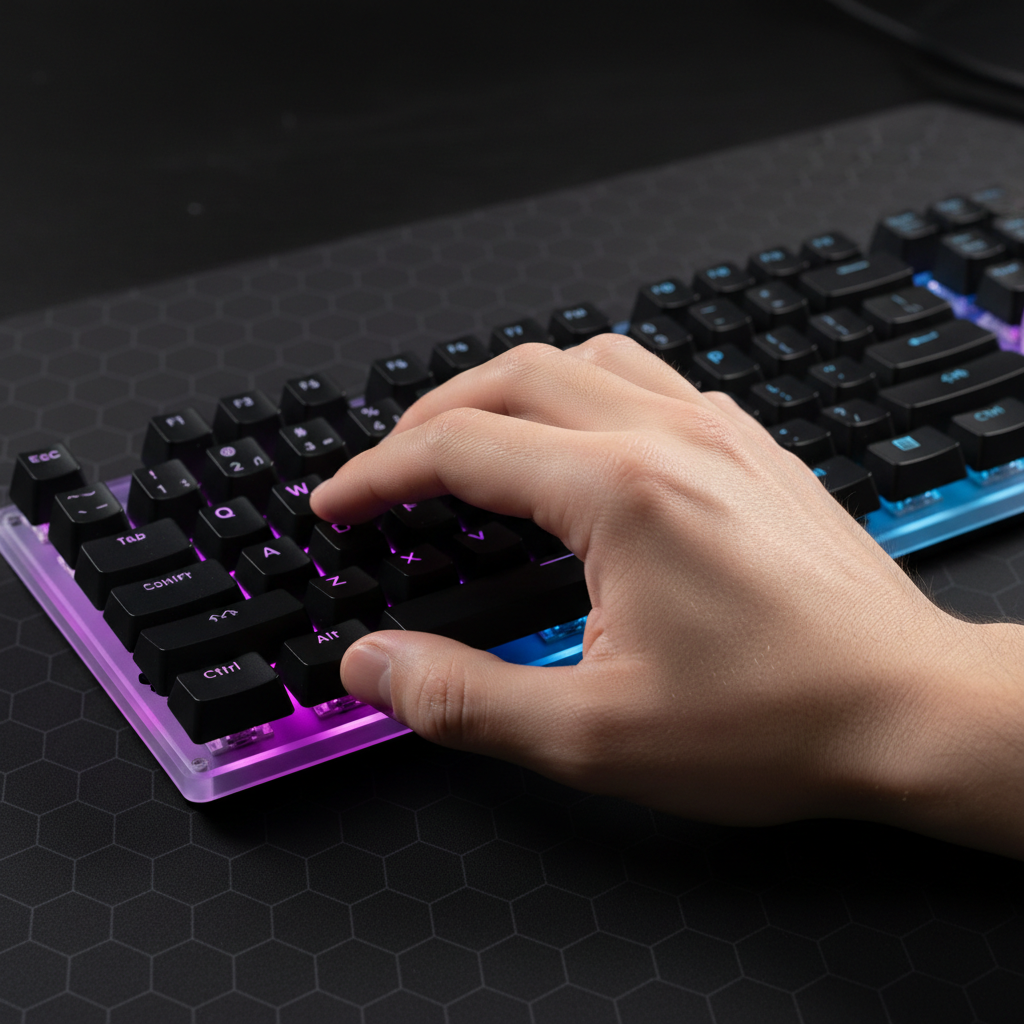
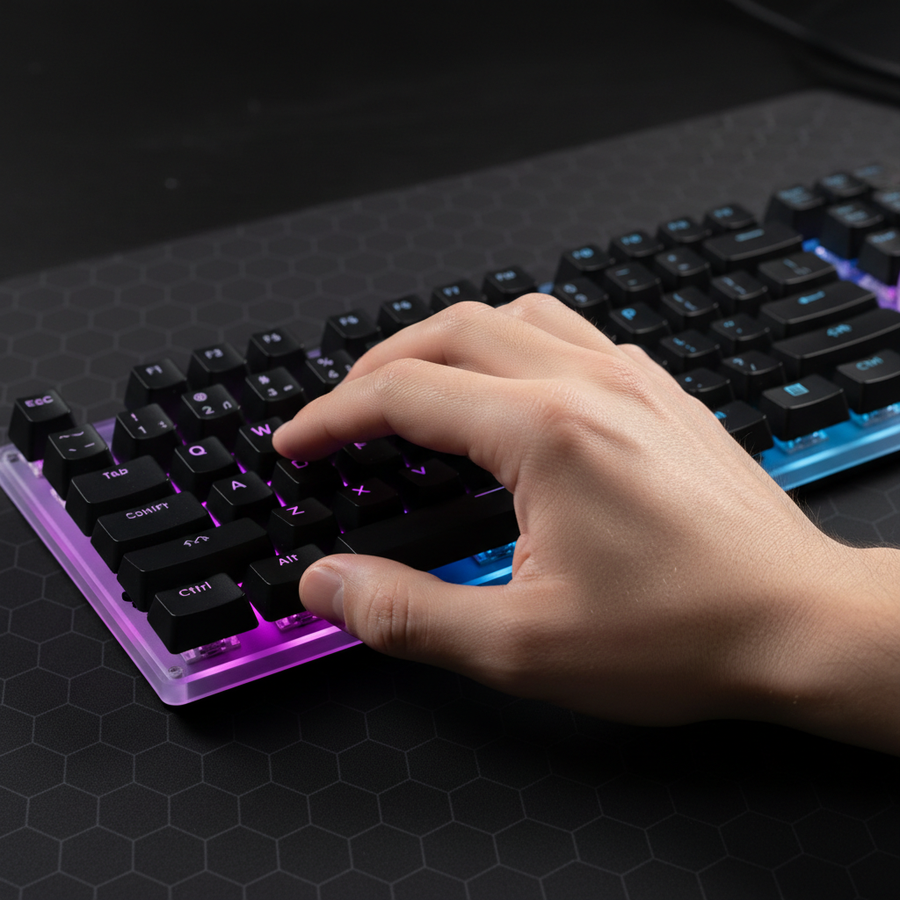
Diagnostiquer le ghosting des modificateurs : résoudre les échecs d'entrée multi-touches
Lorsqu'un raid MMO à enjeux élevés ou un combat d'équipe MOBA critique dépend d'une macro complexe, la dernière chose dont un joueur a besoin est une pression de touche « morte ». Dans le jeu compétitif, l'échec d'une séquence avec beaucoup de modificateurs — comme maintenir Shift et Ctrl tout en tapant rapidement 1, 2 ou 3 — est souvent attribué à un « lag » ou à un « clic raté ». Cependant, la réalité technique est souvent liée au ghosting du clavier ou aux limites de rollover.
Le ghosting se produit lorsque la matrice interne du clavier ne peut pas distinguer plusieurs pressions simultanées, ce qui fait disparaître ou « fantôme » certaines entrées. Bien que l'industrie soit largement passée à l'Anti-Ghosting et au N-Key Rollover (NKRO), ces fonctionnalités ne sont pas toujours absolues. Comprendre les mécanismes sous-jacents de la Définition de classe USB HID (HID 1.11) et comment le firmware moderne gère les accords complexes est essentiel pour tout joueur cherchant une configuration infaillible.
L'anatomie de l'échec d'entrée : Ghosting vs. Rollover
Pour résoudre les échecs d'entrée, il faut d'abord distinguer deux phénomènes souvent confondus : le ghosting et les limites de rollover.
- Ghosting : Il s'agit d'une limitation matérielle de la matrice du clavier. Les claviers sont câblés en grille de rangées et colonnes. Lorsque trois touches formant un angle droit dans la grille sont pressées, le contrôleur peut « voir » une quatrième touche à l'intersection qui n'est en réalité pas pressée. Les claviers de jeu modernes empêchent cela en ajoutant des diodes à chaque interrupteur, mais des matrices mal conçues peuvent encore souffrir de touches « bloquées » où le contrôleur ignore une pression valide pour éviter un ghost.
- Key Rollover (KRO) : Cela fait référence au nombre maximal de touches que le clavier peut enregistrer simultanément. Beaucoup de claviers économiques sont limités à un rollover de 6 touches (6KRO), ce qui signifie que la septième touche pressée ne sera pas détectée. Les modèles haute performance revendiquent souvent le N-Key Rollover (NKRO), permettant théoriquement d'appuyer sur toutes les touches en même temps.
Le mythe du « NKRO via USB »
Une idée reçue courante est que "NKRO" sur la boîte garantit une performance parfaite. En réalité, le protocole USB HID standard a été initialement conçu pour 6KRO (6 octets de données + modificateurs). Pour obtenir le NKRO via USB, les fabricants doivent utiliser le « Report Hacking », où le clavier s'identifie comme plusieurs appareils ou utilise des descripteurs personnalisés. Selon le Livre blanc mondial sur l'industrie des périphériques de jeu (2026), ces implémentations personnalisées peuvent parfois entrer en conflit avec certains réglages BIOS ou environnements OS anciens, nécessitant un basculement manuel (souvent une combinaison de touches Fn) pour activer le mode « True NKRO ».
Modéliser le Raider Compétitif : Ergonomie et Latence
Pour comprendre pourquoi ces défaillances surviennent, nous avons modélisé un scénario courant à haute intensité : un raider MMO compétitif aux grandes mains (~21,5 cm de longueur) effectuant des rotations rapides avec de nombreux modificateurs.
Note de modélisation : Méthode & hypothèses
Type de modélisation : Modélisation déterministe paramétrée de scénario. Contexte : Il s'agit d'un modèle de scénario basé sur des heuristiques industrielles standard, pas d'une étude clinique contrôlée.
| Paramètre | Valeur | Unité | Justification / Source | | :--- | :--- | :--- | :--- | | Longueur de la main | 21,5 | cm | 95e percentile masculin (ANSUR II) | | Taux de sondage | 4000 | Hz | Spécification de souris sans fil haute performance | | Vitesse des doigts | 150 | mm/s | Vitesse de levée en jeu compétitif | | Durée quotidienne | 4-6 | heures | Session de jeu « Hardcore » standard | | Intensité | Élevé | enum | Accords continus de modificateurs (MMO) |
Conditions limites : Les estimations supposent une vitesse constante des doigts et ignorent le jitter du MCU ou la flexibilité individuelle des articulations.
La contrainte de l'accord de modificateurs
Pour les joueurs aux grandes mains, la contrainte ergonomique d'atteindre Shift, Ctrl et Alt tout en maintenant le mouvement WASD est importante. En utilisant l'indice de contrainte Moore-Garg—un outil d'analyse des risques de troubles musculo-squelettiques distaux—nous avons évalué cette charge de travail de jeu.
| Variable | Multiplicateur | Justification |
|---|---|---|
| Intensité | 2 | Force élevée pour les maintiens prolongés de modificateurs |
| Efforts/Min | 4 | 40-60 actions par minute en rotation |
| Posture | 2 | Angles de poignet inconfortables pour les combinaisons de modificateurs |
| Vitesse | 2 | Pressions rapides successives sur les touches |
| Score SI | 64 | Catégorie de risque : Dangereux |
Un score SI de 64 (où >5 est généralement considéré comme un seuil de risque) souligne pourquoi la fatigue des mains n'est pas qu'un problème de confort—c'est un tueur de performance. Lorsque les muscles se fatiguent, le timing de vos accords de touches devient moins précis, pouvant tomber dans les « zones mortes » du taux de balayage de votre clavier.

Analyse technique approfondie : taux de sondage et décalage de balayage
La latence dans une configuration de jeu est cumulative. Si votre clavier a un taux de balayage interne lent, même la plus rapide ATTACK SHARK G3PRO Tri-mode Wireless Gaming Mouse with Charge Dock 25000 DPI Ultra Lightweight ne sauvera pas votre combo.
La réalité du 8000Hz (8K)
Les périphériques modernes tendent vers des taux de sondage de 8000Hz. Alors que 1000Hz offre un intervalle de 1,0 ms, 8000Hz le réduit à un quasi instantané 0.125ms intervalle. Cependant, cette performance s'accompagne d'exigences système strictes :
- Goulot d'étranglement du CPU : Le sondage à 8K sollicite le traitement des IRQ (Interruptions) de votre CPU. Cela nécessite une forte performance monocœur.
- Topologie USB : Les périphériques doivent être connectés aux Ports Directs de la Carte Mère (E/S arrière). L'utilisation de concentrateurs USB ou de connecteurs en façade provoque une congestion de la bande passante partagée et une perte de paquets, ce qui imite les symptômes du ghosting.
- Saturation du capteur : Pour exploiter pleinement une souris à 8000 Hz, la vitesse de déplacement et le DPI doivent être alignés. À 1600 DPI, il suffit de se déplacer à environ 5 IPS pour saturer la bande passante, tandis qu'à 800 DPI, il faut environ 10 IPS.
Effet Hall : la puissance anti-ghosting
Pour les joueurs ayant des difficultés avec les échecs de chording, les switches à effet Hall (magnétiques) offrent un avantage technique considérable. Contrairement aux switches mécaniques qui reposent sur un contact métallique physique (et nécessitent donc un délai de rebond d'environ 5 ms pour éviter le « chatter »), les capteurs à effet Hall utilisent des champs magnétiques pour détecter la position.
| Métrique | Mécanique (Standard) | Effet Hall (Rapid Trigger) |
|---|---|---|
| Distance de réinitialisation | ~0,5 mm | ~0,1 mm |
| Délai de rebond | 5 ms | 0 ms |
| Latence totale | ~13,3 ms | ~5,7 ms |
| Avantage | Référence | Réinitialisation ~7,6 ms plus rapide |
D'après notre modélisation, le delta de latence d'environ 8 ms offert par des claviers comme le ATTACK SHARK X68MAX HE Rapid Trigger CNC Aluminum Keyboard Magnetic Switch with C01Ultra RGB Coiled Cable peut faire la différence entre un modificateur enregistré ou ignoré lors de séquences à haute APM. Cela est particulièrement vrai lors de l'ajustement des points d'activation à des niveaux ultra-sensibles.
Stratégies de diagnostic : au-delà des testeurs statiques
La plupart des joueurs testent le ghosting avec des testeurs statiques en ligne. Bien qu'utiles pour détecter les touches mortes, ces outils ne simulent souvent pas la vitesse élevée et le chording en moins de 100 ms du jeu réel.
1. Le test d'accord dynamique
Au lieu d'appuyer lentement sur les touches, simulez votre rotation « burst » en jeu. Si vous utilisez fréquemment Shift + Ctrl + 3, tapez cette séquence 50 fois à pleine vitesse dans un scénario de mannequin d'entraînement. Si l'entrée échoue sous charge mais fonctionne dans un testeur statique, le problème est probablement un retard d'entrée induit par le firmware ou une interférence à l'échelle du système.
2. Identifier les interférences logicielles
Les applications en arrière-plan comme Discord, MSI Afterburner, ou même les suites de contrôle RGB peuvent créer des conflits de synchronisation d'entrée à l'échelle du système. D'après les tendances observées dans le support client et la gestion des garanties (pas une étude en laboratoire contrôlé), nous avons constaté que la fonction « Touches rémanentes » dans les paramètres d'accessibilité de Windows est souvent responsable du ghosting perçu, car elle peut ignorer des entrées successives rapides destinées à des macros.
3. BIOS et gestion de l'alimentation
Certains claviers modernes nécessitent des réglages BIOS spécifiques pour supporter le NKRO complet. Assurez-vous que le « Legacy USB Support » est activé. De plus, pour les utilisateurs sans fil, les rapports d'autorisation d'équipement FCC (recherche FCC ID) pour les souris haute performance soulignent souvent que les interférences 2,4 GHz provenant des routeurs à proximité peuvent provoquer des pertes de paquets qui donnent l'impression de ghosting.
Stratégie de disposition ergonomique pour macros complexes
La disposition physique est aussi critique que les spécifications internes. Un clavier compact 60 % peut économiser de l'espace sur le bureau, mais il force souvent des contorsions inconfortables du petit doigt pour Ctrl combos.
- L'avantage 65 %/75 % : Les dispositions comme la souris de jeu sans fil légère tri-mode ATTACK SHARK X8 Series associée à un clavier 75 % offrent un décalage plus naturel pour la main gauche, permettant au pouce d'assister avec les modificateurs.
-
Remappage des modificateurs : Une heuristique courante chez les raiders MMO est de remapper
Caps LockenCtrl. Cela permet au petit doigt de rester dans une position plus neutre, réduisant le score de l'indice de contrainte Moore-Garg en améliorant la posture. - Soutien du poignet : Utiliser un repose-poignet en alliage d'aluminium ATTACK SHARK avec boîtier de rangement compartimenté offre l'élévation nécessaire pour garder le poignet droit lors du jeu en accords, ce qui est essentiel pour les joueurs aux grandes mains afin d'éviter les "crampes en griffe".
Liste de contrôle résumée pour résoudre les échecs multi-touches
Si vos macros échouent, suivez ce triage technique :
- Vérification matérielle : Vérifiez que votre clavier prend en charge le NKRO via USB et recherchez un mode "Gaming" ou un basculement BIOS.
- Synergie de latence : Assurez-vous que le taux de balayage de votre clavier ne limite pas votre souris. Envisagez des interrupteurs à effet Hall pour un avantage d'environ 8 ms dans le temps de réinitialisation.
- Topologie : Branchez les périphériques à haute fréquence d'interrogation (4K/8K) directement sur les ports I/O arrière de la carte mère.
- Logiciel : Désactivez les "Touches filtres" de Windows et fermez les applications d'arrière-plan non essentielles qui interceptent les entrées.
- Ergonomie : Remappez les modificateurs pour réduire la sur-extension des doigts. Pour les grandes mains, assurez-vous que votre ratio d'ajustement de la souris est proche de 1,0 (Longueur idéale ≈ Longueur de la main * 0,6).
En traitant à la fois les limitations de la matrice matérielle et la latence cumulée du système, vous pouvez transformer une macro frustrante et incohérente en un outil fiable et compétitif.
Avertissement YMYL : Cet article est à titre informatif uniquement. Les évaluations ergonomiques fournies (comme l'indice de contrainte) sont des outils de dépistage et ne constituent pas un diagnostic médical. En cas de douleur persistante au poignet ou à la main, consultez un professionnel de santé qualifié ou un physiothérapeute.
Sources
- Définition de la classe USB HID (v1.11)
- Tables d'utilisation USB HID (v1.5)
- Moore, J. S., & Garg, A. (1995). L'indice de contrainte
- Livre blanc sur l'industrie mondiale des périphériques de jeu (2026)
- Modèles de consommation d'énergie Nordic Semiconductor nRF52840
- Base de données d'autorisation des équipements FCC