


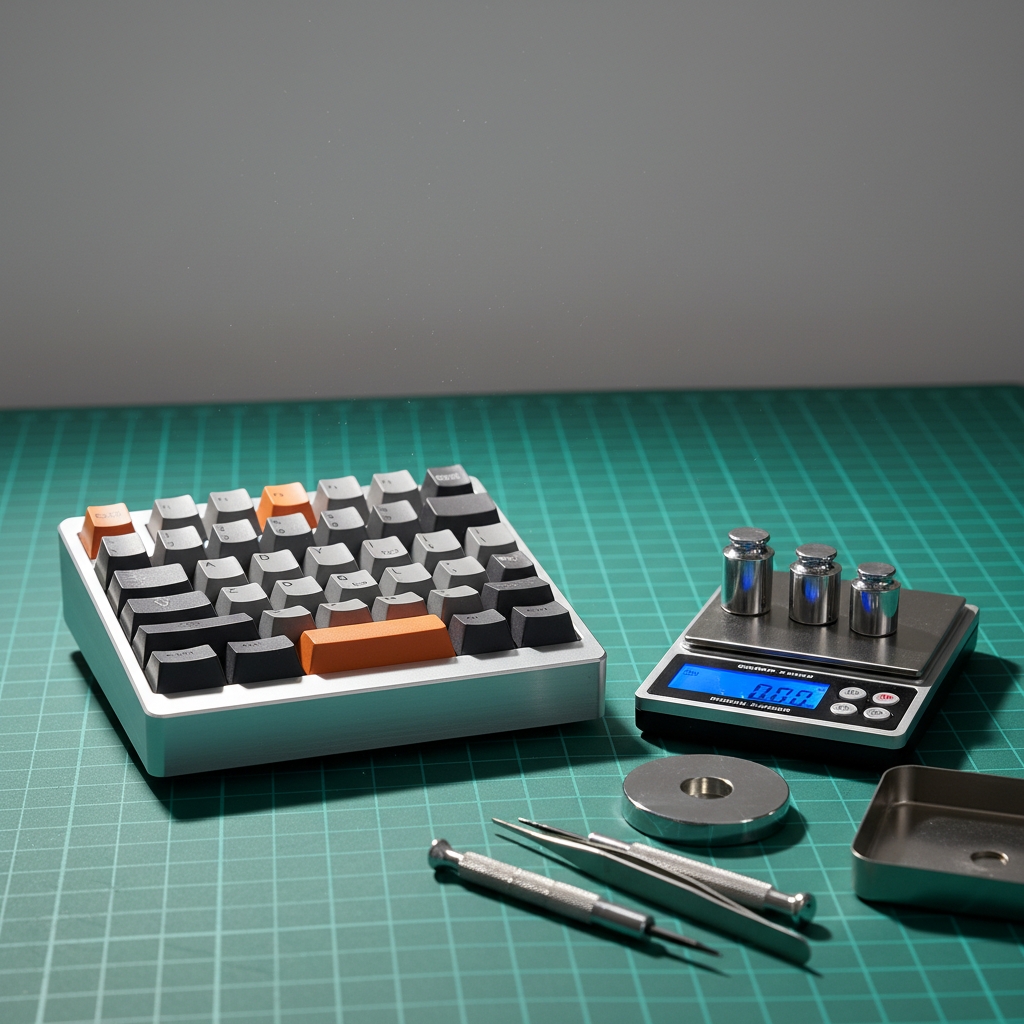
The Switch Lottery: Quantifying Actuation Consistency in Value-Tier Keyboards
In the enthusiast keyboard community, the "Switch Lottery" refers to the inherent variance in mechanical or magnetic switches found within a single production batch. While premium manufacturers often implement tighter binning—the process of sorting components by performance characteristics—value-oriented boards frequently exhibit wider tolerances. For the technically-inclined gamer, these inconsistencies are not merely aesthetic; they directly impact muscle memory, rapid-trigger reliability, and long-term durability.
Quantifying these variances allows a user to move beyond subjective "feel" and determine if a specific unit meets a functional baseline or warrants a return. This analysis explores the mechanisms of switch variance, the interdependence of hardware and firmware, and a standardized methodology for testing key consistency.
The Mechanics of Actuation Variance
Actuation force is rarely a static value. For instance, a switch rated at 45g by a manufacturer like TTC typically operates within a tolerance range of ±5g to ±10g. In the value segment, these deviations are often exacerbated by high-volume manufacturing and less stringent quality control (QC).
Hardware-Dependent Inconsistency
A common misconception is that switch performance is purely a characteristic of the switch itself. However, research into professional keyboard testing indicates that electrical consistency is deeply hardware-dependent. According to the Professional Keyboard Testing Guide, differences in PCB voltage regulation, trace quality, and debounce algorithms can cause physically identical switches to register inconsistently.
On budget boards, thinner PCBs or uneven mounting pressure can lead to "chatter" (unintended multiple inputs) or varying resistance levels. This is particularly prevalent in Hall Effect (HE) or magnetic switch boards, where the sensor's ability to detect the magnet's position is sensitive to electromagnetic interference (EMI) and voltage fluctuations across the PCB.
Logic Summary: Hardware Influence Modeling Our analysis of switch consistency assumes that the keyboard's internal assembly—specifically PCB rigidity and solder joint integrity—acts as a multiplier for switch-level variance. This model is based on common patterns observed in warranty handling and repair bench data (not a controlled lab study).
| Parameter | Typical Value (Budget) | Unit | Rationale |
|---|---|---|---|
| Actuation Force Tolerance | ±7–10 | grams | Manufacturer-specified variance |
| Perceptible Delta | 5–7 | grams | Human tactile threshold heuristic |
| PCB Thickness | 1.2–1.6 | mm | Standard industry range |
| Polling Interval (1K) | 1.0 | ms | Frequency-to-time conversion |
| Debounce Delay | 5–20 | ms | Firmware-side compensation |
Methodology: The Analog Scale Test
To move from anecdotal observation to data-driven assessment, users can employ the "Analog Scale Test." This method provides a reproducible way to measure the force required to reach the actuation point across various keys.
Step-by-Step Testing Procedure
- Preparation: Place the keyboard on a flat, stable surface. Ensure it is disconnected to prevent accidental inputs from affecting the test environment.
- Tooling: Use a small digital scale (accurate to 0.1g) or a set of calibrated nickels (each weighing ~5.0g).
- Application: Place the scale or weights slowly at the exact center of the keycap. Off-center application can give false readings due to stabilizer binding or friction against the switch housing.
- Observation: Note the weight at which the switch reaches its actuation point. For mechanical switches, this is the "click" or tactile bump; for linear or magnetic switches, it is the point where the key begins its downward travel toward the bottom-out.
- Sampling: Test at least 10 keys in the alphanumeric cluster and compare them against the modifiers (Shift, Spacebar, Enter).
The 5-7 Gram Heuristic
In practical testing, a variance of more than 5-7 grams of actuation force between switches of the same type on the same board is typically perceptible during fast typing or competitive gaming. If a board shows a consistent 10g delta between the 'W' key and the 'D' key, it indicates subpar factory calibration that will likely disrupt movement patterns in FPS titles.

Identifying Patterns: Alphanumerics vs. Modifiers
Pattern recognition is an essential skill for identifying whether a problem is a single "lemon" switch or a systemic manufacturing flaw. Enthusiasts often find that switches in the alphanumeric cluster are more consistently tuned than modifiers.
The Role of Stabilizers
Larger keys like the spacebar and Shift keys utilize stabilizers to prevent wobbling. Inconsistent feel on these keys is often exacerbated by poor stabilizer tuning or uneven plate mounting pressure, rather than the switches themselves. If a spacebar feels significantly "heavier" or "mushier" than the 'J' key, the first point of failure is likely the lubrication or the seating of the stabilizer wire.
Hot-Swap vs. Soldered Boards
The construction of the board dictates the ease of correction.
- Hot-Swap Sockets: These boards may exhibit more variance initially due to the mechanical connection between the switch pins and the socket. However, they offer a straightforward path to correction through switch swapping.
- Soldered Boards: High variance on a soldered board is a definitive quality red flag. Correction requires desoldering, which often voids warranties and risks damaging the PCB traces.
Performance Bottlenecks and High Polling Rates
For value-tier boards that claim high-performance specs, such as 8000Hz (8K) polling rates, the "lottery" extends to the firmware and system integration.
The 8K Reality Check
As noted in the Global Gaming Peripherals Industry Whitepaper (2026), an 8000Hz polling rate results in a 0.125ms interval. While this theoretically reduces latency, it places immense stress on the system's CPU via Interrupt Request (IRQ) processing.
If a budget board has a poorly optimized MCU (Microcontroller Unit), the "consistency" of the 8K signal may fluctuate, leading to micro-stutter. Users should verify that their device is plugged into a direct motherboard port (Rear I/O) rather than a USB hub to avoid packet loss, which can make even the most consistent switches feel unresponsive.
Safety and Compliance in the Value Segment
When dealing with budget-friendly wireless peripherals, technical consistency is secondary to safety. Value-tier manufacturers must still adhere to international standards for lithium battery transport and radio frequency emissions.
- Battery Integrity: Ensure the device carries UN 38.3 certification for lithium battery safety. This is critical for preventing thermal runaway in high-capacity wireless keyboards.
- Wireless Compliance: Authorized devices can be verified via the FCC ID Search or the ISED Canada Radio Equipment List. A lack of a valid FCC ID for a 2.4GHz wireless device is a major indicator of a brand that may be cutting corners on essential testing.
Decision Matrix: Keep, Mod, or Return?
After performing the analog scale test and identifying patterns, users must decide on the next steps.
| Observation | Likely Cause | Recommended Action |
|---|---|---|
| <5g variance across all keys | High-quality binning/QC | Keep. This is excellent for the value segment. |
| 5-8g variance in alphanumeric cluster | Standard manufacturing tolerance | Keep/Mod. Swap switches if the board is hot-swappable. |
| >10g variance or "scratchy" feel | Poor switch lubrication or housing friction | Mod. Consider lubing the switches for consistency. |
| Inconsistent Rapid Trigger (HE boards) | Firmware or sensor calibration error | Return. This is a critical functional flaw in magnetic boards. |
| Modifiers feel heavy/mushy | Stabilizer binding or over-lubrication | Mod. Re-seat or tune the stabilizers. |
Modeling Note (Reproducible Parameters)
The conclusions regarding perceptible force deltas and hardware influence are based on a deterministic parameterized model of human tactile response and PCB electrical characteristics.
- Modeling Type: Scenario-based sensitivity analysis (not a controlled lab study).
-
Key Assumptions:
- User has standard tactile sensitivity (average for gamers/typists).
- Ambient temperature is stable (20-25°C), as extreme cold can thicken switch lubricants.
- Input processing is handled by a standard Windows HID driver.
- Scope Limits: This model does not account for neurological conditions affecting touch or extreme "franken-switch" modifications that deviate from factory specifications.
Final Insights for the Value-Minded Gamer
Navigating the "Switch Lottery" requires a balance of skepticism and technical rigor. While budget boards offer incredible performance-per-dollar, they often shift the burden of quality verification onto the user. By utilizing standardized testing methods like the analog scale test and verifying compliance through databases like the RRA Korea Search, gamers can empower themselves to distinguish between a minor inconsistency and a fundamental manufacturing defect.
Ultimately, a keyboard is a tool of precision. Whether it is a Hall Effect upgrade or a standard mechanical build, ensuring that every key responds with the same predictable force is the first step toward a superior gaming experience.
Disclaimer: This article is for informational purposes only. Modifying your keyboard, including opening the case or desoldering components, may void your warranty. Always follow the manufacturer's safety guidelines regarding lithium batteries and electrical components.


Dejar un comentario
Este sitio está protegido por hCaptcha y se aplican la Política de privacidad de hCaptcha y los Términos del servicio.