

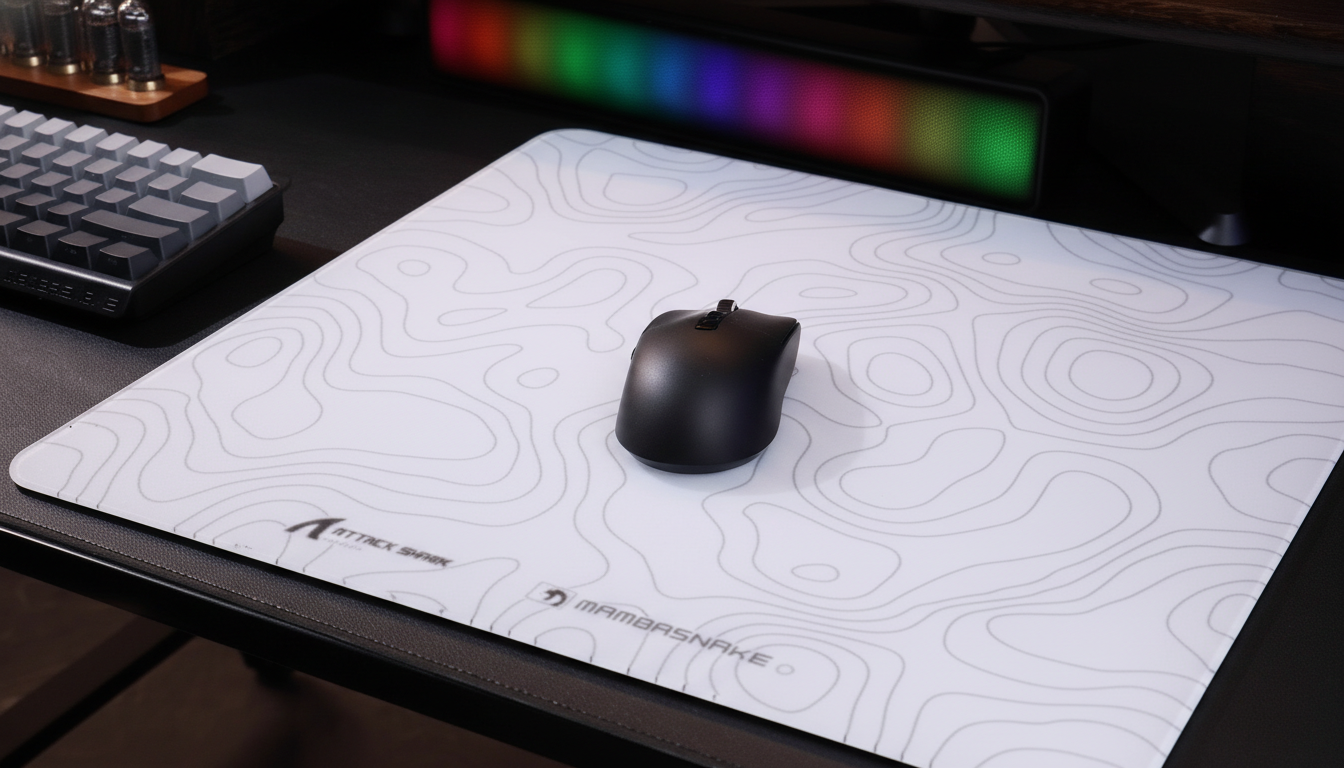
At a Glance: Key Technical Takeaways
For players optimizing for high-polling-rate sensors (4000Hz–8000Hz), the mouse pad surface is a critical component of the signal chain. Below is a quick decision tool for selecting a surface based on your environment and playstyle.
Quick Decision Matrix
| If your priority is... | Recommended Material | Why? |
|---|---|---|
| Consistency in High Humidity | Glass / Carbon Fiber / Hybrid | Non-hygroscopic; fibers won't swell. |
| Tactical Precision (CS2/VAL) | High-Density Plain Weave | High static friction for "locking" onto targets. |
| Tracking/Speed (Apex/OW2) | Satin Weave / Glass | Low dynamic friction for fluid micro-adjustments. |
| Maximum Durability | Tempered Glass | Surface does not "break in" or degrade like cloth. |
The Physics of the Mouse-Surface Interface: A Technical Overview
The interaction between a gaming mouse's PTFE (Polytetrafluoroethylene) skates and the underlying surface is a complex study in tribology—the science of friction, wear, and lubrication. For the performance-conscious gamer, a mouse pad is a precision-engineered substrate that determines the consistency of aim, the effort required for micro-adjustments, and the reliability of high-polling-rate sensor tracking.
At the core of this interaction lie two primary forces: static friction (the force required to initiate movement) and dynamic friction (the force required to maintain movement). Achieving a balance between these forces is the primary objective of mouse pad material science. High-density weaves and advanced coatings are utilized to manipulate these coefficients of friction, ensuring that the "tug-of-war" between the user's hand and the surface remains predictable across extended play sessions.
According to industry projections such as the Global Gaming Peripherals Industry Whitepaper (2026), standardized surface testing is becoming essential as sensors reach 8000Hz polling rates, where even microscopic weave inconsistencies can translate into detectable tracking jitter.

Textile Engineering: Decoding Weave Patterns and Density
Most gaming surfaces utilize synthetic fibers, typically polyester or nylon, woven into specific patterns. While marketing materials frequently cite "high-density weaves," the technical reality is defined by the weave structure itself—plain, twill, or satin—and the resulting Thread Per Inch (TPI).
The Three Pillars of Weave Structure
The mechanical properties of a cloth pad are dictated by how the warp (vertical) and weft (horizontal) threads intersect.
- Plain Weave: The simplest over-under pattern. It offers high X/Y axis symmetry but often results in higher friction due to the high frequency of thread intersections.
- Twill Weave: Threads are woven to create a diagonal ribbing. This structure typically offers a smoother glide in one direction, which can lead to X/Y Variance if not carefully engineered.
- Satin Weave: Characterized by long "floats" where the weft skips several warp threads. This creates a silky, low-friction surface. Technical experiments, such as those published in IOPscience, indicate that a change from plain to satin weaves alters tactile feedback and electrical resistance.
| Weave Type | Surface Texture | Typical Friction Profile | Best Use Case |
|---|---|---|---|
| Plain | Uniform, slightly grainy | High Static, Moderate Dynamic | Tactical Shooters (Control) |
| Twill | Directional, ribbed | Moderate Static, Low Dynamic | Tracking-heavy games |
| Satin | Smooth, glossy | Low Static, Very Low Dynamic | Speed-focused aiming |
| Micro-Weave | Ultra-tight, closed | Variable based on coating | All-around performance |
Technical Note: Friction profiles are a direct result of surface area contact between PTFE feet and fiber "peaks." A tighter weave (higher TPI) typically reduces the depth to which mouse feet sink, lowering dynamic friction.
The "TPI" Standardization Gap
A common misconception is that a higher TPI (Threads Per Inch) automatically equates to a "better" pad. However, weave density remains a largely unstandardized metric. Manufacturers may measure TPI differently, and the thickness of individual threads (denier) significantly impacts the feel. TPI should be treated as a heuristic rather than an absolute performance metric.
Advanced Materials: Hybrid, Carbon Fiber, and Glass
Modern surfaces address the inherent limitations of standard textiles, such as environmental sensitivity and surface degradation.
Hybrid Surfaces and Synthetic Blends
Hybrid pads are engineered to offer a distinct performance profile. By blending synthetic fibers with specialized heat treatments, these surfaces achieve low static friction for initial micro-movements—essential for "flicking"—while maintaining predictable dynamic friction for stopping power.
Carbon Fiber: The Durability Benchmark
Carbon fiber, particularly "dry" carbon fiber, provides a rigid tracking plane. Unlike cloth, which can compress under pressure, carbon fiber maintains uniformity. This material is effective at ensuring X/Y Axis Symmetry, meaning friction remains consistent regardless of movement direction.
Tempered Glass and Nano-Etching
Glass surfaces represent the peak of low-friction technology. Modern glass pads utilize 3D-milled, nano-micro-etched textures.
- Hardness Specification: These surfaces are typically rated at 9H pencil hardness and range between 6 and 7 on the Mohs scale. This makes them exceptionally resistant to surface abrasion compared to traditional cloth.
- Performance: The etching prevents "stiction" (the mouse feet sticking to the surface) while offering a glide that feels nearly resistance-free.
Environmental Dynamics: Humidity and Friction
"Muddy" tracking is often caused by environmental humidity. Uncoated cloth pads are hygroscopic, meaning they absorb moisture from the air.
The Humidity Effect on Static Friction
In humid environments, fibers in a cloth pad can swell, increasing static friction. This may lead to overshooting, as the user must apply more force to break the initial friction, only for the mouse to accelerate too quickly once movement begins.
Recommended for High-Humidity Regions:
- Coated Speed Pads: The coating acts as a moisture barrier.
- Hybrid Surfaces: Synthetic blends less prone to water absorption.
- Glass or Carbon Fiber: Functionally immune to humidity-induced friction changes.
Break-In Period and Surface Fatigue
- Break-In (Experience-based): High-density weaves often require a 10–15 hour break-in period to reach their "steady-state" glide.
- Surface Fatigue: This is the point where the weave has been permanently compressed or the coating has degraded.
- Self-Check for Fatigue: Perform the "Glide Test." Slide your mouse across the center (most used) and the far edge (least used) of the pad with equal force. If the center feels significantly "muddier" or slower, the pad has likely reached Surface Fatigue.
Sensor Synergy: Tracking at 8000Hz
The relationship between weave and optical sensor is critical for PixArt 3395 and 3950 sensors. These sensors capture thousands of surface images per second.
Weave Impact on High-Polling-Rate Sensors
At 8000Hz (8K), the mouse sends an update every 0.125ms. Deep, inconsistent weaves or accumulated dust can cause the sensor to misinterpret the surface, potentially leading to jitter.
Modeling Note (Representative Parameters): This analysis assumes typical operating conditions for a high-performance gaming environment:
Parameter Value/Range Unit Rationale Polling Rate 8000 Hz Modern esports standard Update Interval 0.125 ms Physical limit of 8K DPI Setting 1600 DPI Standard competitive resolution Movement Speed 5–10 IPS Minimum speed to saturate 8K bandwidth Surface Hardness 30–50 Shore A Typical rubber base firmness Note: This is a scenario model based on common industry heuristics. Results vary based on firmware and PTFE wear.
The Maintenance Protocol: Preserving Weave Integrity
Cleaning Heuristics
- Avoid Alcohol: Alcohol-based cleaners can degrade synthetic coatings.
- Weekly Wipe-downs: Use a microfiber cloth and highly diluted dish soap.
- Cold Water Only: Heat can warp the rubber base or cause fabric tension loss. Always refer to specific manufacturer guidelines, as some specialized coatings have unique requirements.
PTFE Management
PTFE is the standard for mouse feet due to its low coefficient of friction (typically 0.05 to 0.10 against steel).
- Typical Wear Cycle: On hybrid pads, PTFE can flatten significantly within 2–4 months of heavy use (approx. 4+ hours daily).
- The "Flashlight Test": Shine a light across your mouse feet. If they appear "shiny" and flat rather than matte and rounded, the increased surface area is likely increasing your friction. Monitoring Worn Mouse Feet is essential for maintaining consistency.
Professional Selection: Finding the Right Fit
The 180-Degree Rule
A reliable heuristic for sizing: your pad should be large enough to allow for a full 180-degree in-game turn from the center to the edge without lifting the mouse. This helps prevent wrist strain and "recentering" errors.
Scenario Analysis
Scenario A: Tactical Shooter (Low Sensitivity)
- Surface: High-density cloth or "Control" hybrid.
- Reasoning: Low-sensitivity players (400–800 DPI) benefit from high dynamic friction for stopping power.
Scenario B: High-Speed Tracker (High Sensitivity)
- Surface: Glass, Carbon Fiber, or Coated Speed Cloth.
- Reasoning: High-sensitivity players (1600+ DPI) benefit from ultra-low static friction to assist with constant micro-corrections.
Disclaimer: This article is for informational purposes only. Performance metrics are based on theoretical modeling and common industry heuristics; individual results may vary based on environmental factors and hardware configurations.


Dejar un comentario
Este sitio está protegido por hCaptcha y se aplican la Política de privacidad de hCaptcha y los Términos del servicio.