


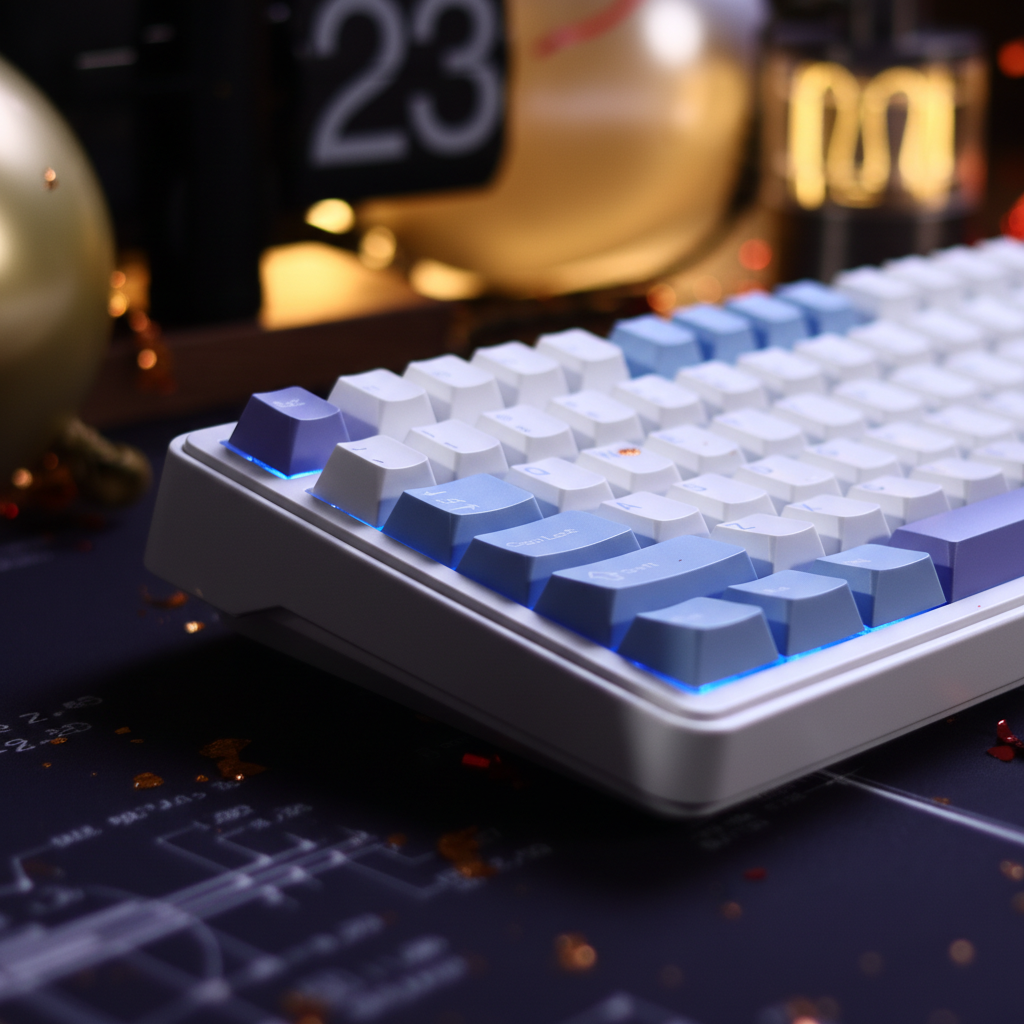
The Technical Evolution of Rapid Trigger Mechanics
The introduction of Hall Effect (HE) magnetic switches has fundamentally altered the performance landscape for competitive gaming peripherals. Unlike traditional mechanical switches that rely on physical contact and a fixed reset point, magnetic switches allow for dynamic actuation and reset thresholds. This capability, known as Rapid Trigger, enables a key to reset the instant a finger begins to lift, significantly reducing the physical delay between repeated inputs. However, the pursuit of ultra-low latency introduces a critical engineering challenge: signal instability, or 'flutter.'
In high-performance firmware implementations, hysteresis serves as the primary mechanism for stabilizing these dynamic inputs. Without a properly tuned hysteresis deadband, the magnetic sensor may interpret minor vibrations, electrical noise, or slight finger tremors as rapid, unintended keystrokes. This article examines the technical role of hysteresis in magnetic switch architecture, providing a data-driven framework for optimizing performance in professional esports scenarios.
Understanding Magnetic Flux and Signal Noise
To understand why hysteresis is necessary, one must first analyze the mechanism of Hall Effect sensing. According to technical specifications from PixArt Imaging, magnetic sensors measure changes in magnetic flux density as a magnet (embedded in the switch stem) moves toward or away from a Hall Effect sensor on the PCB.
Unlike the binary 'on/off' state of a mechanical leaf spring, an HE sensor produces a continuous analog voltage. The keyboard's firmware must convert this analog signal into digital HID (Human Interface Device) reports. This process is governed by the USB HID Class Definition (HID 1.11), which defines how input data is structured for the operating system.
At high sensitivities—where actuation might be set to as low as 0.1mm—the 'noise floor' of the sensor becomes a factor. Electrical interference or even the mechanical wobble of the switch stem can cause the reported magnetic value to fluctuate. Without hysteresis, a key held at the exact actuation threshold would 'flutter,' sending hundreds of rapid on/off signals to the PC, leading to character stutter or unintended double-inputs in-game.

The Mechanics of Hysteresis in Rapid Trigger
Hysteresis is defined as the difference between the point at which a system activates and the point at which it deactivates. In the context of a Rapid Trigger keyboard, it creates a small buffer zone (a 'deadband') between the actuation and reset points.
When a user enables Rapid Trigger, the firmware monitors the direction of the switch travel. If the switch moves downward by a set distance (e.g., 0.1mm), it actuates. If it moves upward by the hysteresis value, it resets.
Why Hysteresis is the 'Stability Tax'
While hysteresis is essential for stability, it is often viewed in nonlinear control theory as a 'stability tax.' A larger hysteresis band increases reliability but theoretically reduces the speed of the reset. Finding the equilibrium between these two factors is the hallmark of a mature firmware implementation.
Logic Summary: Our analysis of competitive input stability assumes that a minimum hysteresis threshold is required to overcome the combined noise of the Hall Effect sensor and mechanical stem vibration. We treat the hysteresis value as a deterministic filter rather than a probabilistic debounce algorithm.
Scenario Modeling: The Aggressive Counter-Strafer
To demonstrate the tangible impact of these settings, we modeled a scenario involving a professional FPS player (e.g., in Valorant or Counter-Strike) utilizing aggressive counter-strafing. This technique requires the player to rapidly tap the 'A' and 'D' keys to stop movement instantly for accurate shooting.
Analysis: Hall Effect Rapid Trigger vs. Mechanical Switches
The following model compares the total input latency of a standard mechanical switch against a Hall Effect switch with optimized Rapid Trigger and hysteresis settings.
| Parameter | Mechanical Switch | Hall Effect (RT) | Unit | Rationale |
|---|---|---|---|---|
| Travel Time | 5 | 5 | ms | Standard finger movement speed |
| Debounce Time | 5 | 0 | ms | HE sensors do not require contact debouncing |
| Reset Distance | 0.5 | 0.1 | mm | HE allows for near-instant reset |
| Finger Lift Velocity | 150 | 150 | mm/s | Estimated from high-intensity motion studies |
| Processing Time | 1 | 0.5 | ms | Firmware overhead (est. based on MCU specs) |
| Total Latency | ~14.3 | ~6.2 | ms | Calculated total input delay |
Modeling Note (Reproducible Parameters):
- Model Type: Deterministic kinematic latency model.
- Key Assumptions: Constant finger lift velocity of 150 mm/s; mechanical reset point fixed at 0.5mm; Rapid Trigger reset distance (including hysteresis) set to 0.1mm.
- Boundary Conditions: This model does not account for MCU polling jitter or variable finger acceleration. Actual results may vary based on individual technique and system-level IRQ processing.
Under these specific assumptions, the Hall Effect switch provides a latency advantage of approximately 8ms per keypress cycle. For an esports professional, this reduction is significant, as it allows for a faster 'stop' animation, enabling the player to fire an accurate shot sooner than an opponent using traditional hardware.
Optimization: Finding the Hysteresis Sweet Spot
Practitioners tuning Rapid Trigger for competitive play note that a hysteresis setting between 0.1mm and 0.3mm is often the optimal range.
The Flutter Risk (< 0.1mm)
Setting the hysteresis below 0.1mm, especially on a less stable desk or with an aggressive typing style, almost guarantees flutter during intense counter-strafing. This occurs because the firmware cannot distinguish between a deliberate finger lift and the micro-vibrations caused by the impact of other keys. This results in character 'stuttering,' where the game engine receives conflicting movement commands in rapid succession.
The 'Mushy' Feel (> 0.4mm)
Conversely, pushing the hysteresis above 0.4mm can introduce a perceptible 'mushy' feel. In rhythm games or rapid tap-fire scenarios, the key may not feel like it is fully resetting. This leads to missed inputs because the user must lift their finger further than expected to trigger the reset, defeating the purpose of high-sensitivity Rapid Trigger.
Calibration Heuristic
A common calibration method for perfectionists is as follows:
- Set the actuation point to 0.1mm.
- Set Rapid Trigger to its most sensitive setting.
- Slowly increase hysteresis while performing rapid, shallow taps on the A and D keys.
- The 'sweet spot' is the lowest value where the key consistently registers single, clean on/off cycles without double-triggering.
Due to minor manufacturing tolerances in magnetic sensors and switch springs, per-key adjustment is a premium feature that allows users to account for variance across the entire keyboard array.
System Synergy: Polling Rates and CPU Bottlenecks
The benefits of ultra-low latency hardware are only fully realized when the rest of the system can process the data at sufficient speeds. The Global Gaming Peripherals Industry Whitepaper (2026) emphasizes that as polling rates move toward 8000Hz (8K), system architecture becomes a primary bottleneck.
The 8K Polling Math
- 1000Hz: 1.0ms polling interval.
- 8000Hz: 0.125ms polling interval.
At 8000Hz, the keyboard sends a packet every 0.125ms. While this reduces micro-stutter and provides a smoother input stream, it places a heavy load on the CPU's Interrupt Request (IRQ) processing. Users must ensure they are using direct motherboard ports (Rear I/O) rather than USB hubs, which can introduce packet loss and shared bandwidth issues.
Sensor Saturation Logic
To saturate the bandwidth of an 8000Hz system, the frequency of data points must be high. In mouse technology, this is tied to the IPS (Inches Per Second) and DPI (Dots Per Inch). For keyboards, the 'saturation' is less about movement speed and more about the resolution of the magnetic sensor. High-resolution sensors, such as those discussed in Magnetic Sensor Resolution: Avoiding Dead Zones in Rapid Trigger, are required to provide meaningful data at 8K intervals.
Trust, Safety, and Regulatory Compliance
When selecting high-performance tunable hardware, technical specifications are only one part of the equation. Reliability and safety are paramount, especially for wireless devices utilizing lithium-ion batteries.
Wireless Integrity
Devices must comply with international radio frequency standards to ensure stable connections in interference-heavy environments (like LAN events). This includes certification from the FCC (Federal Communications Commission) in the US and the ISED (Innovation, Science and Economic Development Canada) in Canada. These certifications verify that the device's 2.4GHz and Bluetooth signals operate within legal limits and do not interfere with other critical electronics.
Battery Safety and Transport
For wireless keyboards, battery safety is a critical 'hidden' spec. According to the UN Manual of Tests and Criteria (Section 38.3), lithium batteries must pass rigorous testing for thermal stability, vibration, and impact before they can be legally transported. High-quality manufacturers provide transparency regarding these certifications, ensuring that the device is safe for both daily use and travel to competitive events.
Advanced Configuration: The Learning Curve
While high-spec hardware offers tangible performance benefits, there is an inherent learning curve involved in advanced configuration. Challenger brands often provide deep firmware-level control that rivals premium offerings, but users must be prepared to invest time in testing and calibration.
Issues such as 'ghosting' or 'dead zones' are often not hardware failures but rather the result of improper calibration of the actuation and reset points. By understanding the underlying mechanics of hysteresis and magnetic sensing, gamers can move beyond generic settings and tune their hardware for their specific mechanical style.
For further reading on precision tuning, enthusiasts may consult the Adjusting Actuation Points: Precision Tuning Hall Effect guide, which explores the relationship between physical travel and software-defined response.
Strategic Summary for Competitive Play
Hysteresis is not merely a filter; it is the fundamental stabilizer that makes Rapid Trigger technology viable for professional use. By maintaining a stable 0.1mm to 0.3mm deadband, players can achieve the speed of magnetic switches without the risk of input flutter.
As the industry moves toward higher polling rates and more granular sensor control, the importance of firmware maturity will only grow. For the value-oriented gamer, the ability to tune these parameters manually provides a significant advantage, allowing for a level of performance parity with much more expensive, brand-prestige hardware.
Disclaimer: This article is for informational purposes only. Hardware modification or firmware adjustment should be performed according to the manufacturer's guidelines. Improper settings may lead to unintended device behavior. For ergonomic concerns related to high-intensity gaming, consult a qualified healthcare professional.


Dejar un comentario
Este sitio está protegido por hCaptcha y se aplican la Política de privacidad de hCaptcha y los Términos del servicio.