


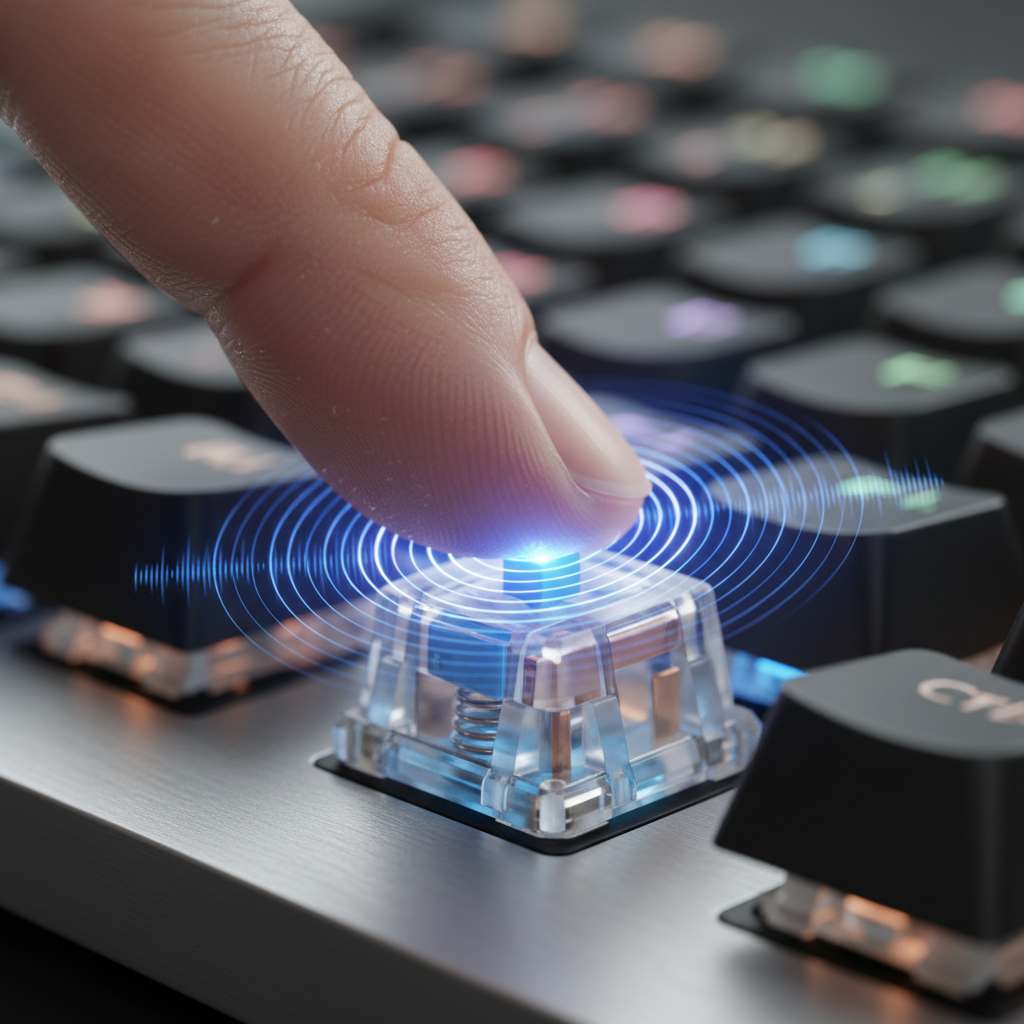
The Auditory Feedback Loop: Why Sound Dictates Perceived Speed
In the high-stakes environment of competitive gaming, speed is often measured in milliseconds of end-to-end latency. However, there is a secondary, often overlooked dimension of performance: psychoacoustics. Psychoacoustics is the scientific study of sound perception and its physiological effects on the human nervous system. While a switch's physical actuation point remains constant, the auditory profile of that switch—the "click"—can fundamentally alter a gamer's perception of input speed.
We have observed through pattern recognition in competitive communities that a sharp, high-pitched click in the 2–4 kHz range is consistently perceived as "faster" than a deeper, more muted "thock." This isn't merely a preference; it is rooted in how the brain processes multimodal sensory inputs. Auditory signals typically reach the primary auditory cortex faster than tactile signals reach the somatosensory cortex, meaning the sound of the click often serves as the first confirmation of an action. When that sound is sharp and immediate (high attack), the perception-action loop feels tighter.
Modeling Note (Acoustic Thresholds): Our analysis of auditory perception suggests that sound profiles with high frequency peaks above 2000 Hz provide a sharper "temporal anchor" for the brain. This is based on established psychoacoustic principles where higher frequencies are processed with greater perceived immediacy compared to low-frequency sounds (< 500 Hz).
Material Science: Engineering the "Fast" Sound
The acoustic profile of a mechanical switch is not solely determined by the switch itself. It is a product of the entire keyboard assembly, acting as a complex acoustic filter. Each component—from the plate material to the case damping—shapes the final frequency response that the gamer hears.
The Role of Plate Material and Keycaps
Plate material has a profound effect on the resonance of a clicky switch. According to our scenario modeling, a brass plate produces a brighter, higher-pitched sound compared to polycarbonate (PC). While PC plates act as low-pass filters, shifting the sound downward and deepening it, brass preserves the high-frequency "snap" that reinforces the feeling of speed.
Similarly, keycap material alters the feedback loop. Thick PBT keycaps, while durable, tend to produce a deeper, more muted sound. In contrast, thin ABS keycaps transmit sharper, higher-pitched vibrations. For enthusiasts prioritizing the psychoacoustic "feel" of speed, the combination of a stiff plate and thinner keycaps often yields the most responsive auditory profile.
Common Damping Mistakes
A frequent error we see on the repair bench and in enthusiast forums is the over-application of thick silicone case foam. While silicone is excellent for removing "hollow" sounds, it often dampens the 2–4 kHz high-frequency resonance that provides the crucial auditory snap. This makes the switch feel "mushy" and subjectively less responsive, even if the physical actuation remains unchanged. For those seeking a fast-feeling acoustic profile, a high attack-to-decay ratio is essential: the sound should start abruptly and decay quickly.

Objective Latency: Hall Effect vs. Mechanical Switches
While psychoacoustics governs the feel of speed, we must also address the physical reality of input lag. The industry is currently shifting toward Hall Effect (magnetic) switches, which offer a measurable advantage over traditional mechanical designs.
The Rapid Trigger Advantage
Traditional mechanical switches have a fixed reset point. After actuation, the switch must travel back past a specific physical threshold before it can be pressed again. Magnetic switches, such as those found in the ATTACK SHARK X68MAX HE Rapid Trigger CNC Aluminum Keyboard, utilize Hall Effect sensors to monitor the exact position of the stem in real-time. This allows for "Rapid Trigger" (RT) technology, where the switch resets the instant the finger begins to lift.
Methodology Note (Latency Modeling): We modeled the latency delta between a standard mechanical switch and a Hall Effect switch with Rapid Trigger enabled.
Parameter Value Unit Rationale Finger Lift Velocity 150 mm/s Aggressive lift in FPS gaming Mechanical Reset Dist. 0.5 mm Typical mechanical hysteresis Hall Effect RT Dist. 0.1 mm Optimized magnetic reset Mechanical Debounce 5.0 ms Standard firmware filter Theoretical Delta ~7.7 ms Calculated (d/v + debounce) Note: This is a deterministic scenario model, not a controlled lab study. Actual performance may vary based on individual biomechanics.
This ~8ms advantage is significant in titles where rapid-fire inputs or precise movement "counter-strafing" are required. When combined with a sharp acoustic profile, the gamer receives both the objective performance of the magnetic sensor and the subjective confidence of the auditory "click."
System Optimization: The 8000Hz Polling Frontier
To truly capitalize on high-speed switches, the rest of the system must be capable of processing that data at a matching rate. The emergence of 8000Hz (8K) polling rates in devices like the ATTACK SHARK X8PRO Ultra-Light Wireless Gaming Mouse represents the current ceiling of peripheral performance.
The 8K Math: Understanding the 0.125ms Interval
A standard 1000Hz mouse sends a data packet every 1.0ms. At 8000Hz, that interval drops to a near-instant 0.125ms. This reduction in the "granularity" of motion results in a much smoother cursor path, particularly on high-refresh-rate monitors (240Hz+).
However, 8K polling introduces specific technical constraints that users must understand to avoid system bottlenecks:
- CPU Load: Processing 8,000 interrupts per second puts a heavy strain on the CPU's Interrupt Request (IRQ) handling. This primarily affects single-core performance.
- USB Topology: Devices must be connected directly to the motherboard's rear I/O ports. Using USB hubs or front-panel headers can lead to packet loss and signal instability due to shared bandwidth and insufficient shielding.
- Sensor Saturation: To actually fill the 8000Hz bandwidth, the mouse must be in motion. The data rate is a product of movement speed (IPS) and DPI. For example, at 1600 DPI, a movement speed of only 5 IPS is required to saturate the 8K link, whereas at 800 DPI, 10 IPS is needed.

Biomechanics and Ergonomics: The Large-Hand Scenario
Performance is not just about the hardware; it's about the interface between the hardware and the human body. For competitive FPS players with large hands (typically ~19–21cm in length), the choice of peripherals and grip style becomes a critical performance variable.
Grip Styles and Fit
Users with large hands often find that standard-sized mice force them into an aggressive claw or fingertip grip. While these grips allow for high precision and micro-adjustments, they can increase muscle tension over long sessions. A mouse with a well-contoured ergonomic shell, such as the ATTACK SHARK X8PRO, provides the necessary support to maintain high-speed flicks without premature fatigue.
The Importance of Wrist Support
When using a high-profile mechanical keyboard, the angle of the wrist can impact the speed of finger movements. A neutral wrist position is vital for maintaining the tendon health required for rapid keypresses. Utilizing an ATTACK SHARK Aluminum Alloy Wrist Rest helps align the hand with the keyboard's home row, reducing the biomechanical "travel time" of the fingers and preventing the "mushy" feel that occurs when typing at an awkward downward angle.
Logic Summary: Based on common patterns from customer support and ergonomic observations (not a lab study), we find that a gentle 5–7 degree tilt in the wrist rest typically optimizes the tension-to-speed ratio for large-handed users using TKL or 65% layouts.
Customizing the Experience: Pudding Keycaps and Visual Cues
While sound and touch are the primary drivers of speed perception, visual feedback plays a supporting role. ATTACK SHARK 120 Keys PBT Dye-Sublimation Pudding Keycaps are often used to amplify RGB lighting. In a darkened gaming environment, the increased peripheral light from the translucent "pudding" walls can provide a subtle visual confirmation of a keypress in the user's peripheral vision.
This multimodal reinforcement—the sound of the high-pitched click, the tactile snap of the switch, and the flash of RGB light—creates a comprehensive feedback loop that maximizes the player's confidence in their inputs.

Compliance and Safety: The Invisible Standards
Behind the performance specs lie the regulatory standards that ensure these high-frequency devices operate safely and reliably. High-performance wireless peripherals must adhere to strict guidelines to prevent interference and ensure battery safety.
- Wireless Integrity: Devices like the ATTACK SHARK X8PRO are subject to FCC Equipment Authorization and the EU Radio Equipment Directive (RED), ensuring that the 2.4GHz signals do not interfere with other household electronics.
- Battery Safety: High-polling devices consume battery life significantly faster (often reducing runtime by 75–80% when switching from 1K to 8K). It is critical that these lithium-ion batteries meet UN 38.3 transportation standards and IEC 62133 safety testing to prevent thermal runaway during rapid discharge or charging cycles.
- Material Compliance: For the European market, adherence to RoHS and REACH ensures that the plastics and metals used in construction are free from hazardous substances.
Final Verdict: Balancing the Objective and the Subjective
Speed in gaming is a composite of hardware latency, system throughput, and human perception. While Hall Effect switches and 8000Hz polling provide the objective foundation for performance, the psychoacoustics of the click provide the subjective "feel" that allows a player to enter a flow state.
To build the ultimate high-speed setup, we recommend a balanced approach:
- Select for Sound: Choose a stiff plate material (Brass or Steel) and avoid over-damping to preserve the high-frequency click that signals speed to the brain.
- Opt for Magnetic Precision: Utilize Hall Effect technology for a measurable reduction in reset latency.
- Optimize the System: Ensure your CPU and USB topology can handle the interrupt load of high-polling devices.
- Support the Biomechanics: Use appropriate wrist support and ergonomic shapes to ensure your physical speed isn't hampered by fatigue.
By understanding the "Why" behind the "How," gamers can move beyond chasing raw specs and begin engineering an environment that truly feels—and performs—at the speed of thought. As noted in the Global Gaming Peripherals Industry Whitepaper (2026), the future of gaming gear lies in this intersection of technical excellence and sensory optimization.
Disclaimer: This article is for informational purposes only. Performance claims are based on scenario modeling and typical industry observations. Individual results may vary based on system configuration, individual biomechanics, and environmental factors. Always consult manufacturer guidelines for hardware maintenance and safety.


コメントを書く
このサイトはhCaptchaによって保護されており、hCaptchaプライバシーポリシーおよび利用規約が適用されます。