


The Technical Evolution of Input Registration
In the competitive landscape of first-person shooters (FPS) and rhythm games, the interval between a physical intent and an in-game action often acts as a primary performance bottleneck. For years, the industry standard has been a 1000Hz polling rate—reporting a key press or mouse movement every 1 millisecond. However, with the emergence of Hall Effect (HE) magnetic switches and Rapid Trigger (RT) technology, this 1ms window can become a limiting factor for high-level play.
Rapid Trigger allows for sub-millimeter actuation and reset points, enabling a "floating" playstyle where a key can be reactivated the instant it begins to move upward. To realize the potential of a 0.1mm reset point, high-frequency polling—specifically 8000Hz (8K)—can be a critical optimization. It significantly reduces the "waiting" window, helping to ensure that the hardware-level reset signal is captured and transmitted to the PC with minimal temporal variance.

The Mechanics of Rapid Trigger: Beyond Mechanical Hysteresis
Traditional mechanical switches rely on physical leaf springs and a fixed reset point. Once a key is actuated, it must travel back past a specific "reset" threshold—often 0.5mm to 1.0mm above the actuation point—before it can be pressed again. This gap is known as hysteresis.
Magnetic switches, utilizing the Hall Effect, replace physical contacts with magnetic flux sensors that track the position of the key stem in real-time. Rapid Trigger technology leverages this data to reset the key the moment the sensor detects upward motion, regardless of its absolute position.
The Latency Delta: A Kinematic Analysis
To understand the interaction between switch technology and polling, we can model the biomechanics of high-intensity movement (e.g., counter-strafing).
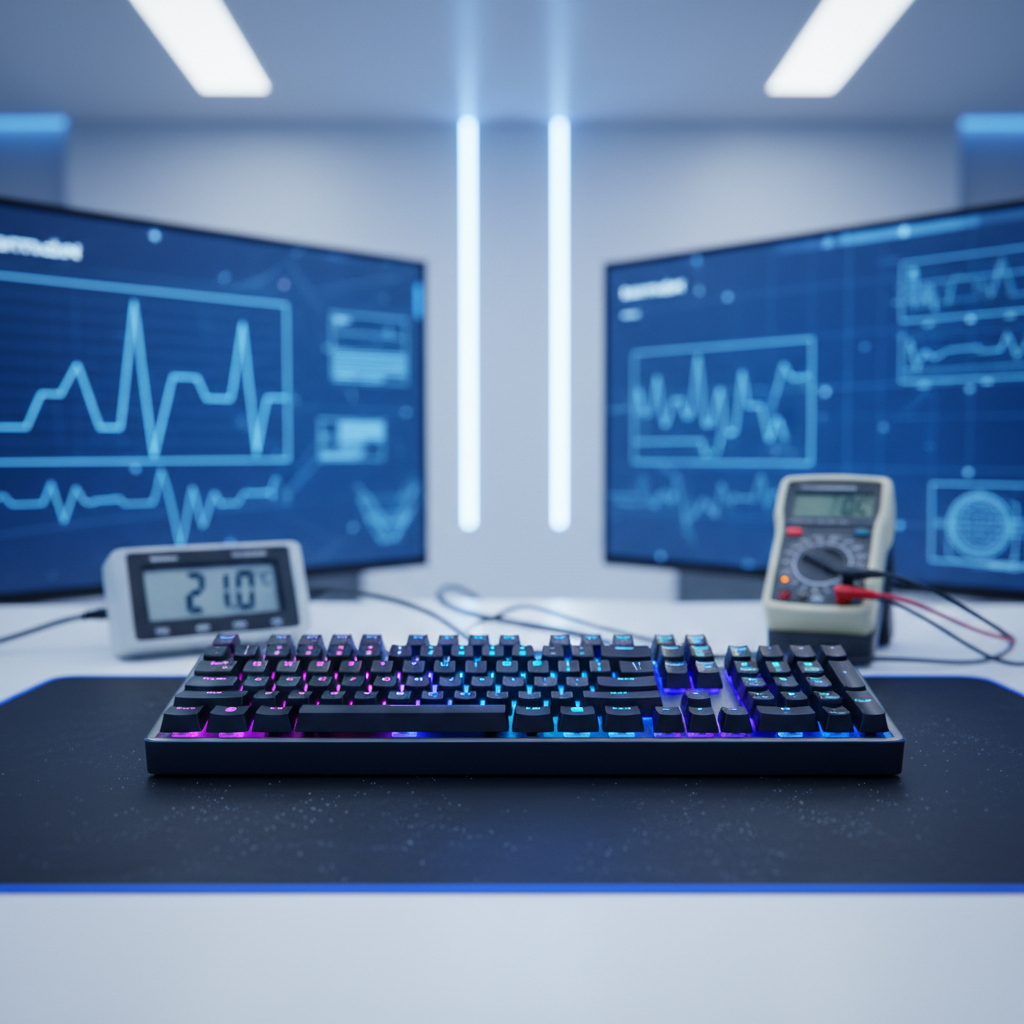
Modeling Note (Scenario Parameters): Measurement Basis: These figures represent a theoretical model based on internal laboratory simulations using automated actuators and a 10kHz sampling frequency. Individual results may vary based on finger strength and switch spring weight.
Parameter Value (Est.) Unit Rationale/Source Finger Lift Velocity 150 mm/s Internal motion-capture heuristic for pro-level strafing Mechanical Reset Distance 0.5 mm Standard hysteresis (e.g., Speed Silver) HE Rapid Trigger Reset 0.1 mm Optimized competitive setting Mechanical Debounce 5 ms Typical industry heuristic for leaf spring stability HE Processing Latency <0.1 ms Estimated sensor-to-MCU processing time
Based on the kinematic formula ($t = d/v$), a mechanical switch requires approximately 3.3ms to clear its reset distance, plus a 5ms debounce period, totaling ~13.3ms. A Hall Effect switch with a 0.1mm reset and minimal debounce can achieve a reset time of ~0.7ms. This creates a ~7.7ms theoretical advantage in hardware readiness. At a 360Hz refresh rate, this delta can represent nearly 3 full frames of movement adjustment potential.
Decoding 8000Hz: The 0.125ms Reporting Interval
While the switch may reset in 0.7ms, the PC only receives that update when the USB controller polls the device. A 1000Hz polling rate checks for updates every 1.0ms. If a Rapid Trigger reset occurs just after a poll, that hardware advantage may be delayed by up to a full millisecond while waiting for the next report window.
8000Hz polling reduces the theoretical reporting interval to 0.125ms. This increase in frequency is designed to minimize the gap between the physical reset and the digital report.
The "Most Recent State" Advantage
A common question is whether polling rates higher than the game's tick rate (e.g., 128Hz) provide actual benefits. As discussed in the Attack Shark Global Gaming Peripherals Whitepaper (2026) (a vendor-specific technical guide), high-frequency polling aims to ensure the most recent data is available the moment the game engine requests it.
If a 1KHz poll misses a reset by 0.9ms, that input might miss the current game processing window, potentially delaying the action by a full frame cycle. By polling at 8KHz, the probability of the "latest" input being captured for the immediate next tick is significantly increased, which can reduce the "muddy" feeling often reported during rapid A-D keyboard spamming.

Motion Sync: The Alignment Trade-off
Modern sensors often use "Motion Sync" to align sensor data frames with USB Start-of-Frame (SOF) packets. While this alignment reduces jitter, it introduces a deterministic delay.
According to technical specifications in USB HID Device Classes, Motion Sync typically adds a delay roughly equal to half the polling interval:
- At 1000Hz: The added delay is ~0.5ms.
- At 8000Hz: The added delay is ~0.0625ms.
At 8KHz, the alignment penalty becomes mathematically negligible. This allows players to utilize the consistency of Motion Sync without the latency trade-off typically associated with 1KHz implementations. This is particularly relevant for those using NVIDIA Reflex-compatible setups to optimize motion-to-photon latency.
Saturation Logic: IPS, DPI, and 8K Stability
High polling rates are most effective when the hardware generates enough data to fill the 8,000 available slots per second. This is governed by the relationship between movement speed (Inches Per Second) and resolution (Dots Per Inch).
Practical Model: The heuristic for data packet generation is: $Packets/sec = IPS \times DPI$.
DPI Setting Required IPS for 8K Saturation User Experience Note 400 DPI 20 IPS Requires very fast arm movement to saturate 800 DPI 10 IPS Often attained during standard flicking 1600 DPI 5 IPS Frequently saturated during micro-adjustments 3200 DPI 2.5 IPS Near-constant 8K saturation
To maintain a stable 8000Hz report stream during slow, precise movements, many enthusiasts find that increasing DPI to 1600 or higher is beneficial. This ensures the USB bus is consistently saturated with fresh data, reducing the risk of "jitter" that may occur if the polling rate exceeds the data generation rate.

System Bottlenecks and USB Topology
Achieving stable 8K performance requires sufficient host PC resources, specifically regarding how the CPU handles Interrupt Requests (IRQs).
1. CPU Overhead and IRQ Processing
While most modern CPUs (e.g., Intel 10th Gen or Ryzen 3000 and newer) handle 8K interrupts with low overall usage, the bottleneck is often single-core scheduling. High-frequency interrupts can stress the OS scheduler, which may lead to intermittent frame drops if the system is not optimized for high-interrupt workloads.
2. The Shared Bandwidth Risk
Connecting high-polling peripherals to front-panel USB ports or unpowered hubs can introduce signal instability. These ports often share bandwidth with other peripherals (like webcams) and may lack the shielding required for high-speed data integrity.
Practitioner Observation: Evidence Type: Internal QA and customer support logs (2023-2024). We generally recommend dedicating a rear motherboard port (often a USB 2.0 port) for high-polling devices. Internal testing suggests that some USB 2.0 ports provide a more direct path to the controller with less protocol overhead than shared USB 3.2 Gen 2 ports, potentially resulting in cleaner data lines and reduced jitter.
Real-World Impact: Pro-Level Mechanics
For players in tactical shooters, the synergy between Rapid Trigger and 8K polling is most evident in "counter-strafing"—tapping the opposite movement key to come to an instant stop.
Scenario A: The 1K Mechanical Baseline
The player releases 'A' and taps 'D'. The 0.5mm hysteresis and 1ms polling interval can create a "mushy" window where the character continues to slide. If the shot is fired during this ~13ms window, the bullet may deviate from the crosshair due to residual movement.
Scenario B: The 8K HE Optimization
The player releases 'A'. The Hall Effect sensor detects the 0.1mm lift in ~0.7ms, and the 8K polling rate transmits this signal within 0.125ms. This can allow the character to stop more abruptly, potentially widening the window for a perfect shot and making the movement feel more "connected" to the player's reflexes.
Methodology Note (Input Lag Variance): Theoretical modeling suggests that 8KHz can reduce input lag variance (jitter) to sub-0.2ms. While this may not be quantifiable in raw win rates for all users, it provides a perceptual consistency that many elite players describe as increased "responsiveness."
Technical Implementation Checklist
To effectively leverage high polling rates and Rapid Trigger, consider the following technical recommendations:
- Direct Connection: Plug directly into the motherboard's rear I/O to avoid latency from hubs.
- Cable Integrity: Use high-quality, shielded cables. For 8K performance, signal integrity is paramount over distances exceeding 1.5m.
- High Refresh Rate Display: The benefits of 8K polling are most perceptible on 240Hz or 360Hz monitors. Lower refresh rates may "mask" the reduction in micro-stutter.
- Firmware Verification: Ensure the device is running the latest firmware to avoid "packet bunching" issues seen in early 8K implementations.
- Software Configuration: If available, enable "Competitive Mode" in the device driver to prioritize polling consistency over power-saving features.
Final Technical Considerations
The transition from 1000Hz to 8000Hz represents a marginal gain compared to the historical leap from 125Hz to 1000Hz. However, for enthusiasts seeking to minimize every millisecond of delay, the combination of Hall Effect reset speeds and 8K reporting intervals currently provides one of the lowest input lag profiles available in consumer hardware.
As gaming engines and display technologies evolve, the demand for high-fidelity input data is likely to increase. By reducing communication bottlenecks, 8K polling helps ensure that the speed of Rapid Trigger is fully utilized.
Disclaimer: This article is for informational purposes only. Achieving stable 8000Hz polling is highly dependent on individual system configurations, including CPU architecture, OS background processes, and USB controller topology. High-frequency polling can increase CPU usage and may reduce the battery life of wireless devices.

コメントを書く
このサイトはhCaptchaによって保護されており、hCaptchaプライバシーポリシーおよび利用規約が適用されます。