
The Physics of Precision: Optimizing Center of Gravity through Internal Customization
In competitive gaming, the quest for the "perfect" mouse often focuses on reducing raw mass. However, experienced practitioners recognize that weight is only half of the equation. The more critical factor for high-speed tracking and flick-shot accuracy is the distribution of that mass—the Center of Gravity (CoG). A mouse can weigh 50 grams, but if it is "tail-heavy," it will feel sluggish during rapid vertical corrections and may cause the front sensor to lift slightly during intense swipes.
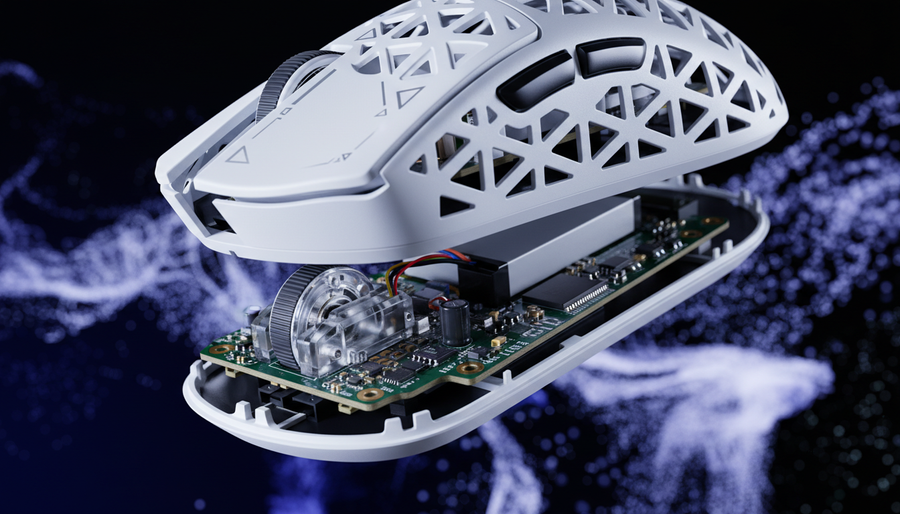
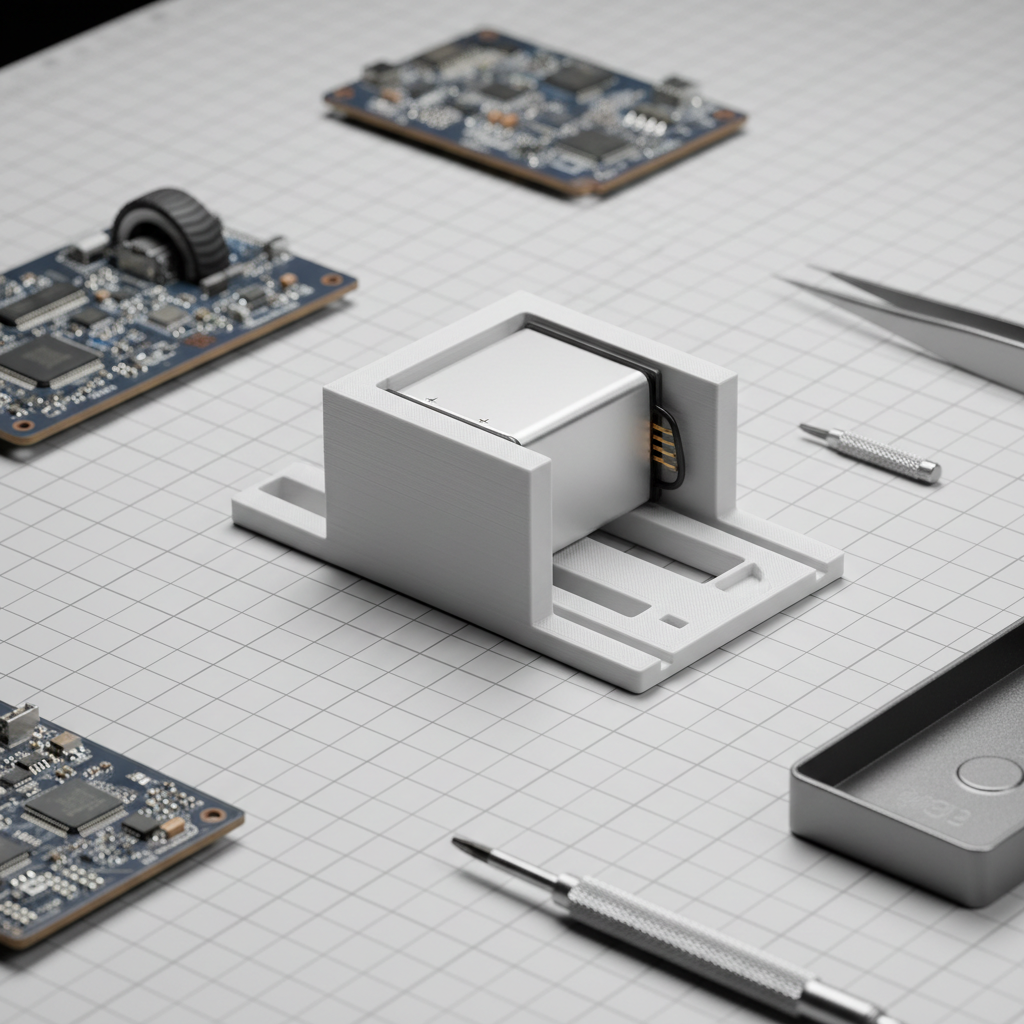
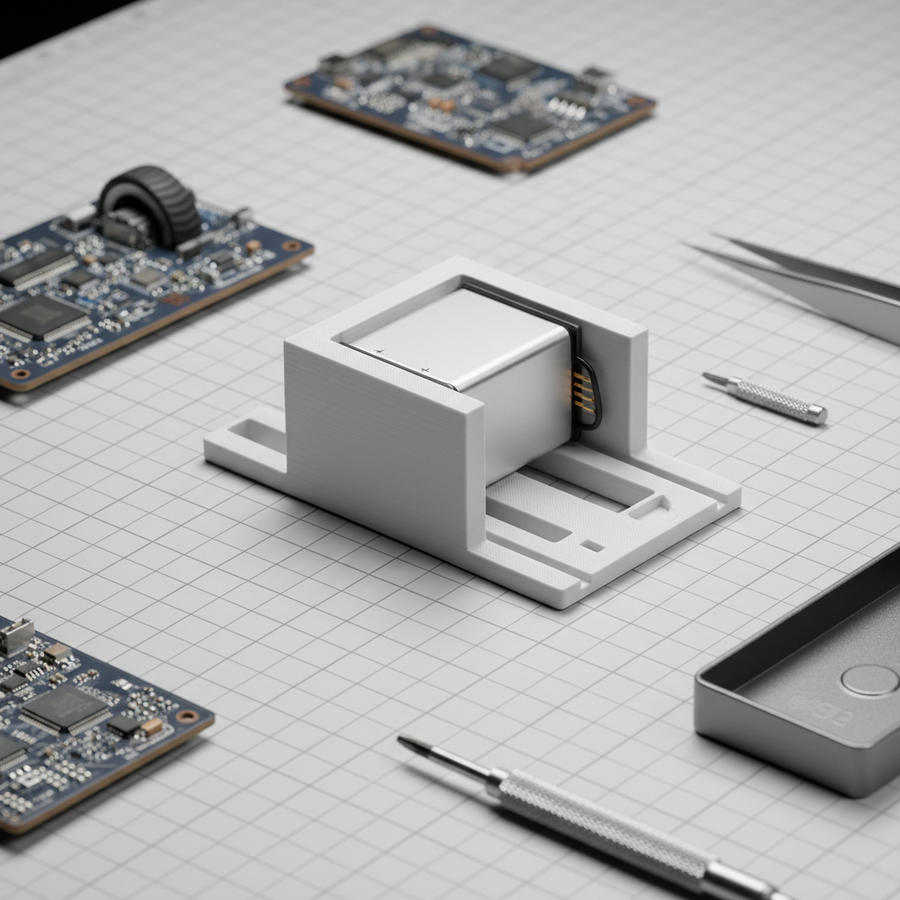
Custom internal brackets, fabricated via 3D printing, represent a sophisticated hardware modification designed to provide a modular solution for this balance dilemma. By replacing static internal structures with adjustable frames, users can shift the battery—typically the densest component in a wireless peripheral—to align the mouse's pivot point with their specific grip style. This technical guide explores the mechanisms of weight redistribution, the CAD constraints of internal modding, and the performance implications for high-spec sensors.
Biomechanical Impact of Weight Distribution
The human hand acts as a complex system of levers. In a fingertip grip, the fulcrum is located at the proximal joints of the fingers, making the user highly sensitive to the rotational inertia of the mouse. If the CoG is located too far behind the sensor, the user must exert more force to initiate a "flick," leading to overshooting or increased muscle fatigue.
Scenario Modeling: The Large-Handed Fingertip User
To quantify the risk of improper balance, we modeled a scenario involving a competitive gamer with large hands (approximately 20.5cm in length), which aligns with the 95th percentile of male hand measurements according to the ANSUR II Anthropometric Database.
Using the Moore-Garg Strain Index (SI)—a validated tool for assessing the risk of distal upper extremity disorders—we analyzed the workload of high-intensity micro-adjustments.
| Parameter | Value/Range | Unit | Rationale/Source |
|---|---|---|---|
| Intensity of Effort | 2 (Sustained Precision) | Multiplier | Low-force but high-precision aiming |
| Efforts per Minute | 6 (Micro-adjustments) | Multiplier | Average frequency in FPS scenarios |
| Posture Multiplier | 2 (Wrist Deviation) | Multiplier | Mismatch between hand size and shell |
| Speed of Movement | 2 (Rapid Flicks) | Multiplier | High-velocity competitive movements |
| Calculated SI Score | 36 | Score | Hazardous Threshold (>5) |
Modeling Note: This is a deterministic scenario model used to identify ergonomic risk factors, not a controlled laboratory study or medical diagnosis. The high SI score (36) indicates that large-handed users using standard-sized mice are at an elevated risk of strain-induced fatigue. This risk is primarily driven by the "posture" and "intensity" multipliers, which can be mitigated by shifting the mouse's center of mass forward to reduce the inertial load on the fingers.
By implementing a 3D-printed bracket that allows the battery to slide ~5–10mm forward, the user moves the CoG closer to the natural fulcrum of the fingers. In practice, this reduces the force required for micro-corrections, potentially lowering the intensity multiplier in the strain model.
Designing Modular Internal Brackets
The primary objective of a "BalanceBase" mod is to create an internal skeleton that supports the PCB and battery while allowing for longitudinal adjustment. This requires a deep understanding of the internal spatial constraints of the peripheral.
1. Material Selection: PLA vs. PETG vs. Advanced Polymers
For most DIY modders, the choice of filament is a trade-off between stiffness and weight.
- PLA (Polylactic Acid): Offers the highest rigidity, which is essential for maintaining a consistent sensor-to-pad distance. However, it can be brittle.
- PETG (Polyethylene Terephthalate Glycol): Provides better impact resistance and is less likely to snap during assembly, though it is slightly more flexible than PLA.
- Advanced Materials: While industrial-grade materials like PEEK or DMLS Aluminum provide superior strength-to-weight ratios, they are often cost-prohibitive for individual mods, with DMLS parts often exceeding $100 per unit. According to the Global Gaming Peripherals Industry Whitepaper (2026), the industry is trending toward high-performance glass-fiber reinforced polymers to achieve similar rigidity at a lower mass.
2. Structural Integrity and Ribbing
To minimize weight without sacrificing the "click feel" of the main buttons, the bracket must use structural ribbing. This involves removing solid material and replacing it with a lattice or T-beam structure. This technique, often referred to as "topological optimization," ensures that the frame does not flex when the user applies downward pressure during intense gaming sessions.

The Practitioner's Workflow: The Finger Balance Test
Achieving a neutral balance is a process of trial and error. Experienced modders often use the "Finger Balance Test" to verify the CoG before final assembly.
- Preparation: Assemble the internal components (PCB, 3D-printed bracket, battery) but leave the top shell off.
- The Fulcrum: Place two pencils or thin dowels on a flat surface, spaced approximately 40mm apart.
- Positioning: Place the mouse board on the pencils so that one pencil is directly under the sensor and the other is near the front edge of the PCB.
- Adjustment: Slide the battery along the custom bracket until the board remains perfectly horizontal without tipping forward or backward.
- Temporary Securing: Use a small amount of poster tack or double-sided tape to hold the battery in this "neutral" position for playtesting.
Professional Insight: We often observe that moving the battery too far forward can make the mouse feel "nose-heavy," which stabilizes tracking but makes vertical flicks more difficult. A neutral balance is typically the most versatile starting point for most competitive titles.
Electrical and Signal Constraints
Modifying the internal layout of a wireless mouse introduces risks related to Radio Frequency (RF) interference.
The Faraday Cage Effect
Lithium-ion batteries are encased in metal foils that can block or reflect 2.4GHz signals. If a custom bracket places the battery too close to the antenna trace on the PCB, it can create a "dead zone" in the signal, leading to packet loss or increased latency.
- Recommendation: Ensure a minimum clearance of 3–5mm between the battery casing and the antenna area.
- Verification: Use tools like the NVIDIA Reflex Analyzer to monitor system latency after the mod. A sudden increase in "Mouse Latency" or "System Latency" often indicates signal degradation rather than a sensor issue.
8000Hz (8K) Polling Considerations
For users seeking the near-instant 0.125ms response time of 8000Hz polling, internal stability is paramount. High polling rates increase the CPU's IRQ (Interrupt Request) load. Any physical instability in the battery or PCB can lead to micro-vibrations that the high-resolution sensor (e.g., PixArt PAW3395) might interpret as unintended motion.
To saturate the 8000Hz bandwidth, a user must move the mouse at least 10 IPS (Inches Per Second) at 800 DPI. At higher settings, such as 1600 DPI, only 5 IPS is required to maintain a consistent 8K data stream. A well-balanced mouse allows for smoother micro-movements at these high velocities, ensuring the system receives clean data without the "jitter" associated with an unbalanced chassis.
Safety and Regulatory Compliance
When handling internal components, particularly lithium-ion batteries, adherence to safety standards is non-negotiable.
- Battery Integrity: Ensure the battery has not been punctured or compressed during the mod. Batteries should ideally meet UN 38.3 standards for transport safety and IEC 62368-1 for electronic safety.
- RF Compliance: Modifications to the internal structure can technically alter the device's RF characteristics. While DIY mods are common, professional entities must ensure devices remain within FCC Part 15 limits for intentional radiators to avoid interference with other wireless equipment.
- Material Safety: Use filaments that are compliant with RoHS (Restriction of Hazardous Substances) to ensure that the mod does not introduce restricted chemicals into the gaming environment.
Optimizing Performance for High-Refresh Environments
The visual benefit of a perfectly balanced mouse is most apparent on high-refresh-rate monitors (240Hz or 360Hz+). While the "1/10th Rule" (suggesting a 10:1 ratio between polling and refresh) is a common community myth, the actual relationship is one of perceptual smoothness. A high polling rate reduces the "micro-stutter" of the cursor path, but it requires a balanced physical chassis to allow the user to execute the steady, high-speed swipes that these monitors are capable of rendering.
Technical Checklist for Balance Modding
- Weight Target: Aim for a total mass reduction of 5–10% while maintaining structural rigidity.
- Pivot Point: Align the CoG within ±2mm of the sensor's optical center.
- Connectivity: Use direct motherboard USB ports (Rear I/O) to avoid the IRQ conflicts often found in front-panel headers or unpowered hubs.
- Firmware: Always verify the mod with the Official Driver to ensure the sensor and MCU are reporting correctly after the hardware change.
Conclusion
3D printing custom internal brackets is more than a weight-reduction tactic; it is a precision engineering approach to gaming ergonomics. By shifting the internal mass to suit specific hand sizes and grip styles, modders can significantly reduce the biomechanical strain associated with competitive play while maximizing the potential of high-performance sensors. While the process requires technical diligence—particularly regarding RF interference and structural rigidity—the resulting "perfect" balance provides a quantifiable edge in consistency and comfort.
YMYL Disclaimer: This article is for informational purposes only. Modifying electronic devices involves risks, including the potential for electrical shock, fire, and voiding of warranties. Always handle lithium-ion batteries with extreme caution. If you are unsure of your technical ability, consult a professional.


コメントを書く
このサイトはhCaptchaによって保護されており、hCaptchaプライバシーポリシーおよび利用規約が適用されます。