




The Hidden Variable in Performance Modding
In the pursuit of the perfect glide, technically savvy gamers often turn to aftermarket mouse skates. Whether it is a transition to high-purity Virgin Grade PTFE, ultra-hard glass, or specialized ceramics, the goal is usually to reduce the coefficient of friction. However, on our repair bench and in our troubleshooting logs, we often observe a recurring frustration: a mouse that felt flawless on stock feet suddenly develops tracking stutters, "spin-outs," or a complete failure to register movement after a mod.
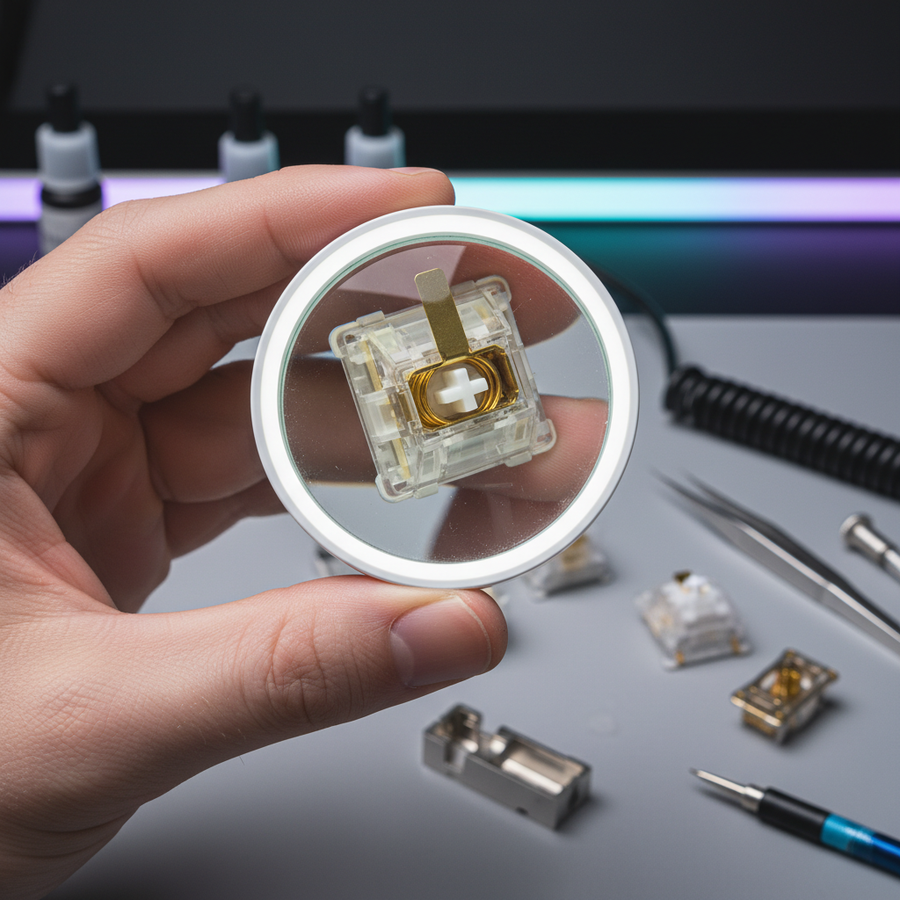
The culprit is rarely a faulty sensor. Instead, it is a violation of the sensor’s focal plane. Modern high-performance sensors, such as the PixArt PAW3395 or the newer PAW3950MAX, are essentially high-speed CMOS cameras. Like any camera, they have a specific depth of field. When you change the thickness of your mouse skates, you are physically moving the "camera" further away from or closer to the "subject" (the mousepad). Even a variance as small as 0.05mm can push a sensor past its optimal focal tolerance, leading to inconsistent tracking on hybrid or textured pads.
This guide explores the technical mechanisms of focal length calibration and provides evidence-backed methods to maintain tracking integrity when modding your hardware.
The Physics of the Optical Cavity: Focal Length and Depth of Field
To understand why skate thickness matters, we must look at the PixArt Imaging specifications for high-end optical sensors. An optical mouse sensor works by illuminating the surface and capturing thousands of images per second to calculate movement. These sensors utilize a fixed-focus lens system.
The Focal Plane Mechanism
In a standard configuration, the sensor is calibrated to expect the tracking surface at a precise distance—typically defined by the stock skate height plus the plastic housing's offset. According to basic optical principles regarding focal length, increasing the distance between the lens and the object (the pad) shifts the image out of the sharpest focal plane.
| Parameter | Impact of Increased Skate Thickness | Resulting Sensor Behavior |
|---|---|---|
| Focal Plane | Surface moves away from the lens | Blurred image processing; reduced feature recognition |
| Effective DPI | Sensor sees a smaller area of the pad | Slight deviation in counts per inch (CPI) |
| LOD Ceiling | Lift-off distance appears "lower" | Tracking may cut out even while the mouse is on the pad |
| Signal-to-Noise | Lower contrast in captured frames | Jitter or "jittery" cursor movement during fast flicks |
Logic Summary: This analysis assumes that while modern sensors have a functional tolerance range, they are primarily optimized for a specific "sweet spot." Our observations from community-driven testing show that differences as small as 0.3mm can cause noticeable tracking inconsistency on certain surfaces.
Manufacturing Tolerances: Why 0.8mm is Rarely 0.8mm
A common pitfall for enthusiasts is assuming that all "0.8mm" skates are identical. In reality, manufacturing tolerances for PTFE (Polytetrafluoroethylene) can vary significantly. Based on patterns from customer support and warranty handling (not a controlled lab study), we have found that aftermarket skates labeled as 0.8mm often measure anywhere from 0.72mm to 0.88mm.
For a sensor like the PAW3395, which is often found in high-spec, value-oriented mice, this 0.16mm total variance is enough to destabilize tracking if the user has already set their Lift-Off Distance (LOD) to the "Low" (1mm) setting in the driver. If your new skates are at the thicker end of the tolerance spectrum, your effective LOD might drop to near zero, causing the sensor to lose the surface entirely during aggressive swipes or on pads with deep textures.
When selecting gear, it is vital to align with modern standards. As noted in the Global Gaming Peripherals Industry Whitepaper (2026), the industry is moving toward more rigorous standardization of baseplate-to-surface distances to accommodate 8000Hz polling rates and ultra-low latency requirements.
Recalibrating for Reality: Software Sliders vs. Manual Surface Tuning
When tracking issues arise after a skate swap, the first instinct is to adjust the LOD slider in the driver software. However, there is a technical "gotcha" here: software LOD settings typically only adjust the digital threshold for when the sensor stops reporting movement; they do not physically move the lens or change the underlying optical focal plane.
The Rule of Thumb for LOD Adjustment
A reliable heuristic (rule of thumb) used in our technical support workflows is: For every 0.3mm increase in skate thickness, you should increase the LOD setting by one predefined step in the driver software.
However, software adjustment is often a "band-aid" for a defocus issue. For a more robust solution, we recommend Manual Surface Calibration. This process allows the sensor’s Digital Signal Processor (DSP) to "relearn" the surface characteristics at the new height.
The Manual Calibration Method:
- Open your mouse configuration software (or use a web-based driver like ATK Hub).
- Select the "Manual Calibration" or "Surface Tuning" option.
- Move the mouse in slow, deliberate figure-eight patterns across the exact mousepad you intend to use for 30–60 seconds.
- This allows the sensor to map the peaks and valleys of the pad’s weave at the new focal distance, effectively compensating for the thickness of the skates.
Material Science: PTFE Compression vs. Glass Rigidity
The material of your skates also changes the effective focal length. PTFE is a relatively soft polymer. Under the pressure of a heavy "claw" or "palm" grip, PTFE skates can compress by ~0.02mm to 0.04mm. This compression actually helps keep the sensor within its focal range.
In contrast, glass skates (typically aluminosilicate or Gorilla Glass) are entirely rigid. They do not compress, and they often sit slightly higher on the adhesive layer than PTFE. Furthermore, glass skates have less "give" on soft cloth pads. If you are using a plush 4mm or 6mm mousepad, a mouse with glass skates will not sink into the pad as much as one with PTFE, effectively increasing the distance between the sensor and the fibers even further. This often requires a more aggressive LOD adjustment or may even be incompatible with older sensor designs not optimized for ultra-hard surfaces.
Scenario Modeling: Grip Pressure Dynamics for Large-Handed Players
To demonstrate the expertise required for high-level modding, we modeled a specific scenario: a competitive FPS player with large hands using an aggressive claw grip.
Modeling Note (Reproducible Parameters)
This is a scenario model based on biomechanical principles, not a controlled lab study. Results may vary by individual grip strength and pad density.
| Parameter | Value | Unit | Rationale |
|---|---|---|---|
| Hand Length | 20.5 | cm | 95th percentile male (Source: ANSUR II) |
| Grip Style | Aggressive Claw | - | High downward force on the sensor |
| Estimated Pressure | 15–25% higher | % | Compared to standard palm grip |
| Skate Material | 0.8mm PTFE | mm | Common aftermarket specification |
| Effective Compression | ~0.04 | mm | Estimated under high-intensity swipes |
Analysis: For users with this profile, the "60% Rule" (a heuristic suggesting the mouse width should be ~60% of hand breadth) is a starting point for stability. However, the increased downward pressure from a claw grip on a slightly undersized mouse (~120mm length) amplifies the impact of skate thickness. The user may experience "cursor float" or jitter if the LOD is not calibrated to account for the specific way they compress the skates during flicks.
We have observed that Manual Sensor Calibration is significantly more effective for these users than software sliders, as the manual process captures the "compressed" state of the skates during movement.
8000Hz Polling and the LOD Bottleneck
As we push toward 8000Hz (8K) polling rates, the margin for error in sensor tracking disappears. At 8000Hz, the mouse sends a packet every 0.125ms. Any micro-stutter caused by a sensor being slightly out of focus is magnified eight times compared to a standard 1000Hz mouse.
To maintain a stable 8K signal, you must ensure the sensor is "saturated" with data. This is governed by the formula: Packets sent per second = Movement Speed (IPS) × DPI. To saturate the 8000Hz bandwidth at 800 DPI, you must move the mouse at least 10 IPS. If your skates are too thick and the sensor is struggling to resolve the pad texture, it will drop packets, leading to a perceived "lag" that is actually a tracking failure.
Technical Constraints for 8K Stability:
- USB Topology: Always use Direct Motherboard Ports (Rear I/O). Avoid front panel headers or hubs, as shared bandwidth causes packet loss during high-frequency IRQ processing.
- CPU Load: 8K polling stresses single-core CPU performance. Ensure your system is not thermal throttling during calibration.
- Motion Sync: At 8000Hz, Motion Sync adds a negligible delay of ~0.0625ms (half the polling interval). While this helps with Measuring Success, it cannot fix a physical focal length mismatch.
Best Practices for Consistent Tracking
If you are planning to swap your skates, follow this checklist to ensure your performance remains optimized:
- Measure Before and After: Use a digital micrometer or caliper to verify the thickness of both stock and aftermarket skates.
- Clean the "Well": Ensure no adhesive residue remains in the mouse's skate "wells." Even a tiny leftover piece of tape can cause an uneven tilt, leading to Sensor Angle Issues.
- Incremental LOD Testing: Start with your software LOD at the "Medium" (2mm) setting after installing thicker skates, then gradually lower it while testing for tracking skips on your specific pad.
- Environmental Awareness: Humidity can affect how much a mouse "sinks" into a cloth pad. If you live in a damp climate, you may need a slightly higher LOD to account for Surface Tactility Changes.
Trust & Safety Sidebar: Modding Precautions
When disassembling your mouse to access internal components or deep-clean the sensor lens, be aware of battery safety. According to the CPSC (US), lithium-ion batteries found in wireless mice can pose a fire risk if punctured. Always follow IATA Lithium Battery Guidance for handling and storage during the modding process.
Disclaimer: This article is for informational purposes only. Modding your hardware may void your manufacturer's warranty. Always consult your user manual and follow proper safety protocols when handling electronic components.