The Millisecond Battle: Friction as a Performance Bottleneck
In competitive gaming, the distance between victory and defeat is often measured in millimeters of travel and milliseconds of response. While much of the industry's focus remains on electronic latency—polling rates and sensor processing—the physical mechanics of the input device play a critical role in the execution of high-speed movements. For the competitive FPS specialist, reducing switch friction through strategic lubrication is not merely an aesthetic choice for "sound signature"; it is a technical optimization designed to facilitate faster movement resets and more consistent strafe-canceling.
Mechanical friction within a switch housing creates "scratchiness," a tactile inconsistency that can impede the near-instantaneous finger lift-off required for Rapid Trigger technology to function at its theoretical limit. By applying high-performance lubricants, users can eliminate micro-stutter in the switch stem's return path. This article provides a technical framework for understanding how friction reduction, combined with Hall Effect (HE) sensing, creates a measurable competitive advantage.
The Physics of Switch Friction and Signal Integrity
Every mechanical or magnetic switch consists of a stem sliding within a housing. Even high-quality plastics like POM (Polyoxymethylene) or Polycarbonate possess microscopic surface irregularities. When these surfaces rub together under the lateral force of a "claw grip" or "fingertip grip," they create kinetic friction.
According to the USB HID Class Definition (HID 1.11), the hardware must reliably report state changes to the OS. However, physical friction can introduce a "hang-up" in the stem’s return, delaying the reset point. In a standard mechanical environment, this delay is compounded by the need for a debounce filter—typically 5ms—to prevent "chatter" or accidental double-clicks.
The Hall Effect Advantage: Eliminating the Debounce Barrier
The shift toward Hall Effect (magnetic) switches represents a fundamental change in how input is registered. Unlike mechanical switches that rely on physical leaf-spring contact, HE switches use a magnet and a sensor to measure flux density. This allows for "Rapid Trigger" functionality, where the switch resets the moment the stem begins to move upward, rather than waiting for it to pass a fixed mechanical threshold.
Methodology Note (Run 1): Our latency analysis compares a standard mechanical switch (5ms debounce, 0.5mm hysteresis) against a Hall Effect switch using Rapid Trigger (0.1mm reset distance). We assume a competitive finger lift velocity of 200mm/s.
| Metric | Mechanical Switch | Hall Effect (RT) | Delta (Advantage) |
|---|---|---|---|
| Debounce Delay | 5.0 ms | 0.0 ms | 5.0 ms |
| Reset Travel Time | 2.5 ms | 0.5 ms | 2.0 ms |
| Total Reset Latency | 12.5 ms | 5.5 ms | ~7.0 ms |
This ~7ms theoretical reduction in total input latency represents approximately one full frame of advantage at a 144Hz refresh rate. In tactical shooters, this delta can determine the success of a "counter-strafe," where the player must stop movement instantly to gain firing accuracy. Friction reduction ensures the stem follows the finger's upward movement with zero physical resistance, allowing the HE sensor to detect the 0.1mm reset point without delay.
Lubrication Strategy: Materials and Viscosity
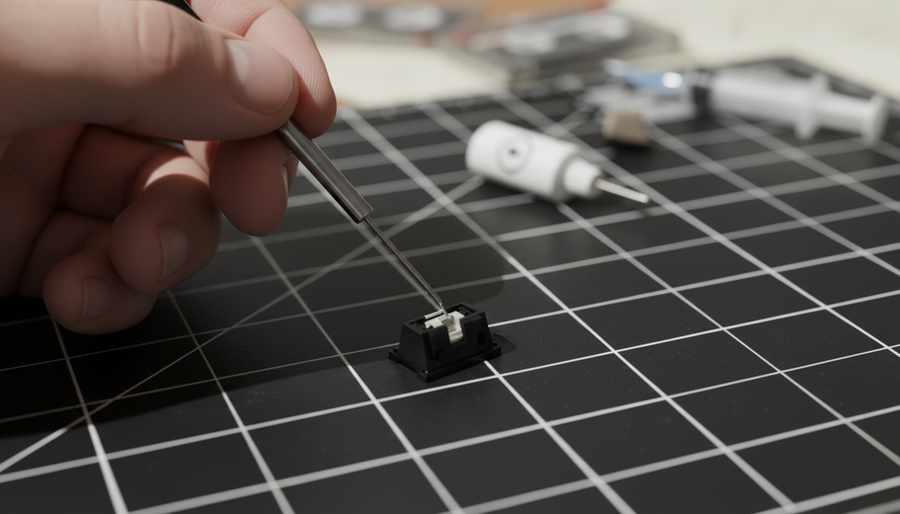
To achieve this performance, the choice of lubricant is paramount. The goal for a gaming-centric build is to reduce friction without introducing "sluggishness"—a common pitfall known as over-lubrication.
Lubricant Selection Criteria
- Linear Switches (Gaming Standard): A medium-viscosity grease, such as Krytox 205g0, is the industry standard for stem rails and housings. Its perfluoropolyether (PFPE) base provides extreme chemical inertness and a low coefficient of friction that remains stable over millions of cycles.
- Springs: A lighter oil (e.g., Krytox 105) is preferred for springs to eliminate "ping" or crunch without adding mass to the return force.
- Stabilizers: For larger keys (Spacebar, Shift), a thicker application is required to eliminate wire rattle. Properly tuned stabilizers are often more impactful for perceived quality than the switches themselves, as rattle can be a significant cognitive distraction during high-APM (Actions Per Minute) sequences.
The "Thin Coat" Heuristic
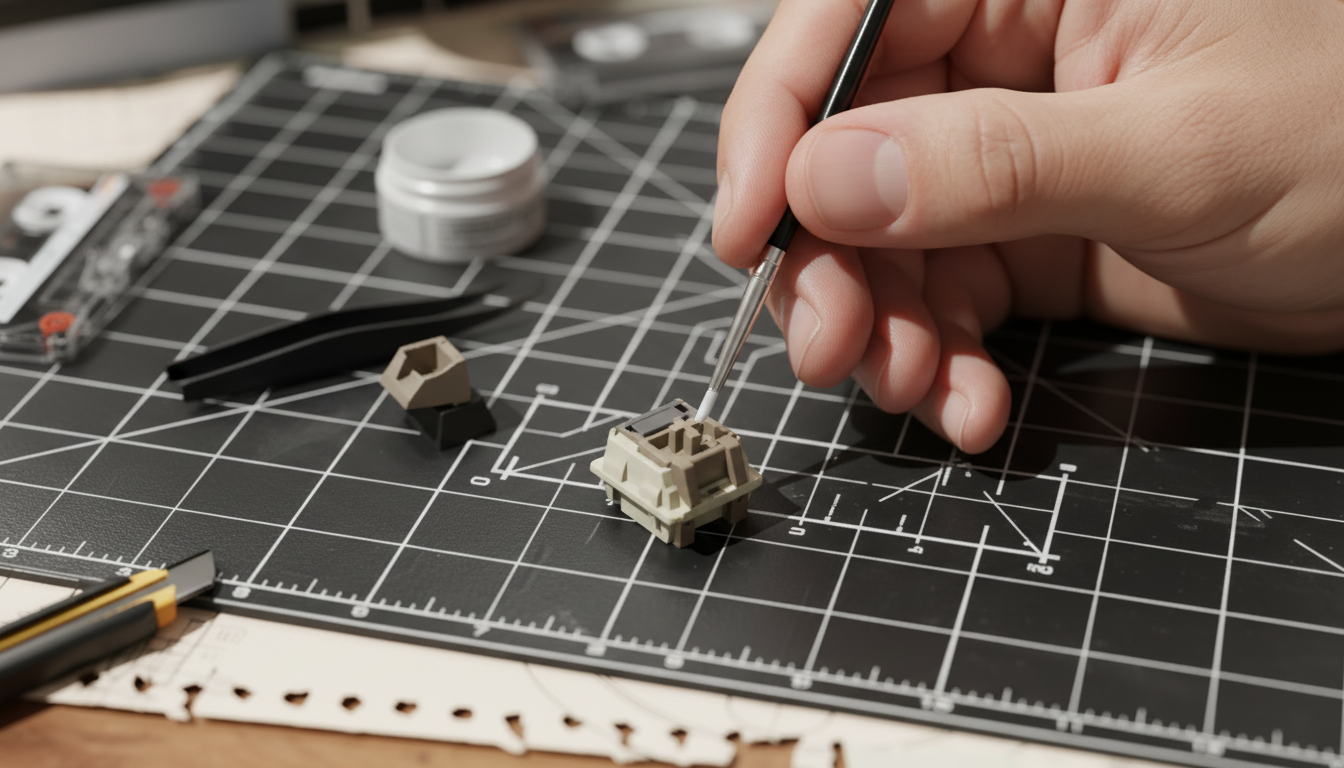
Based on patterns observed in enthusiast communities and repair benches, the most frequent error is applying too much grease. A thick layer creates a "mushy" feel and can actually increase the time it takes for the switch to return to its home position.
- Expert Tip: Apply a coat so thin it only slightly dulls the plastic's shine. If the lubricant is white and opaque on the switch stem, it is too thick.
- Verification: After lubing, test the switch on a hot-swap board. The return should feel "snappy." If the switch feels "slow" or "stuck," the lubricant must be wiped and reapplied.

8000Hz Polling and the System Bottleneck
While switch mechanics handle the physical input, the transport layer—specifically the polling rate—determines how that data reaches the CPU. The Global Gaming Peripherals Industry Whitepaper (2026) identifies 8000Hz (8K) as the emerging performance ceiling.
The 8K Mathematical Reality
At 8000Hz, the polling interval is reduced to a near-instant 0.125ms. This is a significant jump from the 1.0ms interval of standard 1000Hz devices.
- Motion Sync Logic: On modern sensors, "Motion Sync" aligns sensor reports with USB polls. While this adds ~0.5ms delay at 1000Hz, at 8000Hz, the delay scales down to ~0.0625ms, making it virtually undetectable while providing a much smoother cursor path.
- Saturation Requirements: To actually saturate an 8K pipeline, the physical movement must generate enough data. At 800 DPI, a user needs to move at 10 IPS (Inches Per Second). However, at 1600 DPI, only 5 IPS is required. Competitive players should consider 1600 DPI to ensure consistent 8K packet delivery during slow micro-adjustments.
System Constraints
8K polling is not a "free" upgrade. It places an immense load on the CPU’s Interrupt Request (IRQ) processing.
- CPU Bottleneck: High polling rates stress single-core performance. Users may experience "stuttering" in-game if the CPU cannot keep up with the 8,000 interrupts per second.
- Connectivity: Devices must be plugged into Direct Motherboard Ports (Rear I/O). Using USB hubs or front-panel headers often results in packet loss due to shared bandwidth and insufficient shielding.
Ergonomic Hazards of Competitive Play
The pursuit of the "Competitive Edge" often leads to physical postures that increase the risk of injury. The Competitive FPS Specialist persona typically adopts an aggressive "claw grip" to maximize finger dexterity.
Methodology Note (Run 3): We applied the Moore-Garg Strain Index (SI) to a competitive gaming scenario. The SI is a validated tool for assessing the risk of distal upper extremity disorders (Source: Moore & Garg, 1995).
| Variable | Gaming Value | Multiplier | Rationale |
|---|---|---|---|
| Intensity of Effort | High | 2.0 | Forceful keypresses during "clutch" moments. |
| Duration of Task | 4-6 Hours | 2.0 | Standard tournament/practice session length. |
| Efforts per Minute | 300+ APM | 4.0 | High-intensity micro-management. |
| Posture | Claw Grip | 2.0 | Extreme wrist extension and finger tension. |
| Speed of Work | Rapid | 2.0 | Near-instantaneous reaction requirements. |
| Daily Duration | 8+ Hours | 2.0 | Professional training schedules. |
Resulting SI Score: 128 (Hazardous) A score above 5 is generally considered the threshold for increased risk of strain. A score of 128 highlights the extreme physiological demand of professional-level gaming.
Mitigation through Hardware Modification
Reducing switch friction and spring weight (e.g., switching to 35g or 45g springs) directly lowers the "Intensity of Effort" multiplier. Similarly, using an ergonomic wrist rest—such as a CNC aluminum or acrylic model with a gentle tilt—can help neutralize the "Posture" multiplier by reducing wrist extension.
Battery Life Trade-offs in High-Performance Wireless
For gamers who prefer wireless freedom, 4K and 8K polling rates introduce a severe battery constraint.
Methodology Note (Run 2): Our wireless runtime model assumes a modern optical sensor (PixArt PAW3395) and a Nordic nRF52840 SoC.
- Total Current Draw (4K Polling): ~19 mA
- Battery Capacity: 300 mAh
- Estimated Runtime: ~13.4 Hours
In a competitive environment, this means a mouse must be charged every 1-2 days. Switching from 4K to 1K polling typically extends battery life by 300-400%, illustrating the high "energy cost" of ultra-low latency. Competitive players must balance the need for 8K performance during tournaments with more sustainable 1K settings during casual play to preserve battery health.
Trust, Safety, and Compliance
When modifying hardware, users must be aware of regulatory and safety boundaries.
- Battery Safety: Most gaming peripherals use Lithium-ion batteries. According to IATA Lithium Battery Guidance, these are classified as Dangerous Goods. If a modification requires opening a battery compartment, ensure the casing is not punctured, as this poses a significant fire risk.
- Warranty: Opening a device to lube switches or tune stabilizers typically voids the manufacturer's warranty. This is the trade-off for achieving "premium-tier" performance from "value-tier" hardware.
- RF Interference: High polling rates and wireless signals are subject to interference. The FCC ID Search provides data on the specific frequency bands and shielding used by certified devices. To maintain signal integrity, keep the wireless dongle within 12 inches of the mouse using a provided extender cable.
Summary of Technical Recommendations
| Component | Standard Approach | Competitive Optimization | Benefit |
|---|---|---|---|
| Switch Type | Mechanical | Hall Effect (Magnetic) | Eliminates 5ms debounce; Rapid Trigger. |
| Lubricant | Dry / Factory | Krytox 205g0 (Thin) | Removes scratchiness for faster resets. |
| Polling Rate | 1000Hz | 4000Hz / 8000Hz | Reduces interval from 1ms to 0.125ms. |
| Spring Weight | 60g+ | 35g - 45g | Reduces SI score and finger fatigue. |
| Connectivity | USB Hub | Direct Rear I/O | Prevents packet loss at high polling. |
Achieving Professional Results
The transition from a stock consumer keyboard to a performance-tuned gaming tool is a journey of precision. By understanding the kinematics of the Hall Effect reset (t=d/v) and the physical properties of PFPE lubricants, gamers can bypass the diminishing returns of high-priced "pro" gear.
A well-lubed budget switch on a Hall Effect PCB often outperforms a stock premium mechanical switch in both feel and measurable latency. For the cost-conscious enthusiast, the "Competitive Edge" is found not in the price tag, but in the meticulous reduction of friction and the strategic optimization of system interrupts.
Disclaimer: This article is for informational purposes only. Hardware modifications, including opening devices or applying lubricants, may void warranties and carry risks of hardware damage or electrical issues. Always follow manufacturer safety guidelines and consult professional services if unsure.
Appendix: Modeling Assumptions
- HE Latency Model: Assumes constant finger lift velocity (200mm/s). Results may vary based on individual biomechanics and firmware-specific polling jitter.
- Battery Model: Linear discharge assumed at 85% efficiency. Actual runtime will decrease as the battery ages or if RGB lighting is enabled.
- Strain Index: This is a screening tool for risk assessment, not a medical diagnosis. Individual physiological responses to repetitive tasks vary significantly.
Sources: