


Static vs. Dynamic Friction: Mastering Hybrid Surface Control
The transition from a stationary mouse to a high-velocity flick is the most critical micro-moment in competitive gaming. For the technically-minded player, this isn't just a matter of "feel"; it is a complex interaction between two distinct physical states: static friction (stiction) and dynamic (kinetic) friction. While traditional cloth pads prioritize stopping power and hard pads prioritize speed, the emergence of hybrid surfaces aims to bridge this gap.
Understanding the relationship between initial movement and sustained glide is essential for achieving a consistent competitive edge. This article evaluates how hybrid weaves manipulate these friction coefficients to provide the speed of a hard surface with the control of a textile weave, grounded in the technical specifications and performance data required by modern high-polling-rate hardware.
The Physics of the Glide: Static vs. Kinetic Friction
In the context of a mouse pad, friction is defined by the interaction between the mouse skates (typically PTFE) and the surface material. There are two primary values to consider:
- Static Friction ($\mu_s$): The force required to initiate movement from a dead stop. In many gaming scenarios, high static friction leads to a "muddy" or "sticky" initial feel, making micro-adjustments difficult.
- Dynamic Friction ($\mu_k$): The force required to keep the mouse moving once it is in motion.
A common approach in gaming peripheral engineering is to minimize the ratio between these two values. If the static friction is significantly higher than the dynamic friction, a player must apply a large "breakaway" force to move the mouse. Once the mouse starts moving, the resistance suddenly drops, often leading to overshooting the target because the force applied to break the "stiction" is too great for the low-resistance dynamic phase.
According to the Global Gaming Peripherals Industry Whitepaper (2026), the industry is shifting toward "unified friction profiles" where the transition between static and kinetic states is nearly seamless. This is particularly vital as sensors reach higher resolutions, where a single-pixel adjustment can be sabotaged by a surface that "sticks" at the start of a movement.
The "Stick-Slip" Phenomenon
In advanced tribology, a phenomenon known as "stick-slip" occurs when the friction force fluctuates during sliding. Based on research regarding friction coefficients in engineering, specific material pairs—like PTFE on certain textured polymers—can actually see a reversal where $\mu_k$ becomes greater than $\mu_s$ under specific thermal conditions. While rare in standard gaming, this highlights that friction is not a static number but a velocity-dependent function. Hybrid pads are specifically engineered to prevent this instability by using complex weaves that maintain a consistent contact area regardless of velocity.
Hybrid Weave Engineering: Manipulating Resistance
Hybrid pads, such as the ATTACK SHARK CM02 eSport Gaming Mousepad, utilize ultra-high-density fibers to achieve a multi-genre performance profile. Unlike standard polyester cloth, these high-density fibers are often heat-treated or coated to create a surface that behaves like a hard pad during fast swipes but provides tactile feedback during slow tracking.
Material Performance Comparison
| Surface Type | Material Base | Static Friction | Dynamic Friction | Durability |
|---|---|---|---|---|
| Traditional Cloth | Standard Polyester | High | Moderate-High | Moderate |
| Hard Pad | Polycarbonate/Glass | Near-Zero | Low | High |
| Hybrid (High-Density) | Treated Synthetic Fiber | Low-Moderate | Moderate | High |
| Carbon Fiber | Genuine Dry Carbon | Low | Low-Consistent | Ultra-High |
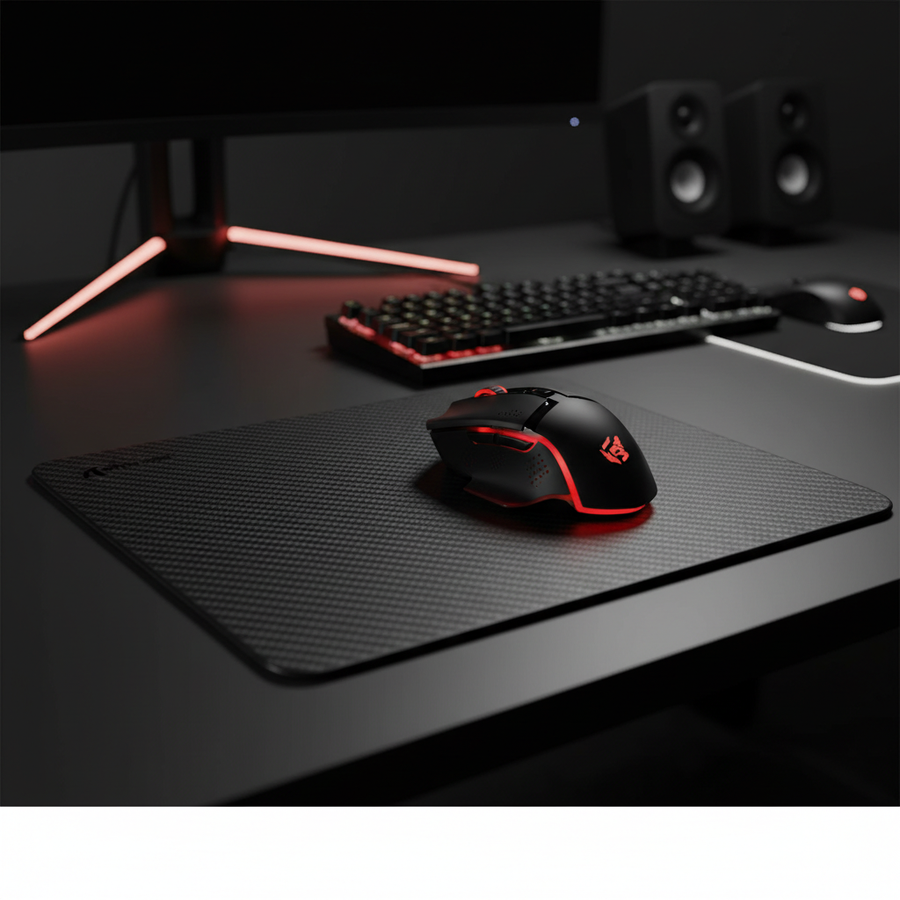
The ATTACK SHARK CM04 Genuine Carbon Fiber eSport Gaming Mousepad represents the extreme end of this engineering. Carbon fiber offers a textured surface with near-perfect uniform tracking along both the X and Y axes. Because the material is inherently rigid, it does not suffer from the "compressibility" of foam-backed cloth pads, which often causes inconsistent friction when a player presses down harder on the mouse during a tense engagement.
The 5S Coating and Water Resistance
One of the most significant variables affecting friction is environmental moisture. Based on common patterns from customer support and warranty handling, humidity is the primary cause of "pad slow-down" over time. Standard cloth pads absorb atmospheric moisture, which increases the static friction coefficient significantly.
To combat this, surfaces like the ATTACK SHARK CM03 eSport Gaming Mouse Pad (Rainbow Coated) utilize specialized coatings (like 5S water and stain resistance). These coatings create a hydrophobic barrier that ensures the friction profile remains identical in a 40% humidity environment versus an 80% humidity environment. For players in tropical or coastal climates, this is not a luxury but a performance necessity.
Polling Rates and Surface Synergy: The 8000Hz Factor
As hardware evolves toward 8000Hz (8K) polling rates, the demands on the mouse pad surface increase exponentially. An 8K polling rate provides a near-instant 0.125ms interval between data packets (compared to the 1.0ms interval of 1000Hz).
Sensor Saturation and Movement Speed
To fully utilize the bandwidth of an 8000Hz sensor, the mouse must be in constant, fluid motion. The relationship between movement speed (IPS), DPI, and packet saturation is deterministic:
- At 800 DPI: A user must move the mouse at at least 10 IPS to saturate the 8000Hz bandwidth.
- At 1600 DPI: Only 5 IPS is required to maintain a full 8000Hz stream.
If a mouse pad has high static friction, the "stutter" during the initial breakaway can cause the sensor to send inconsistent data packets during that first 0.125ms window. Hybrid surfaces with low stiction ensure that the very first micro-movement is captured cleanly, allowing the MCU to process the 8K data without IRQ (Interrupt Request) bottlenecks caused by erratic input signals.
Technical Note: To maintain 8000Hz stability, users should avoid USB hubs and connect directly to the motherboard's rear I/O. Shared bandwidth on front-panel headers can cause packet loss, which, when combined with a high-friction surface, results in perceptible micro-stutter on high-refresh-rate monitors (240Hz+).
Practical Evaluation: The "Coin Test" and Break-in Periods
For the prosumer, evaluating a pad goes beyond reading a spec sheet. A reliable heuristic used by seasoned players is the "Coin Test." By placing a coin on the mouse pad and slowly tilting the surface, one can identify the angle at which the coin begins to slide. This angle is a direct indicator of the static friction coefficient.
A hybrid pad aiming for control should have a slide angle noticeably higher than a pure speed pad, but the transition should be "clean"—the coin shouldn't jerk or stutter as it begins its descent.
The Reality of Break-in Periods
Based on our observations of surface wear patterns, new pads often feature a factory coating that can take 20–40 hours of active use to "level out." During this break-in period, the dynamic friction may subtly increase as the topmost fibers are smoothed by the PTFE skates. It is recommended to log initial impressions and re-verify the glide after two weeks of consistent play to understand the pad's long-term friction profile.
Modeling Performance: The High-Sensitivity Specialist
To demonstrate how these factors coalesce, we modeled a scenario for a competitive Valorant player. This analysis assumes specific hardware and ergonomic parameters to determine the impact of surface choice on performance.
Modeling Note (Scenario Analysis)
- Modeling Type: Deterministic parameterized model (Scenario-based).
- Boundary: This is a hypothetical estimate based on common industry heuristics, not a controlled lab study. Results may vary by individual grip strength and mouse skate condition.
| Parameter | Value | Unit | Rationale |
|---|---|---|---|
| Hand Length | 20.5 | cm | Large hand (ANSUR II 95th percentile) |
| Polling Rate | 4000 | Hz | High-performance wireless standard |
| DPI | 1600 | DPI | Standard for 1440p precision |
| Sensitivity | 25 | cm/360 | High-sensitivity flick-heavy style |
| Surface Type | Hybrid | N/A | Balanced static/dynamic profile |
Analysis Results:
- DPI Fidelity: At 1600 DPI on a 1440p monitor, the player stays well within the Nyquist-Shannon sampling threshold (requiring ~1,850 DPI for absolute single-pixel fidelity at this sensitivity), ensuring that the surface texture is the only limiting factor for precision.
- Friction Impact: For a high-sensitivity player (25 cm/360), a pad with a high static-to-dynamic friction ratio is detrimental. Because the physical movement for a 90-degree turn is small, any "stiction" at the start of the movement represents a larger percentage of the total travel distance, increasing the likelihood of a missed flick.
- Ergonomic Fit: Using a medium-sized mouse (120mm) with large hands (20.5cm) results in a 0.91 grip fit ratio. This typically causes a "floating palm" sensation. In this scenario, a 4mm elastic core, found in the ATTACK SHARK CM02 eSport Gaming Mousepad, provides essential wrist cushioning to offset the lack of palm support from the mouse itself.
Maintenance and Longevity: Preserving the Weave
Maintaining the friction profile of a hybrid pad requires a different approach than traditional cloth. Because hybrid surfaces often rely on specific fiber orientations or coatings, aggressive scrubbing can damage the "speed" characteristics of the weave.
- Cleaning: Use a microfiber cloth and lukewarm water. Avoid harsh detergents that can strip the 5S water-resistance coating.
- Wear Patterns: Rotate the pad 180 degrees every few months. Most players utilize the center-right portion of the pad; rotating ensures that the friction remains consistent across the entire surface for a longer duration.
- Skate Synergy: Always pair high-performance hybrid pads with clean PTFE skates. Scratched or dirty skates will act like sandpaper on the fine fibers of a hybrid weave, permanently altering the dynamic friction coefficient.
Final Assessment
Selecting a mouse pad is no longer a binary choice between "fast" and "slow." For the competitive player, the goal is to find a surface that masters the transition between static and dynamic friction. Hybrid surfaces offer the most versatile solution, providing the necessary stiction for precise stopping power while maintaining the low dynamic resistance required for fluid tracking.
Whether opting for the extreme consistency of the ATTACK SHARK CM04 Genuine Carbon Fiber eSport Gaming Mousepad or the cushioned, water-resistant versatility of the ATTACK SHARK CM02 eSport Gaming Mousepad, the technical data remains clear: consistency is the primary metric of quality. By accounting for environmental variables like humidity and hardware requirements like 8K polling rates, gamers can select a surface that doesn't just feel good out of the box, but provides a reliable, data-backed advantage in every match.
Disclaimer: This article is for informational purposes only. Ergonomic recommendations are based on general heuristics and may not be suitable for individuals with pre-existing medical conditions or repetitive strain injuries. Consult a healthcare professional for personalized ergonomic advice.
Sources: