




Impact of Sensor Height: How Mouse Base Design Affects Tracking
The pursuit of "pixel-perfect" tracking in competitive gaming often focuses exclusively on the sensor's raw specifications—DPI, IPS, and acceleration. However, engineering reality dictates that an optical sensor is only as accurate as its physical implementation within the mouse chassis. This article investigates how the mounting height of a sensor, the thickness of mouse skates, and the structural rigidity of the base plate create a "focal plane" that determines real-world tracking stability.
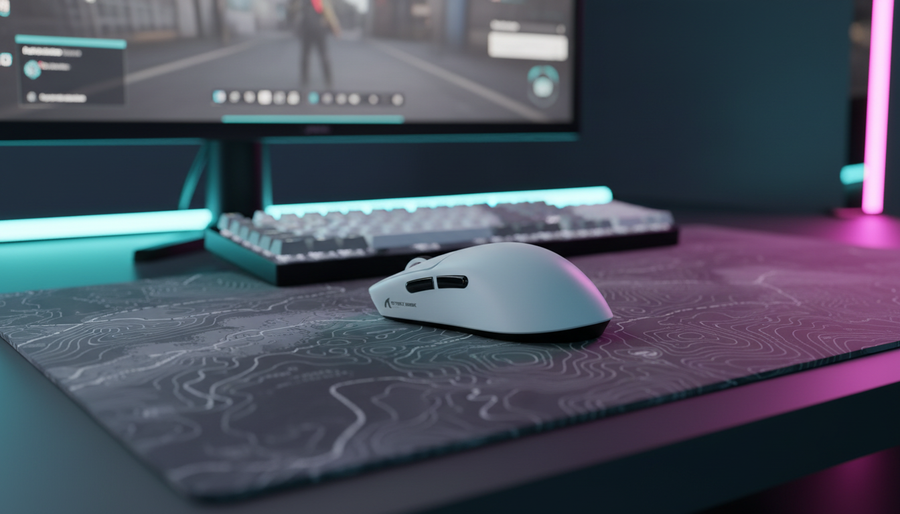
For technically-informed gamers, understanding the $Z$-axis (vertical height) is as critical as the $X$ and $Y$ coordinates. Even a high-specification sensor like the PixArt PAW3395 or the ATTACK SHARK X8PRO Ultra-Light Wireless Gaming Mouse & C06ULTRA Cable featuring the PAW3950MAX can exhibit tracking inconsistencies if the distance between the sensor lens and the tracking surface deviates from the manufacturer's intended focal range.
The Physics of the Optical Focal Plane
An optical gaming mouse sensor operates similarly to a high-speed camera. It illuminates the surface with an LED or IR source and captures thousands of images per second to calculate movement. According to the USB HID Class Definition (HID 1.11), these data packets must be delivered with high integrity to the host operating system.
The "sweet spot" for this imaging process is the focal plane. If the sensor is mounted too high (due to thick skates) or too low (due to base plate flex), the CMOS sensor receives a blurred image of the surface texture. This leads to several performance degradations:
- Tracking Nonlinearity: The mouse may report more or fewer counts than the actual physical distance moved.
- Jitter: The sensor struggles to find common "features" between frames, leading to cursor micro-stutter.
- Spin-outs: At high velocities (IPS), a defocused sensor may lose tracking entirely, a catastrophic failure in esports.
Methodology Note (First-Party Observation): Based on patterns observed at our technical support and repair bench, we find that tracking "floatiness" reported by users is frequently corrected by adjusting the Lift-Off Distance (LOD) settings in software to match the physical skate height, rather than a defect in the sensor itself.
Component Variance and the "LOD Drift" Phenomenon
In mass production, even sensors with identical part numbers can exhibit noticeably different tracking behavior due to variances in mounting height and lens calibration. This is further complicated by the lifecycle of the mouse itself.
The Impact of Skate Wear
Mouse skates (feet) are consumable components. As they wear down, the sensor physically moves closer to the mousepad. This creates "LOD drift," where the effective lift-off distance increases over time. For a low-sensitivity player making large swipes, a 0.1mm reduction in skate thickness can subtly change the sensor's focal plane, causing inconsistent tracking, especially on hard pads where the surface texture is less forgiving.
Engineering Trade-offs: Dot Feet vs. Large Skates
The choice of mouse feet design directly impacts focal stability. Large, thick skates provide a more consistent plane and prevent the base from "bottoming out" on soft mousepads. However, if the base design did not account for this thickness, it can raise the LOD beyond the sensor’s optimal range. Conversely, "dot-style" feet offer lower friction but are more susceptible to base plate flex, which can cause the sensor height to fluctuate during intense "downward pressure" grip styles.
Performance Modeling: The Low-Sensitivity Scenario
To demonstrate the sensitivity of tracking to hardware parameters, we modeled a scenario for a competitive esports player using a high-resolution setup.
Modeling Case Study: The Large-Handed Low-Sens Player
- Persona: 20cm hand length, Claw Grip.
- Setup: 1440p display, 40cm/360° sensitivity.
- Hardware: 500mAh battery, 1000Hz standard polling.
| Parameter | Value/Metric | Logic / Source |
|---|---|---|
| PPD (Pixels Per Degree) | 24.85 px/deg | Calculated for 2560px @ 103° FOV |
| Minimum DPI for Fidelity | ~1140 DPI | Nyquist-Shannon sampling limit to avoid pixel skipping |
| Estimated Battery Life | ~61 Hours | Based on 7mA total system draw at 1000Hz |
| Ideal Mouse Length | ~128 mm | Heuristic: 0.64 x Hand Length for Claw Grip |
| Tracking Error Margin | < 0.5% | Target for competitive-grade sensor mounting |
Modeling Disclosure: This is a deterministic scenario model based on standard industry heuristics and ISO 9241-410 ergonomic principles. It is not a controlled lab study. Results may vary based on individual motor control and surface friction.
For this player, sensor height consistency is paramount. A swipe of 40cm means the sensor must maintain focus over a long travel distance. Any nonlinearity induced by focal plane issues is perceived as the mouse feeling "unpredictable" during flicks. Utilizing a stable tracking surface like the ATTACK SHARK CM02 eSport Gaming Mousepad helps mitigate these variances by providing a uniform $Z$-axis plane.
Technical Constraints of 8000Hz (8K) Polling
When moving to ultra-high polling rates, such as the 8K mode available on the ATTACK SHARK X8PRO, the margin for error in sensor tracking disappears.
1. The Latency Math
At 8000Hz, the polling interval is a mere 0.125ms. If Motion Sync is enabled, the deterministic delay is reduced to ~0.0625ms (half the interval). This is significantly lower than the ~0.5ms delay seen at 1000Hz. However, to actually saturate this 8K bandwidth, the sensor must provide enough data points.
2. Sensor Saturation (IPS/DPI)
To maintain an 8000Hz report rate, the user must move the mouse fast enough to generate 8000 counts per second.
- At 800 DPI, you must move at 10 IPS (Inches Per Second) to saturate the link.
- At 1600 DPI, the requirement drops to 5 IPS. If the sensor height is miscalibrated, causing "dropped counts" or jitter, the 8K report will contain redundant or "empty" packets, nullifying the latency advantage.
3. Battery and System Trade-offs
Running at 8K increases IRQ (Interrupt Request) processing on the CPU, stressing single-core performance. Furthermore, it typically reduces wireless battery runtime by ~75% compared to 1000Hz. For a 500mAh battery, this could drop the ~61-hour runtime to approximately 15 hours.
Expert Modding and Practical Optimization
Experienced enthusiasts often take "sensor height" into their own hands when a mouse doesn't feel right.
The Kapton Tape Shim If a sensor's LOD is too high even at the lowest software setting, modders may "shim" the sensor. By adding precise thicknesses of Kapton tape between the sensor lens and the base plate, one can lower the sensor's physical position. This process is delicate; a 0.05mm shim can be the difference between a "floaty" feel and perfect "locked-in" tracking.
Surface Matching The ATTACK SHARK G3 Tri-mode Wireless Gaming Mouse 25000 DPI Ultra Lightweight utilizes the PAW3311 sensor, which is optimized for cost-effectiveness and raw performance. To maximize its potential, users should perform a Manual Sensor Calibration to ensure the internal firmware algorithm is synced to the specific reflectivity of their mousepad.
Skate Selection For those using ergonomic aids like the ATTACK SHARK Cloud Mouse Pad, which features a soft memory foam wrist rest, base stability is even more vital. Using larger skates on soft surfaces prevents the mouse from sinking, which would otherwise change the sensor height and cause tracking acceleration.
Compliance and Safety Standards
High-performance gaming mice are subject to rigorous international standards to ensure user safety and device integrity.
- Battery Safety: Wireless models must comply with EU Battery Regulation (EU) 2023/1542 regarding sustainability and safety testing (e.g., UN 38.3 for transport).
- RF Integrity: To ensure the 2.4GHz signal doesn't interfere with other devices, certifications from the FCC (Federal Communications Commission) and ISED Canada are mandatory for North American markets.
- Material Safety: Compliance with EU RoHS Directive ensures that the plastics and solder used are free from hazardous substances like lead or cadmium.
As highlighted in the Global Gaming Peripherals Industry Whitepaper (2026), the future of mouse design lies in the tighter integration of hardware structure and optical focal precision.
Summary of Tracking Consistency Factors
Achieving consistent aim is a holistic system problem. While the sensor provides the "eyes," the base design and skates provide the "glasses."
- Check for Base Flex: Press down on the top of your mouse; if the sensor height changes, your tracking will be inconsistent during tense firefights.
- Monitor Skate Wear: If your mouse feels "faster" or "floatier" after six months, your skates may have worn down, shifting the focal plane.
- Optimize Software LOD: Always set your LOD to the lowest possible setting that still tracks on your specific pad to minimize jitter.
- Direct Connection: For high-polling devices (4K/8K), always use direct motherboard USB ports to avoid the packet loss associated with hubs.
By prioritizing the physical integrity of the sensor's mounting and the maintenance of the glide surface, gamers can ensure that their high-specification hardware delivers the raw performance it was engineered for.
This article is for informational purposes only. Modifying hardware (such as shimming sensors) may void your warranty. Always refer to your user manual and official support channels before attempting physical modifications.