The Operational Footprint: Redefining Mouse Movement Space
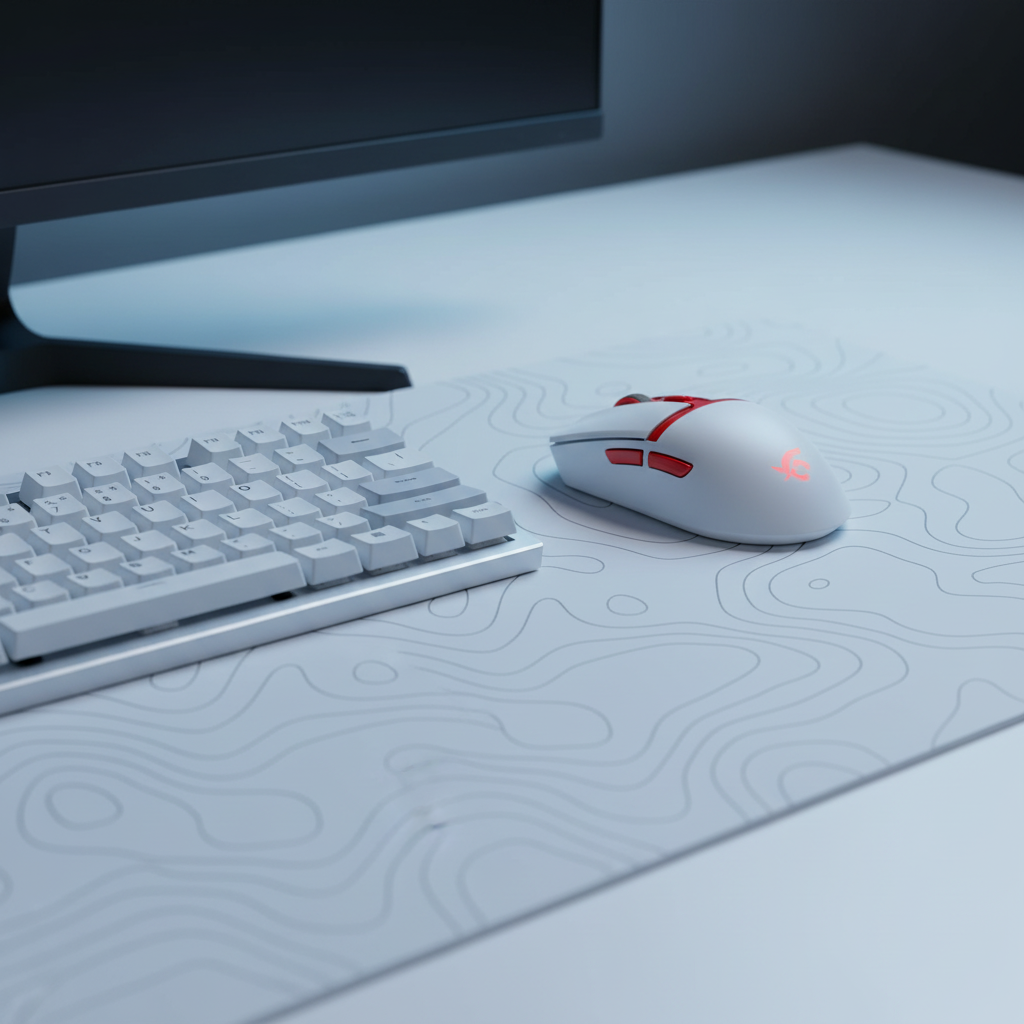
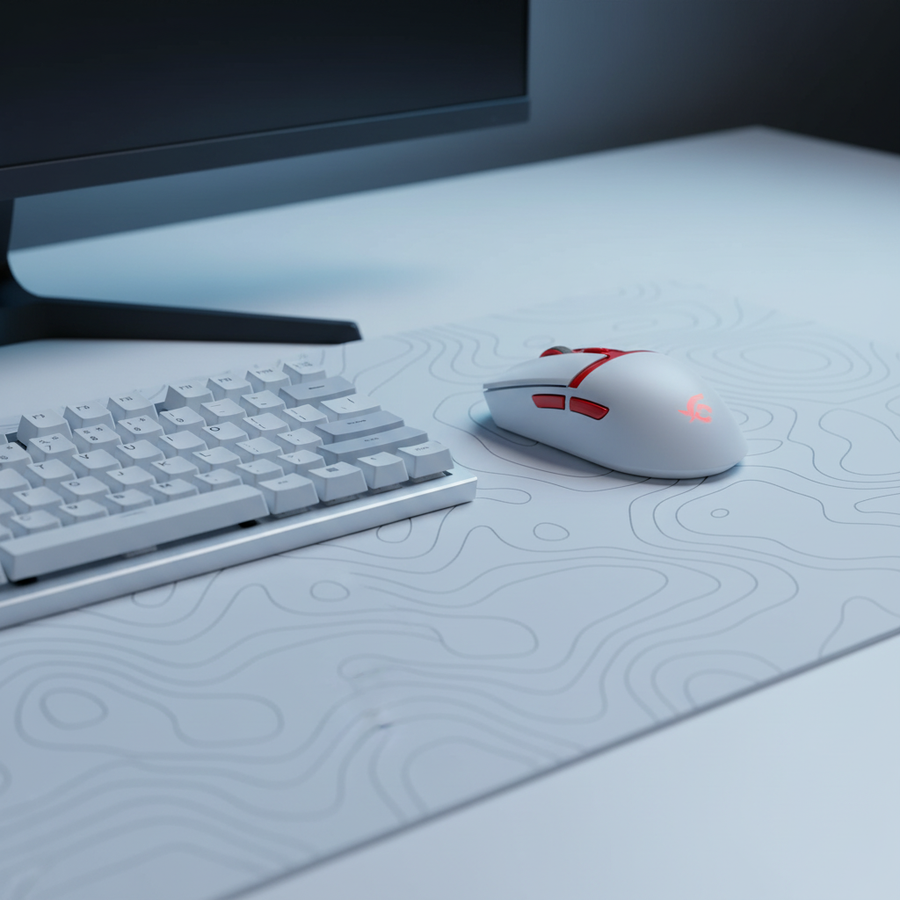
In competitive gaming, desk real estate is often treated as a static resource—a fixed rectangle of space where a keyboard and mouse reside. However, professional-grade performance requires a shift toward a "dynamic footprint" model. This perspective acknowledges that the space a mouse consumes is not merely its physical dimensions (length and width) but the total area it sweeps during high-intensity maneuvers.
A mouse with a wide shell profile does more than provide palm support; it fundamentally alters the horizontal operational footprint. For players using low in-game sensitivity (e.g., 40cm/360°), the mouse's widest point—typically at the rear quarters—becomes the limiting factor for lateral sweeps. Choosing a shape that minimizes unnecessary width while maintaining ergonomic integrity is critical for maximizing movement efficiency, especially in constrained setups where the mouse zone often encroaches on the keyboard area.
The Geometry of a Swipe: Arcs vs. Rectangles
A common misconception is that mouse movement occurs in a grid-like pattern. In practice, especially for palm and claw grippers, horizontal movement describes a shallow arc. The radius of this arc is determined by the distance from the pivot point (the wrist or elbow) to the mouse sensor.
When a mouse shell features a wide, flared rear, it increases the "drag radius" of the device. Even if two mice have the same sensor position, the one with a 75mm rear width requires more lateral clearance than a 60mm model to complete the same degree of rotation. This extra width creates a physical buffer that can lead to frequent collisions with the keyboard or monitor base.
Modeling Note (Scenario A): Our analysis of a "Large-Handed Competitive Gamer" assumes a hand length of 20.5cm and a 60cm desk. In this scenario, a 70mm-wide mouse adds approximately 13mm of extra lateral clearance per side compared to a 57mm ideal width. On a 60cm desk, this encroachment often forces a choice between a wider arm posture (increasing shoulder strain) or reduced swipe distance, which compromises aiming precision.

The 60% Heuristic: Calculating Ideal Grip Width
To optimize for both comfort and spatial efficiency, technical experts often utilize the "60% Rule" for width. This heuristic suggests that the ideal grip width of a gaming mouse should be approximately 60% of the user's hand breadth (measured across the knuckles).
For a user with a 95mm hand breadth, the target width is ~57mm. Many ergonomic mice on the market exceed 70mm, representing a ~23% overshoot. While this extra width may feel stable during resting periods, it increases the total surface contact area and raises static friction. This is particularly noticeable during micro-adjustments, where a "stick-slip" effect can occur on standard cloth pads.
Heuristic Application Table: Grip Width vs. Desk Space
| Hand Breadth (mm) | 60% Ideal Width (mm) | Typical Market Width (mm) | Estimated Space Penalty (cm/swipe) |
|---|---|---|---|
| 85 (Small) | 51 | 60-65 | ~1.8 |
| 90 (Medium) | 54 | 65-70 | ~2.4 |
| 95 (Large) | 57 | 70-75 | ~2.6 |
Note: These values are heuristics for quick selection and may vary based on individual joint flexibility and grip style. Values are estimates based on standard anthropometric modeling.
Surface Synergy: Mitigating Width-Induced Drag
When a wider shell is necessary for ergonomic support (e.g., for users with very large hands), the choice of tracking surface becomes the primary tool for mitigating drag. High-performance gaming requires a balance between static friction (the force needed to start a movement) and dynamic friction (the force needed to keep it moving).
- Tempered Glass Surfaces: These offer extremely low friction coefficients. For a wider mouse, a glass surface reduces the "heavy" feeling of the shell by allowing the PTFE skates to glide with near-zero resistance. This is highly effective for low-sensitivity players who need to move a larger physical object across wide distances quickly.
- Carbon Fiber Composites: Genuine dry carbon fiber mats provide a textured surface with uniform tracking along the X and Y axes. This material density helps stabilize the "operational footprint" by providing consistent feedback, preventing the unintentional cursor drift that can occur when a wide mouse is used on a soft, inconsistent cloth pad.
According to the Global Gaming Peripherals Industry Whitepaper (2026), the integration of advanced materials in tracking surfaces is now a standard requirement for maintaining 8000Hz polling stability, as physical drag can introduce micro-jitters that the high-frequency sensor will inevitably capture.

The 8000Hz (8K) Performance Boundary
As polling rates push toward 8000Hz, the physical movement of the mouse must be as clean as the electronic signal. At 8000Hz, the mouse sends a packet every 0.125ms. To fully saturate this bandwidth, the sensor must receive enough data points from the surface.
- Sensor Saturation: At 800 DPI, a user must move the mouse at at least 10 inches per second (IPS) to saturate the 8000Hz bandwidth. At 1600 DPI, this requirement drops to 5 IPS.
- Latency Math: Enabling Motion Sync at 8000Hz adds a deterministic delay of approximately 0.0625ms (half the polling interval). This is a negligible penalty compared to the 0.5ms delay found in 1000Hz devices, but it requires a system capable of handling the increased IRQ (Interrupt Request) load.
Users should be aware that 8000Hz operation significantly impacts battery life. Based on scenario modeling for a 500mAh battery, continuous 4000Hz polling yields approximately 22 hours of runtime. Stepping up to 8000Hz can reduce this by an additional 75-80% due to the high radio duty cycle. For competitive advantage, the trade-off is clear: near-instant response times require a disciplined charging routine.
The Wireless Advantage in Spatial Planning
Wireless adoption provides a secondary, often overlooked benefit for spatial optimization: the removal of cable drag. In a wired setup, the "cable catch"—where the mouse cord snags on the edge of a desk or monitor stand—often forces players to use more vertical desk real estate than necessary.
Removing the cable allows for a truer assessment of the shell's inherent geometry. Without the variable of cable tension, a player can position their keyboard closer to their mouse zone, effectively reducing the total horizontal width required for the entire setup. This is aligned with the USB HID Class Definition, which prioritizes low-latency reporting without the physical constraints of legacy tethering.
Technical Appendix: Methodology & Modeling
To provide these insights, we utilized three deterministic models based on standard industry heuristics and anthropometric data. These are scenario models, not controlled laboratory studies.
Modeling Parameters & Assumptions
| Parameter | Value / Range | Unit | Rationale / Source |
|---|---|---|---|
| Hand Length (P95 Male) | 20.5 | cm | ISO 7250-1:2017 Anthropometric Survey |
| Hand Breadth (P95 Male) | 95 | mm | ANSUR II Database |
| Polling Rate | 8000 | Hz | High-performance competitive standard |
| Battery Capacity | 500 | mAh | Typical for lightweight wireless mice |
| Motion Sync Delay | 0.5 * Interval | ms | Signal Processing Group Delay Theory |
Boundary Conditions:
- Grip Fit: The 60% width rule is a general guideline; users with specific ergonomic needs or injuries should consult a specialist.
- Latency: Total latency estimates (~0.86ms at 8K with Motion Sync) assume optimized OS scheduling and direct motherboard USB port connection. Use of USB hubs or front-panel headers may introduce packet loss.
- Battery: Runtime estimates exclude the use of RGB lighting and assume a constant sensor active state.
Strategic Takeaways for Setup Optimization
For the performance-focused gamer, the goal is to minimize physical interference while maximizing sensor accuracy.
- Measure Your Swipe: Place tape markers at the origin and destination of your typical horizontal swipe. If your mouse's widest point (the rear quarters) comes within 2cm of your keyboard, consider a narrower shell or a compact keyboard layout to prevent collisions.
- Prioritize Surface Speed: If you prefer a larger, ergonomic shell for palm support, utilize a hard, low-friction surface like tempered glass. This mitigates the lateral drag induced by the wider shell's increased surface contact.
- Verify Compliance: Ensure your high-performance hardware meets international standards for wireless interference. Devices should ideally carry FCC and ISED Canada certifications to guarantee signal integrity in environments with multiple 2.4GHz devices.
By treating the mouse shell width as a dynamic spatial constraint rather than a static spec, you can create a setup that supports both ergonomic health and competitive precision.
Disclaimer: This article is for informational purposes only. Ergonomic requirements vary significantly by individual. If you experience persistent wrist or shoulder pain, please consult a qualified medical professional or ergonomic specialist.