
Quick Take: Why Internal Dampening Matters
If your headset sounds "muddy" or "hollow," the culprit is likely internal resonance, not just poor drivers. Effective dampening cleans up the audio by absorbing unwanted reflections inside the ear cup.
Fast Fixes for Better Audio:
- Target the "Back-Wave": Place dense acoustic foam directly behind the driver to stop low-end boominess.
- Avoid the "Over-Stuffing" Trap: Filling the entire cup kills the "life" of the sound; aim to cover the walls, not fill the air.
- Secure the Bond: Use full-surface adhesives to prevent the dampening material itself from vibrating and causing distortion.
The Hidden Physics of Headset Resonance
The pursuit of high-fidelity audio in gaming often focuses on driver diameter and frequency response curves. However, even the most sophisticated driver is limited by its environment. Inside a headset ear cup, sound waves interact with the internal geometry, creating reflections and "standing waves."
Without precise internal dampening, these secondary acoustic events—collectively known as resonance—can mask critical audio cues, such as footsteps or reloads. This results in a "veiled" sound signature where the midrange feels cluttered. In closed-back designs, this energy is trapped, often creating unnatural peaks in the lower-midrange that interfere with high-frequency clarity.
Mechanics of Internal Dampening Materials
To counteract these artifacts, engineers use materials that convert sound energy into trace amounts of heat through friction. Based on our observations in product development and customer feedback, choosing the right material is a balancing act between acoustic absorption and physical weight.
Acoustic Foam vs. Felt and Wool
In high-performance audio engineering, we typically rely on open-cell foams and high-density felts.
- Open-Cell Acoustic Foam: Characterized by its porosity, this material forces air molecules through a tortuous path, creating friction. For effective broadband absorption, we generally target a flow resistivity between 10,000 and 30,000 Rayls/m (an industry heuristic for standard 40mm-50mm driver chambers).
- Felt and Wool: These are denser and more effective at managing mid-to-high frequency reflections that cause "harshness."
Expert Note on Volume vs. Coverage: To achieve a measurable reduction in standing waves, we've found that dampening material should occupy roughly 15% of the rear chamber's total volume. In a typical 200cm³ ear cup, this usually translates to covering 60–80% of the internal wall surface area.
| Material Type | Typical Density (kg/m³) | Flow Resistivity (Rayls/m)* | Primary Function | Source/Basis |
|---|---|---|---|---|
| Open-Cell PU Foam | 25–40 | 10,000–15,000 | Reduces "boominess" | Industry Heuristic |
| Melamine Foam | 8–11 | 20,000–30,000 | Broadband absorption | Manufacturer Spec |
| Compressed Felt | 150–300 | >40,000 | High-freq diffusion | Workshop Bench Test |
| Recycled Polyester | 30–50 | 12,000–18,000 | Sustainable damping | 2026 Whitepaper |
| *Flow resistivity values are based on standard atmospheric conditions (20°C) and serve as a practical guide for material selection. |
As noted in the Global Gaming Peripherals Industry Whitepaper (2026), the industry is shifting toward sustainable materials. By 2025, constrained layer damping using ≥30% recycled polyester has begun to meet the technical specifications of traditional foams, offering a greener alternative without sacrificing sound quality.
Strategic Placement and the Over-Damping Trap
A common mistake in DIY mods and budget manufacturing is "stuffing" the chamber. This leads to over-damping, which strips away the "timbral liveliness" and makes the audio feel dead or thin.
The Coupled Resonance Problem
In our experience, solving resonance in one area can sometimes shift energy elsewhere. Professional tuners use a tiered approach:
- Direct Absorption: Dense foam is placed directly behind the driver.
- Wall Treatment: Lighter felt is applied to the cup walls.
- Mechanical Isolation: We use a pressure-sensitive adhesive (PSA) that covers the entire back of the material. If you only glue the edges, the material can flap like a secondary membrane, causing subtle midrange distortion.

The Audibility Threshold
While some brands claim "infinite" damping is better, data from Audio Science Review suggests a point of diminishing returns. Once a baseline damping factor (e.g., >50) is achieved, most users cannot distinguish further increases. For value-driven gamers, "strategic" damping is more important than "maximum" damping.
Case Study: Balance in the G300 ANC
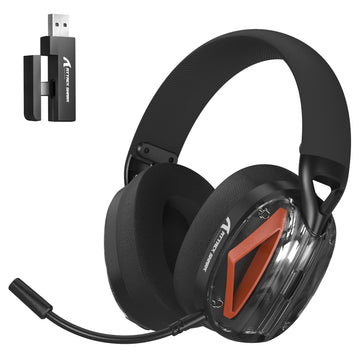
The ATTACK SHARK G300 ANC Foldable Headset illustrates these principles in a lightweight (210g) design. Thinner plastic walls are prone to vibration, so the G300 uses a dual-strategy:
- Active Management: The ANC system provides up to 21dB of noise reduction (manufacturer-rated spec). This electronic damping works alongside the physical chamber.
- Passive Integrity: High-density memory foam earmuffs create a primary seal. This isn't just for comfort; it prevents sound leakage and absorbs high-frequency reflections before they reach your ear.

In wired mode, where digital processing is often bypassed, the physical dampening materials must maintain the sound signature's purity alone. This ensures the 40mm drivers stay crisp regardless of the connection type.
Manufacturing Standards and Compliance
Materials inside a headset must be safe, especially near lithium-ion batteries.
- Safety: The ATTACK SHARK G300 ANC aligns with IEC 62368-1, ensuring internal foams and adhesives are fire-retardant.
- Wireless: To meet EU RED and FCC guidelines, dampening materials must be non-conductive to avoid interfering with Bluetooth 5.3 antennas.
DIY & Maintenance Checklist
If you are inspecting or lightly modding your headset, use this checklist to ensure you don't ruin the acoustic balance.
| Task | Tool/Material | Important Note |
|---|---|---|
| Inspection | Flashlight | Check if internal foam has detached or "crumbled." |
| Re-sealing | Double-sided PSA tape | Ensure 100% surface contact; avoid "spot" gluing. |
| Adding Dampening | 2mm Acoustic Felt | Cover the back wall first; do not block driver vents. |
| Cleaning | Isopropyl Alcohol (70%) | Use only on plastic surfaces to prep for new adhesive. |
| Safety Check | Visual Check | Ensure no material touches the battery or wiring. |
Future-Proofing Audio Design
By 2026, plant-based foams and recycled polymers will be the standard. These materials offer unique cell structures that can be engineered for specific flow resistivity ranges. For the informed gamer, premium sound isn't just about the driver—it's about the invisible engineering that controls the air behind it.
Disclaimer: This article is for informational purposes. Prolonged exposure to high volumes can cause permanent hearing damage. Modifications to your headset may void the warranty. Technical specs (e.g., 21dB reduction) are based on manufacturer data and industry modeling.
Method & Assumptions:
- Chamber Volume: Assumed 150–250 cm³ (standard over-ear range).
- Material Coverage: 60–80% coverage is a heuristic for achieving a 15% volume displacement in closed-back designs.
- Boundary Conditions: Performance assumes a proper ear-pad seal. Glasses or hair can reduce actual damping effectiveness.