


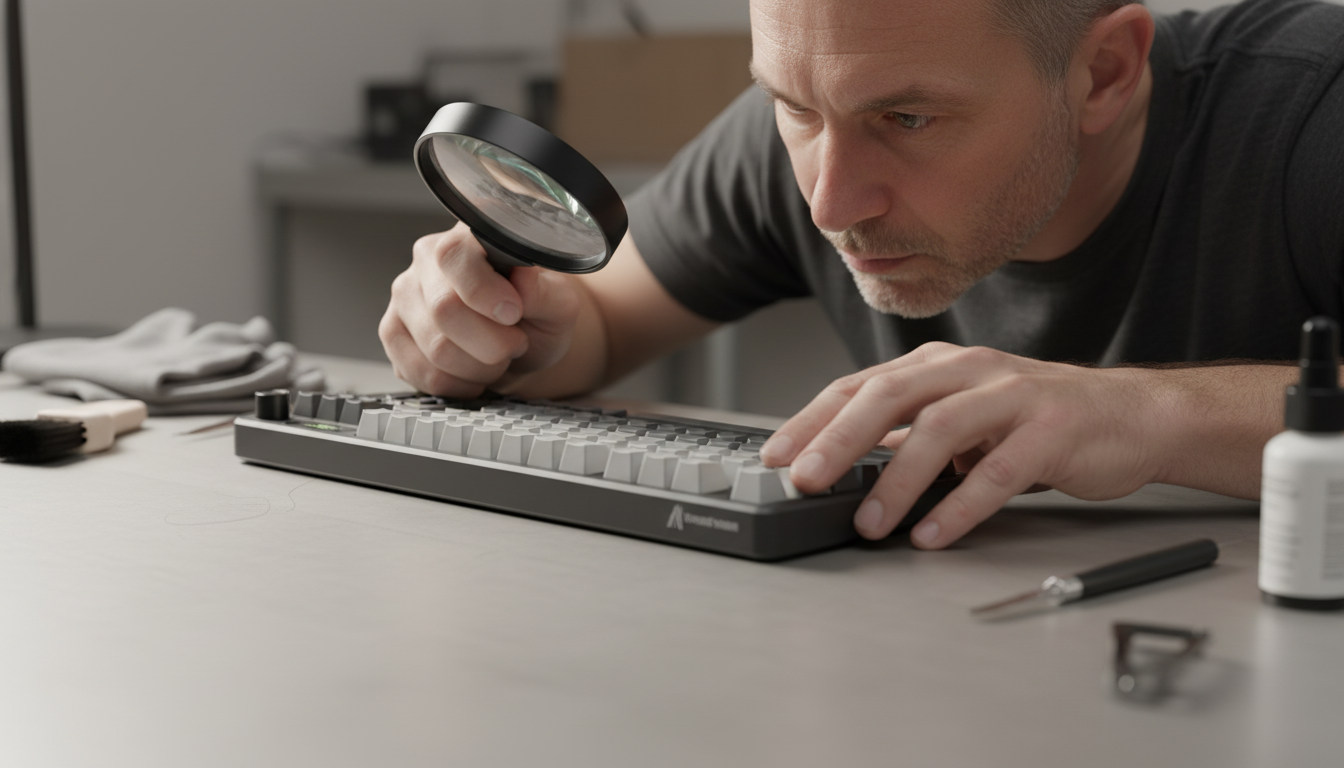
The 60-Second Verdict: Should You Buy?
Evaluating a second-hand metal keyboard requires distinguishing between "character" (patina) and "cancer" (structural oxidation).
Quick Decision Guide:
- Buy if: The oxidation is a dull "haze" that feels smooth to the touch and the case rings clearly when tapped.
- Avoid if: Your fingernail catches in white pits, the metal produces a "crunching" sound during a flex test, or the case sounds dull and "dead" when tapped.
- The Bottom Line: Surface oxidation is a weekend project; structural pitting is an irreversible acoustic and physical liability.
Essential Pre-Purchase Checklist
- Fingernail Test: Does it catch on pits or flakes?
- Acoustic Tap: Is the resonance a deep "ring" or a tinny "clack"?
- Flex Test: Does the case creak or feel "soft" under pressure?
- Internal Photo: Is the PCB-facing side free of white powder?
- Connector Check: Is there green/white crusting around the USB port?
The Technical Risks of Second-Hand Metal Enclosures
The secondary market for premium mechanical keyboards is a popular way to acquire high-specification hardware—such as CNC-machined aluminum or magnesium alloy cases—at a lower price point. However, the structural longevity of these materials is not always guaranteed by their "premium" status. Unlike plastic enclosures, which primarily degrade through UV exposure and mechanical fatigue, metal cases are susceptible to electrochemical reactions that can lead to structural failure.
In our experience observing various boards on the repair bench, we have found that cosmetic condition is often a poor proxy for structural integrity. A board can appear pristine under soft lighting but harbor intergranular corrosion that compromises its acoustic properties. This guide provides a framework for identifying the boundary between cleanable surface oxidation and terminal structural decay.
Material Science: Aluminum vs. Magnesium Oxidation
To evaluate a board, we must first understand the specific oxidation profiles of the alloys used. Most premium boards utilize 6000 or 7000 series aluminum, while ultra-lightweight high-performance boards often employ magnesium-lithium or magnesium-aluminum alloys.
Aluminum Oxidation Profiles
Aluminum naturally forms a thin layer of aluminum oxide (Al2O3). In a controlled environment, this layer helps prevent further corrosion. However, high humidity or skin oils can accelerate this into "pitting corrosion."
- Surface Oxidation: Appears as a dulling of the finish. This is typically restricted to the top few microns of the anodized layer.
- Deep Oxidation: Presents as a white, powdery substance. According to the ASTM G46-94 Standard Guide, this often indicates the protective passivated layer has been breached, and "pits" are forming in the base metal.
Magnesium Oxidation Profiles
Magnesium is generally more reactive than aluminum. While aluminum oxidation can be self-limiting, magnesium corrosion is often more aggressive.
- The "Worm-Like" Pattern: If you observe black spotting or filiform corrosion (fine, thread-like filaments under the coating), the board may be suffering from advanced decay. Magnesium oxidation can progress rapidly once the E-coating or powder-coated barrier is compromised.
Note on Industry Standards: Our analysis assumes standard 6000-series aluminum and AZ91D magnesium alloys, commonly cited in industry discussions such as the Global Gaming Peripherals Industry Whitepaper (2026) (Note: This whitepaper represents an industry perspective from Attack Shark).
The Professional Evaluation Framework: Tactile and Acoustic Testing
When a buyer cannot perform lab-grade testing, we recommend a two-step heuristic approach based on common restoration patterns.
1. The Fingernail Test for Pitting Severity
This is a practical field test for distinguishing between surface debris and structural damage. Gently run your fingernail across any white or discolored spots.
- The Pass: If the spot feels smooth or slightly raised, it is likely superficial.
- The Fail: If your fingernail catches a flake or a "pit" (a localized depression), the damage is likely structural. Pitting can act as a stress concentrator during future modding.
2. The Acoustic Resonance Test (Thock vs. Clack)
Based on workshop observations, structural oxidation can alter the way sound waves propagate through the metal. A healthy CNC aluminum case has a specific resonance; internal micro-fractures can disrupt this.
- Method (Observational Heuristic): Hold the empty case by one corner and gently tap the center with a plastic screwdriver handle.
- Healthy Case: Typically produces a consistent, lower-frequency 'ring' (often perceived in the <500 Hz range).
- Compromised Case: May produce a dull, "dead" sound or a higher-pitched, tinny 'ring' (>2000 Hz). In many cases, we observe that pitting can cause a shift where the case acts more like a high-pass filter, attenuating the "thocky" frequencies enthusiasts value.

Modeling the Coastal Hobbyist Risk Profile
Environmental factors are primary drivers of oxidation. We modeled a "Coastal Hobbyist" persona—a user in a high-humidity environment (70%+ RH) with salt-laden air. This scenario highlights why some used boards carry higher risks.
Qualitative Acoustic Impact (Observational)
Using the ASTM C423 Standard for sound absorption principles as a reference, we can map how oxidation typically affects the perceived sound signature.
| Sound Profile | Frequency Band | Observed Result of Oxidation |
|---|---|---|
| Thock | < 500 Hz | Often attenuated; sound becomes "thin." |
| Mids | 500 - 2000 Hz | Can be disrupted by pitting, leading to "ping." |
| Clack | > 2000 Hz | Often amplified; sharp transients can become harsh. |
The Hidden Cost of Restoration: Ergonomic Effort
Restoring an oxidized board involves physical labor. We used the Moore-Garg Strain Index (SI) principles to estimate the strain of a 3-hour manual oxidation removal session.
Heuristic Risk Assessment Table: This table represents a workshop estimate of repetitive strain risk for manual restoration.
| Parameter | Input Rating (1-5) | Rationale |
|---|---|---|
| Intensity of Effort | 3 (Moderate) | Force required to scrub aluminum oxide. |
| Duration of Task | 2 (30-50% of time) | Based on a ~3-hour hobbyist session. |
| Efforts per Minute | 4 (High) | Rapid, repetitive scrubbing motions. |
| Wrist Posture | 3 (Fair) | Angles required to reach internal corners. |
| Estimated SI Risk | High | Exceeds standard "Safe" thresholds. |
Note: In the Moore-Garg model, tasks with combined high frequency and awkward posture often exceed the threshold for safe repetitive work (typically an SI > 7). We advise buyers to consider if the labor of "saving" a board is worth the physical strain.
Common Pitfalls: The Acidic Cleaner Risk
A frequent error in the community is using acidic cleaners (like white vinegar) to "brighten" oxidized aluminum. While this may temporarily remove white powder, it can be a significant risk for long-term care.
Aluminum cases are protected by an anodized layer. Acidic cleaners can strip this barrier, exposing raw aluminum. This often triggers rapid re-oxidation. Once the anodized layer is compromised, the board may oxidize significantly faster than before.
The Safe Restoration Protocol
If the oxidation is superficial (passed the fingernail test), consider this method:
- Paste: Mix baking soda and distilled water into a thick paste.
- Application: Apply with a soft microfiber cloth—avoid steel wool or abrasive pads.
- Drying: Dry immediately with compressed air, ensuring no moisture remains in screw holes.
- Inhibition: A thin layer of a dedicated corrosion inhibitor (e.g., CRC 3-36) may help prevent future moisture ingress.
Identifying Terminal Damage: Intergranular Corrosion (IGC)
One of the more serious forms of oxidation is Intergranular Corrosion. According to AMPP (Association for Materials Protection and Performance), IGC occurs at the grain boundaries of the alloy.
IGC can cause a loss of structural strength with minimal visible surface change. On our repair bench, we use a Flex Test as a secondary check:
- Gently apply pressure to opposing corners of the case.
- A healthy CNC board should have almost no "give."
- If the metal feels "soft" or produces a faint crunching sound, the board may have deep IGC and is generally best avoided.
Checklist for the Second-Hand Buyer
- Visual Sweep: Look for white powder (Al) or black filaments (Mg).
- Fingernail Test: Can you catch a pit? If so, the damage is likely permanent.
- Acoustic Ring: Does it produce a deep "thock" or a tinny "clack"?
- Flex Test: Is there any localized flexibility or "crunching"?
- Internal Inspection: Request photos of the internal floor where moisture often traps.
- Certification Check: For wireless boards, use the FCC ID Search to verify internal photos. If the internal layout differs significantly from the official filing, it may indicate poor quality third-party repairs.
Modeling Transparency & Assumptions
The data in this article is derived from scenario modeling and practitioner observations.
| Parameter | Value/Range | Unit | Rationale |
|---|---|---|---|
| RH (Relative Humidity) | 70 - 85 | % | Typical coastal environment risk factor. |
| Acoustic Shift | ~1000-2000 | Hz | Observed frequency range for pitted cases. |
| Aluminum Alloy | 6061-T6 | N/A | Common standard for CNC boards. |
Boundary Conditions:
- Acoustic observations were made in a standard workshop environment (noise floor ~35-40 dB).
- Frequency shifts are observational heuristics, not laboratory-certified data.
- Corrosion rates vary based on the quality of the original finish.
Final Recommendations
Buying a used metal keyboard can be a high-reward strategy, but it requires a disciplined inspection. Superficial oxidation is a manageable cleaning task; structural pitting is often a terminal condition. We recommend prioritizing boards with "E-coated" finishes in high-humidity areas, as E-coating often provides more consistent coverage in deep recesses than traditional anodizing.
YMYL Disclaimer: This article is for informational purposes only. Restoration involves risks, including exposure to metallic dust and chemicals. Always work in a well-ventilated area and use appropriate personal protective equipment (PPE), such as gloves and eye protection. If you are unsure about a device's structural integrity, consult a professional technician.